Pattern Making & Fitting · Draping
Draping on the Dress Form
The three-dimensional design method: muslin pinned, smoothed and shaped directly on the form until the garment exists — then marked, removed and flattened into a paper pattern.
Where flat drafting designs on paper and hopes the body agrees, draping designs on the body itself. It is the older of the two methods in the Pattern Making, Draping & Fitting guide — couture houses have always worked this way — and for fluid, folded, asymmetric designs it remains unmatched, because the designer watches the actual cloth fall, fold and pull as the decisions are made. A drape is not the pattern, though. It is the pattern's source material, and the discipline of draping lies as much in capturing the drape accurately as in creating it.
Preparing the Form
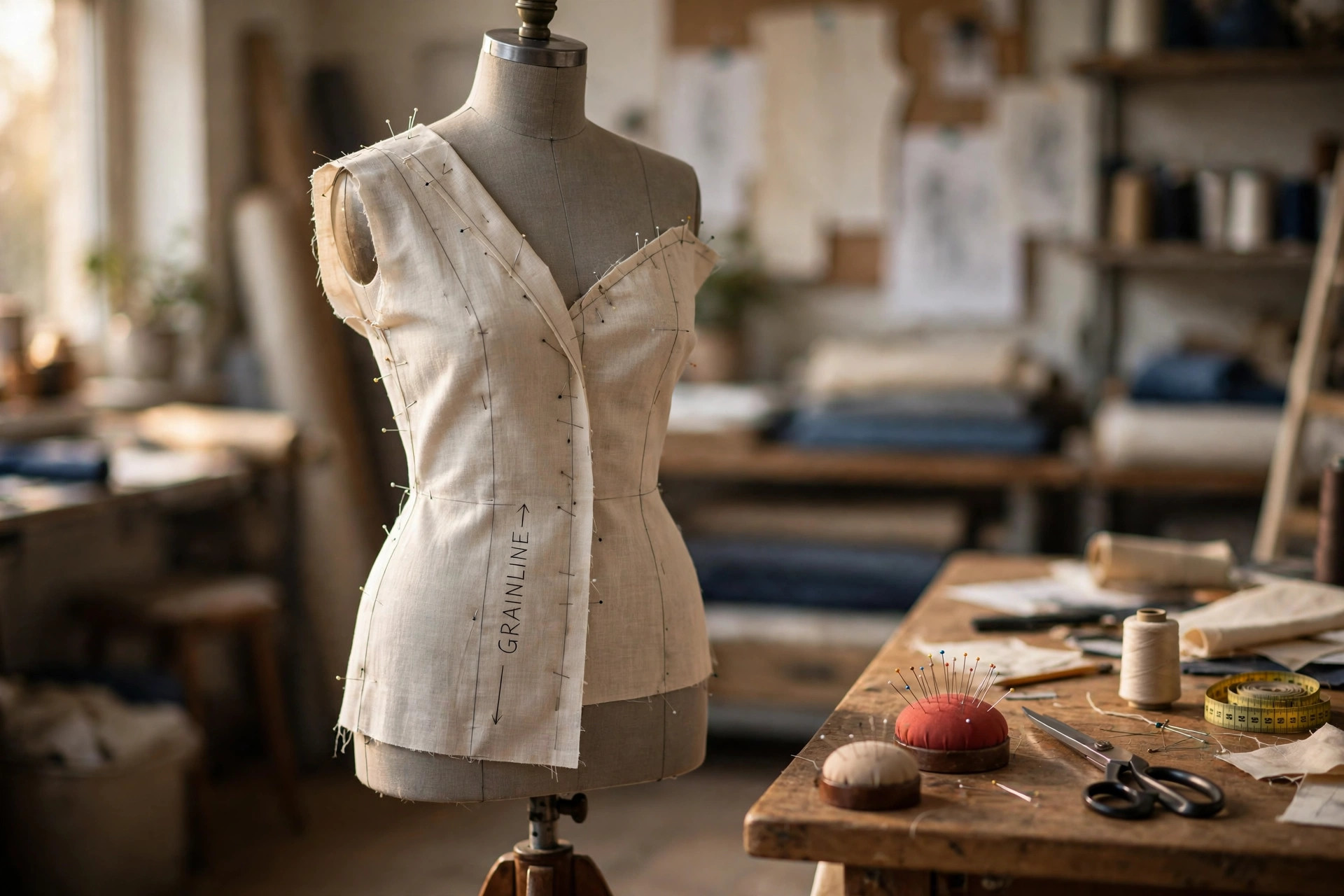
A dress form is useful only when it truly represents the figure. Professional forms are padded out with batting and a fitted cover until their bust, waist and hip measurements, and the lengths between them, match the client or the sample size. Then the form is styled: narrow twill tape — style tape — is pinned along the center front and center back, the bust, waist and hip levels, the neckline and the armholes, and along any style lines of the design. These tapes are the draper's map. Every pin placed later is judged against them: a waistline that drifts above the tape at the side seam is wrong, however pretty it looks.
Preparing the Muslin
Muslin pieces are cut generously — roughly to the length and width of the garment section, plus several inches in every direction — then blocked: the lengthwise and crosswise threads are pulled square so the grain is perfectly true, and the piece is pressed. The center grainline and the crossgrain at the bust or hip level are drawn on with pencil. These two lines are the draper's compass; they will be matched to the form's tapes constantly, because the moment the grain slips, the drape stops telling the truth about how the finished garment will hang.
The Draping Sequence
Anchor the Grain
The muslin is pinned to the form at its drawn center line and crossgrain, matching the form's tapes exactly. From this anchor, all shaping spreads outward — never the reverse.
Smooth, Pin and Shape
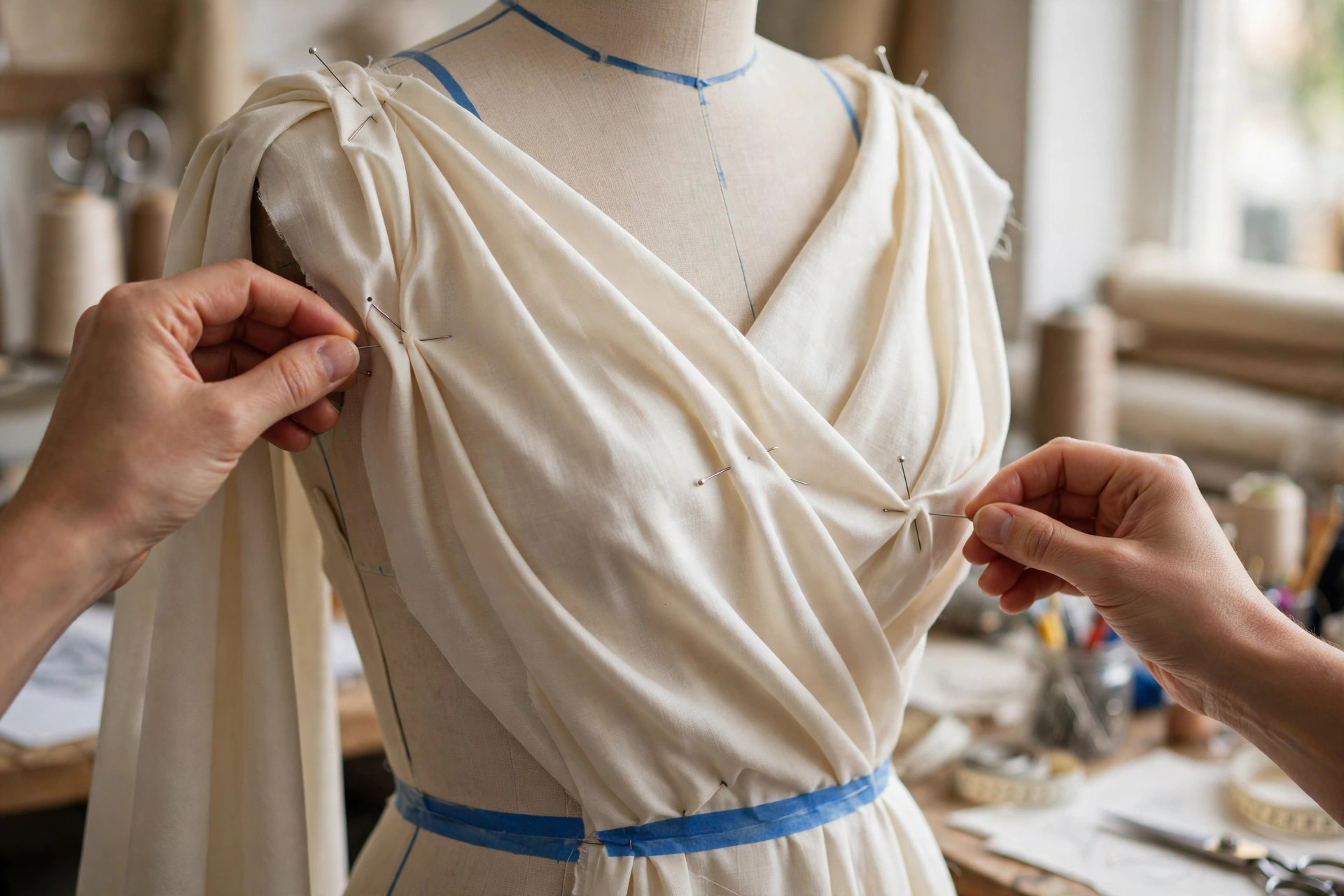
Working from the anchor points toward the edges, the draper smooths the cloth over the curves, letting excess fabric collect where darts or folds will absorb it. Bust fullness is eased into a dart or into soft folds; a cowl is allowed to drop into its natural catenary curves; bias-cut sections are left to stretch and settle, sometimes overnight, before being marked.
Form the Details
Necklines are clipped into and pinned to the tape; armholes are marked and trimmed with seam allowance left on; seams are pinned where two sections meet, one over the other, following the style lines of the design.
Mark Everything
Still on the form, every seam line, dart leg, notch point, crossmark and hem level is drawn in pencil on both layers of cloth where they overlap. This marking is the moment the design becomes data — a sloppy marking loses the drape forever.
Remove, True and Transfer
The muslin comes off the form and is laid flat. Lines are trued with rulers and curves, seam allowances are added, and the drape is either kept as a muslin pattern or transferred to paper or oak tag. Left and right sides are compared; unless the design is deliberately asymmetric, the better-fitting half becomes the pattern for both.
Why Drapers Trust Grain More Than Eyes
A drape can look magnificent on the form and still be unusable, because cloth pinned under tension, or with its grain pulled off true, will relax into a different garment the moment it is worn. The drawn grainlines and the form's tapes exist to expose that deception while it can still be fixed. If the crossgrain at the bust has climbed an inch above the tape at the side seam, the pattern made from that drape will twist and ride up in wear — no matter how beautiful the photograph of the drape looks.
Draping vs. Drafting: Choosing the Method
Draping earns its keep wherever the design is the behavior of cloth: cowls and draped necklines, bias cuts, twists and knots, Grecian folds, asymmetric wraps, and soft unstructured jackets. It is also the fastest way to test a silhouette in real volume — five minutes at the form can kill an idea that five hours of drafting would have polished. Drafting wins for tailored structure, for grading-friendly basics, and for any design that must be reproduced identically by other hands. In practice, the two methods merge constantly: a bodice is draped, then its armhole is trued against the drafted sleeve block; a skirt is drafted, then its hemline is checked draped. After transfer, the draped pattern enters the same proving loop as any draft — the muslin fitting and corrections covered in Muslins, Toiles & the Fitting Process.
More in Pattern Making, Draping & Fitting
Common Questions
What fabric is used for draping?
Most draping is done in muslin — an inexpensive, plain-weave cotton that behaves predictably and takes pencil and pin marks well. The weight of muslin should imitate the final fabric: a soft, light muslin for a fluid dress, a firmer one for a structured jacket. Draping an evening gown design directly in a similar drape-weight substitute fabric gives the most honest preview of how the real cloth will fall.
Why does the muslin have to be blocked and pressed before draping?
Blocking squares the muslin so its lengthwise and crosswise threads are at true right angles, and pressing removes distortion from the bolt. If the grain is crooked when you drape, the grainlines you draw and follow will be crooked too, and the finished pattern will twist on the body no matter how beautiful the drape looked on the form.
Can you drape without a dress form?
Draping fundamentally needs a three-dimensional form. Professionals drape on adjustable or custom-padded dress forms; a form padded out to a specific person's measurements (sometimes called a dress form double) is the standard substitute for draping on the person. Simple designs can be draped on the body itself with a helper pinning, but fitting and marking your own back is impractical, so a form is strongly preferred.
Is draping better than flat pattern drafting?
Neither is better in general; they suit different designs. Draping excels at cowls, twists, bias cuts, asymmetric styles and any design whose effect depends on how cloth falls and folds. Drafting is faster and more precise for tailored, symmetrical, repeatable basics. Most design rooms use both: a draped bodice may be combined with a drafted sleeve and skirt taken from blocks.
Back to Pattern Making, Draping & Fitting
The Pattern Making, Draping & Fitting hub maps the whole craft — drafting, draping, darts, fitting, muslins and finishes — with links to every guide in this cluster.