Pattern Making & Fitting · Muslins
Muslins, Toiles & the Fitting Process
The test garment is the pattern's moment of truth. How muslins are made, how a fitting is conducted in the right order, and how the wrinkles themselves tell you what to fix.
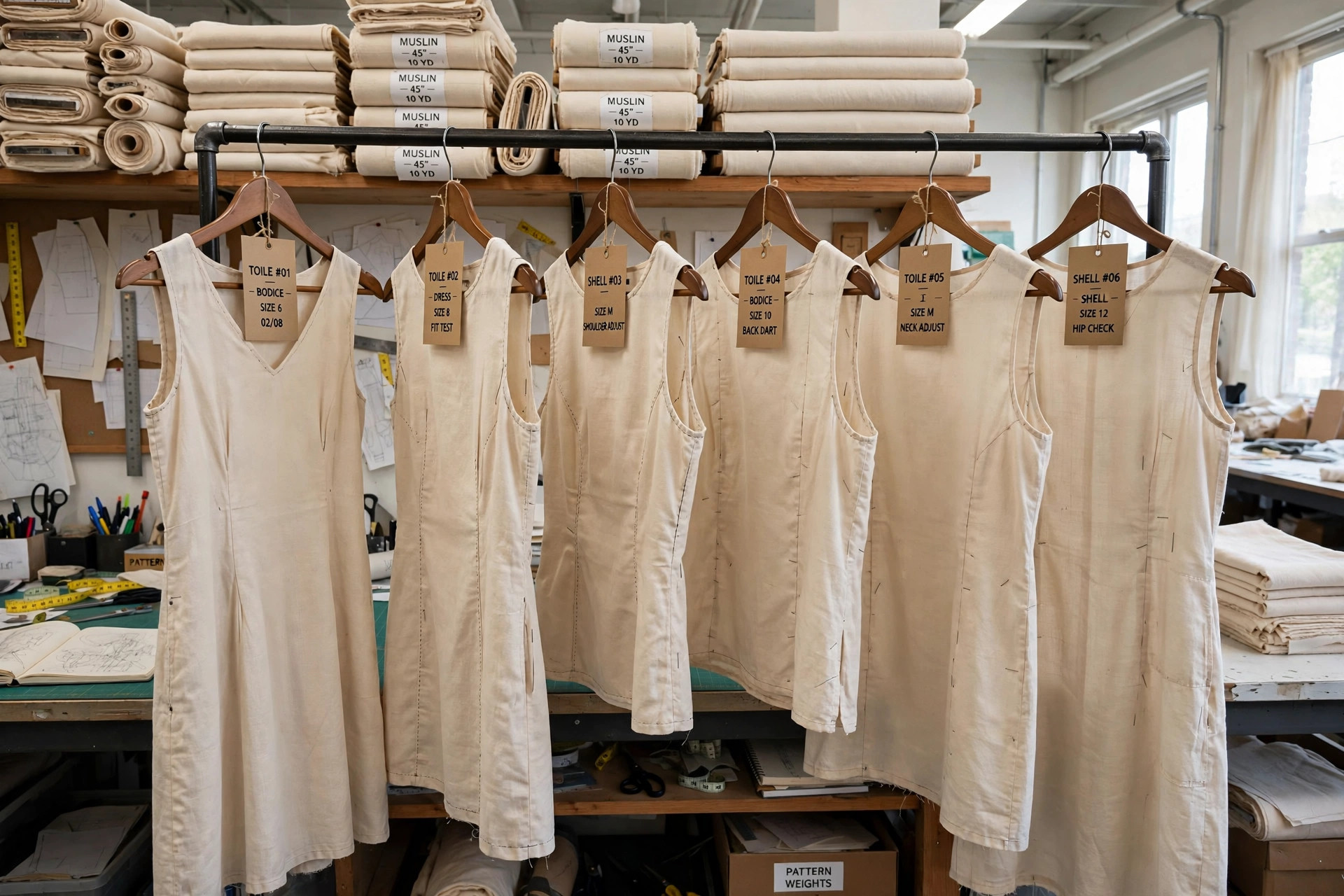
No pattern — drafted, draped or bought — is trusted until it has been sewn in cheap fabric and put on a body. That test garment is called a muslin in America and a toile in Britain and France, and the fitting session it makes possible is the hinge of the whole Pattern Making, Draping & Fitting process. Everything before it is prediction; the muslin is evidence. This guide covers what a good test garment is (and is not), the special case of the fitting shell, the paper shortcut of tissue fitting, and the disciplined order in which a fitting is actually run.
Making a Muslin That Tells the Truth
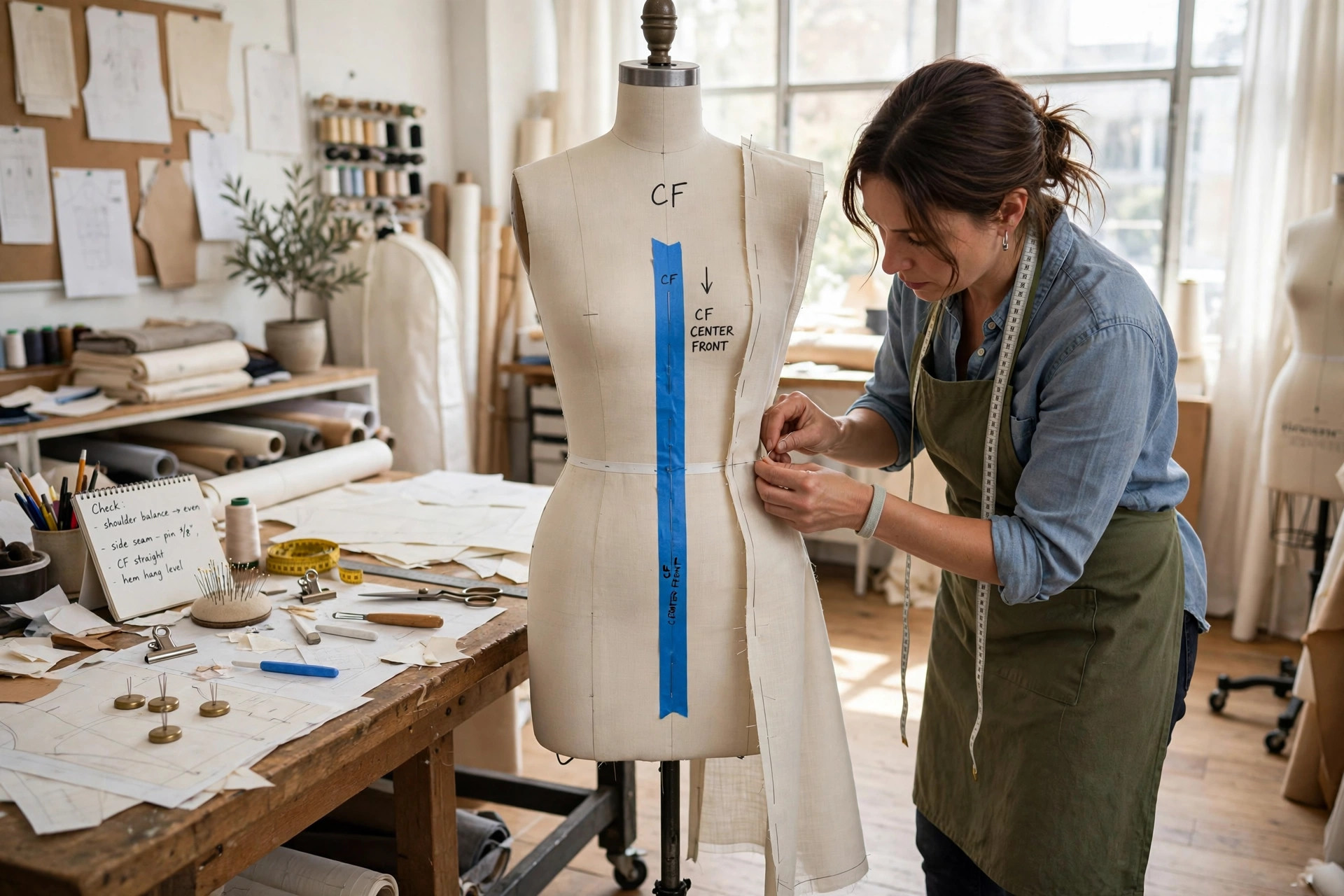
A muslin fabric should imitate the final cloth's weight and behavior as closely as cheapness allows — a fluid dress draped in stiff calico will hide its real problems, and a tailored jacket tested in flimsy cotton will invent problems it does not have. The grainlines, center lines and bust/waist/hip levels are drawn directly on the fabric before cutting, so distortion is visible at a glance during the fitting. Seams are sewn with a long stitch for easy removal, closures are pinned or basted rather than finished, and seam allowances are left generous — an inch at side seams and center back is common insurance — because letting out is the correction you cannot make if the cloth is not there. Facings, linings and details are omitted unless they affect the hang; the muslin exists to judge fit, balance and proportion, nothing else.
The Fitting Shell: Proving the Block
Before a new block is used to develop styles, it is proven as a fitting shell: the plainest possible garment — a close-fitting bodice and skirt, or a simple dress — with every reference line marked. Fitting the shell is the most demanding fitting of all, because there is no style to hide behind: center lines must hang vertical, crossgrains must sit level, darts must point at the apex without reaching it, and the shell must carry exactly its intended wearing ease and no more. Corrections made here go back into the block itself, using the named adjustments in Pattern Fitting Adjustments. A pattern room that has fitted its shells can develop new styles with confidence; one that has not will re-fight the same fitting battles on every garment.
Running the Fitting: Order Matters
Check Balance First
Before any detail: do the center front and center back hang plumb? Do the horizontal grainlines sit level at bust, waist and hip? Is the garment twisting toward one side? Balance errors are length errors in disguise, and they outrank everything else.
Check Lengths
Waistline placement, bodice and skirt lengths, sleeve length. A waist seam that rides above or below the natural waist re-labels every fit issue below it, so lengths are settled before circumferences are judged.
Check Circumference and Ease
Is there enough room to breathe, sit and reach — and not so much that the garment collapses into folds? Pin out excess or let out seams at this stage, marking exactly how much, and where it stops.
Read the Drag Lines
Remaining wrinkles are diagnostic, not decorative. Drag lines point like arrows toward the point that needs more fabric or length — wrinkles radiating from the bust point ask for an FBA; horizontal folds at the back waist ask for the swayback correction. The wrinkle is the symptom; the pattern adjustment is the cure.
Mark, Then Transfer
Every correction is pinned and marked on the muslin with chalk or pencil — new seam lines, dart positions, hem levels — on both sides, noting which side fits better. The muslin is then opened flat, the marks are measured, and they are transferred to the paper pattern, which is re-trued. The pattern, not the muslin, is the permanent record.
Tissue Fitting: The Paper Shortcut
Home sewers often pre-fit the pattern tissue itself, pinning the paper pieces together and trying them on. Tissue fitting is genuinely useful as a screening step — it catches wrong lengths, misplaced darts and gross circumference errors before any fabric is cut, and costs nothing. But paper has no drape, no stretch and no forgiveness, so it can only screen: a bodice that tissue-fits can still misbehave in cloth. Professionals use the equivalent constantly — comparing pattern measurements against body measurements on paper before the muslin is cut — then let the muslin have the final word.
After the Fitting
The corrected pattern is re-trued, its alterations dated and noted, and — for any area that changed substantially — verified with a second, sometimes partial, muslin. Only then is fashion fabric cut. The finishing quality of that final garment is a separate craft, covered in Seam Finishes & Pressing. The muslin habit is the cheapest insurance in all of garment making: the fabric it consumes is worth pennies against the cost of discovering, in silk, what muslin would have said for free.
More in Pattern Making, Draping & Fitting
Common Questions
What is the difference between a muslin and a toile?
They are the same thing — a test garment sewn from cheap fabric to check fit and proportion before cutting the real cloth. Muslin is the American term, named after the plain cotton fabric traditionally used; toile is the British and French term, used in couture and British pattern rooms. In American usage, 'muslin' names both the fabric and the test garment made from it.
What is a fitting shell?
A fitting shell (or fitting toile) is a plain, close-fitting basic garment — typically a bodice and skirt or a dress with no style details — sewn from a block pattern and fitted precisely to one person or one standard size. It is the physical proof of the block: once a shell fits, every pattern developed from that block starts from a verified foundation, and later fitting problems can be traced to the style changes rather than the foundation.
What is tissue fitting?
Tissue fitting means pinning the paper pattern pieces together and trying the paper itself on the body before cutting any fabric. Popularized by the Palmer/Pletsch method for home sewers, it catches the big errors — wrong length, badly placed darts, insufficient circumference when ease is allowed for — at zero fabric cost. Its limits are real: paper does not drape, stretch or slide like cloth, so tissue fitting is a screening step before the muslin, never a replacement for it.
How many muslins should a garment take?
One good muslin is the norm for a style built on a proven block; two for a new block, a complex design or a figure with several adjustments to combine. Couture work may use more. The discipline is to correct the pattern fully after each muslin and to re-test only the areas that changed — often a partial muslin of one bodice or one sleeve is enough — rather than re-making the whole garment repeatedly.
Back to Pattern Making, Draping & Fitting
The Pattern Making, Draping & Fitting hub maps the whole craft — drafting, draping, darts, fitting, muslins and finishes — with links to every guide in this cluster.