Bisht
Clothing Definitions — definitions of garments and clothing terms from Apparel Search
Search Apparel Search
At a Glance
Definition: A bisht is a traditional Arabic men's cloak, worn over other clothing for prestige on special occasions such as weddings and official gatherings, and also for warmth.
Pronunciation: BISHT (one syllable)
Category: Clothing Definitions
Word Origin
The word is Arabic: bisht. It is often traced further to a Persian word for the back or shoulders — the part of the body the cloak covers — though the Arabic name is the one the garment carries throughout the Gulf.
In the dress of the Gulf, the last garment put on carries the most meaning. The bisht is that garment: a full cloak worn over a man's formal clothing, famous in Kuwait and across the Gulf countries, that converts ordinary formal dress into ceremonial dress. A man does not wear a bisht for an ordinary day. He wears it when the gathering matters — and everyone in the room can read the signal.
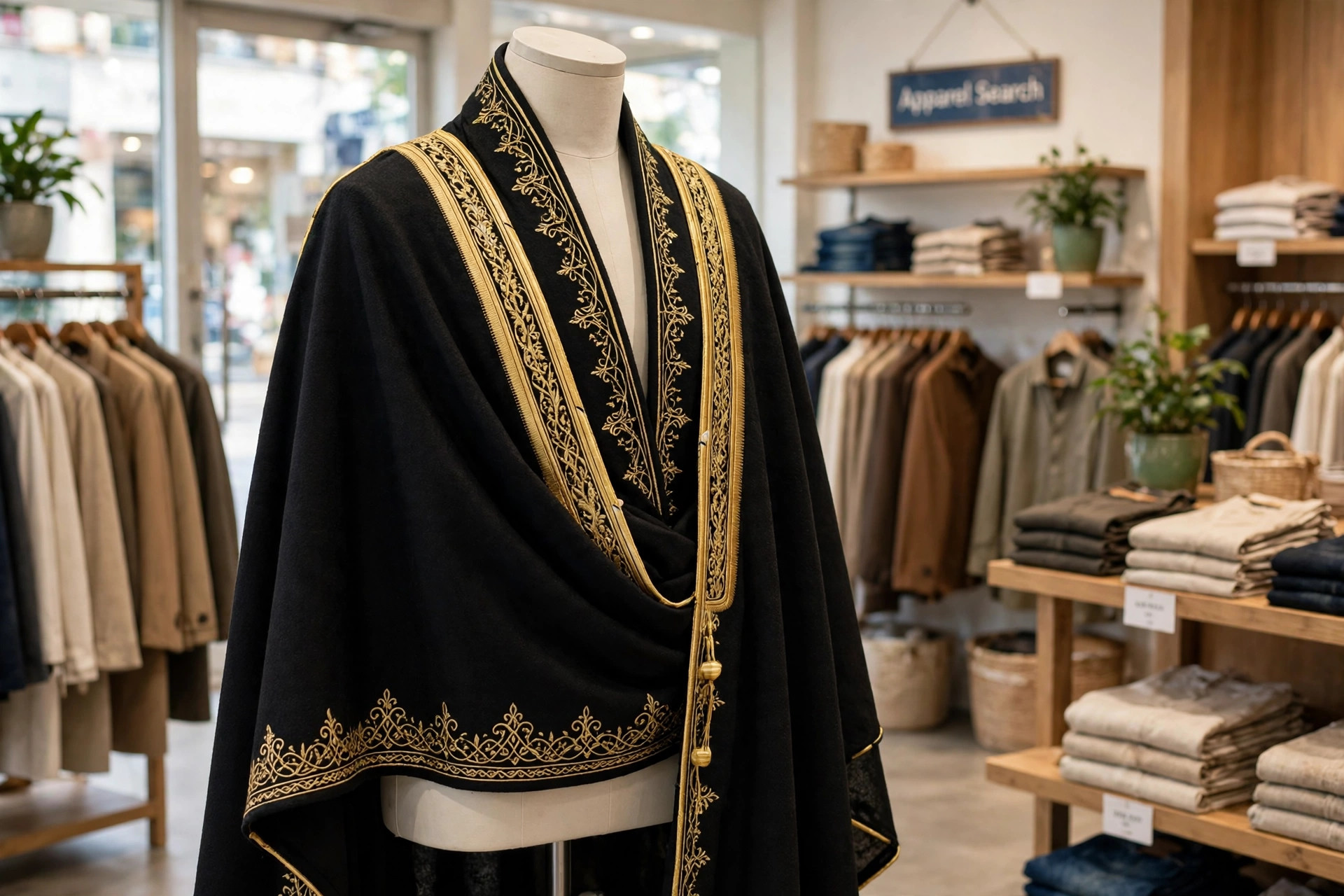
A Cloak Worn Over Everything
The bisht is worn as the outermost layer, placed over the shoulders above the rest of the outfit, in the way a formal overcoat or ceremonial robe completes dress in other traditions. As a cloak it is among the simplest garment forms — no tailored structure, its effect carried entirely by its fall and drape. A full cloak adds presence to the wearer's silhouette and moves with a gravity that suits ceremony, which is precisely its function at a wedding or official gathering: it separates the principals and honoured guests, in appearance, from everyday dress.
Fine bishts are made as prestige objects in their own right, in wool and other warm cloth, with the borders of formal examples finished with decorative trim, and they are sold and given as honoured gifts. Because the cloak is kept for significant occasions, it is stored carefully, worn for the hours of the event, and expected to last for years — the pattern of ownership familiar from all prestige clothing.
Worn for Prestige — and for Warmth
The bisht's first role is ceremonial. It is the recognised dress of honour for weddings, official functions, formal receptions and religious festivals in Kuwait and the wider Gulf, worn by grooms, officials and honoured guests, and it appears wherever Gulf formal dress is represented, from wedding parties to official portraits. Its meaning is public and immediate: the wearer is dressed for the significance of the event.
Its second role is plainly practical. Gulf winters and desert nights can be cold, and a full woollen cloak worn over everything is a serious warm layer — the layer kept on against the cold outdoors and removed indoors. The two roles do not conflict. Traditional dress often survives precisely because it is both meaningful and useful, and the bisht, worn for standing on great occasions and for warmth when needed, is a clear example of that double life.
The Bisht Among Gulf and Regional Garments
Within Gulf dress the bisht sits at the formal end of a layered system: everyday garments beneath, and the cloak as the finishing layer that carries the public meaning. It belongs to the wider family of traditional and national dress across the region. The closest counterpart is the abaya, the women's overgarment worn in the same role — the outer layer put on over other clothing when going out or receiving guests. Related regional garments covered in these definitions include the chador and the hijab, and the burka; the bisht's own family, the cloak, reaches back to garments such as the Greek chlamys. Travellers meeting the region's formal dress can place the bisht quickly: it is the men's prestige cloak, the counterpart at the top of the men's wardrobe to what the abaya is in women's dress. The United Arab Emirates clothing industry page gives wider context on dress in the Gulf today.
Making, Giving and Keeping a Bisht
A fine bisht is a made object, not a bought commodity. Formal examples are cut from light wool or wool blends suited to the Gulf climate, and their open edges and borders are finished with embroidered trim — on the most prestigious pieces, worked in gold-coloured thread in patterns that identify the maker's tradition and the garment's grade. Hand-finished bishts from established makers are prized accordingly, and price follows workmanship in the way it does for any ceremonial clothing.
That value makes the bisht a classic honoured gift, presented to mark weddings, appointments and achievements, and a garment families keep with care. Stored folded away from light and damp, aired rather than frequently cleaned, a good bisht serves its owner across decades of occasions — and may be handed down, carrying its occasions with it. In that keeping, as in its wearing, the bisht behaves like prestige dress everywhere: the cloth is valuable because of what it is for.
Not to Be Confused With
Bisht vs. abaya: both are Gulf outer garments worn over other clothing, but the bisht is a men's cloak worn for prestige and ceremony, while the abaya is a women's overgarment. The two are counterparts, not versions of the same garment.
Common Questions
What is a bisht?
A bisht is a traditional Arabic men's cloak, famous in Kuwait and other Gulf countries. It is worn over other clothing as an outer garment, and it is associated with prestige and ceremony in the Gulf region.
When is a bisht worn?
A bisht is usually worn for prestige on special occasions such as weddings, official gatherings and formal receptions. It is also worn simply for warmth when it is cold, since as a full cloak it serves as a warm outer layer in either role.
What is the difference between a bisht and an abaya?
Both are outer garments worn over other clothing in the Gulf region. The bisht is the men's prestige cloak, worn for ceremony and formal occasions; the abaya is a women's overgarment. They occupy the same position — the outermost, public layer — in men's and women's dress respectively.