Chaps
Clothing Definitions — definitions of garments and clothing terms from Apparel Search
Search Apparel Search
At a Glance
Definition: Chaps are sturdy leather coverings for the legs that hang from a belt and are not joined at the crotch, worn over trousers to protect riders' legs from brush, rope and weather.
Also known as: Chaparajos (full Spanish form)
Pronunciation: SHAPS
Category: Clothing Definitions
Word Origin
Chaps is a shortening of Spanish chaparajos, the leather leg coverings of Mexican vaqueros — named for the chaparral, the dense thorny brush the leggings were made to protect the rider against.
Chaps — pronounced 'shaps', and short for chaparajos — are sturdy leather coverings for the legs. They hang from a belt, but unlike trousers they are not joined at the crotch, so each leg is an independent shield worn over jeans or work pants. Developed in the cattle country of Mexico and the American West, chaps protect the rider's legs from brush, rope, weather and the friction of the saddle. This page explains the main styles — batwing and shotgun chaps and the shorter chinks — and how chaps are fitted, fastened and cared for.
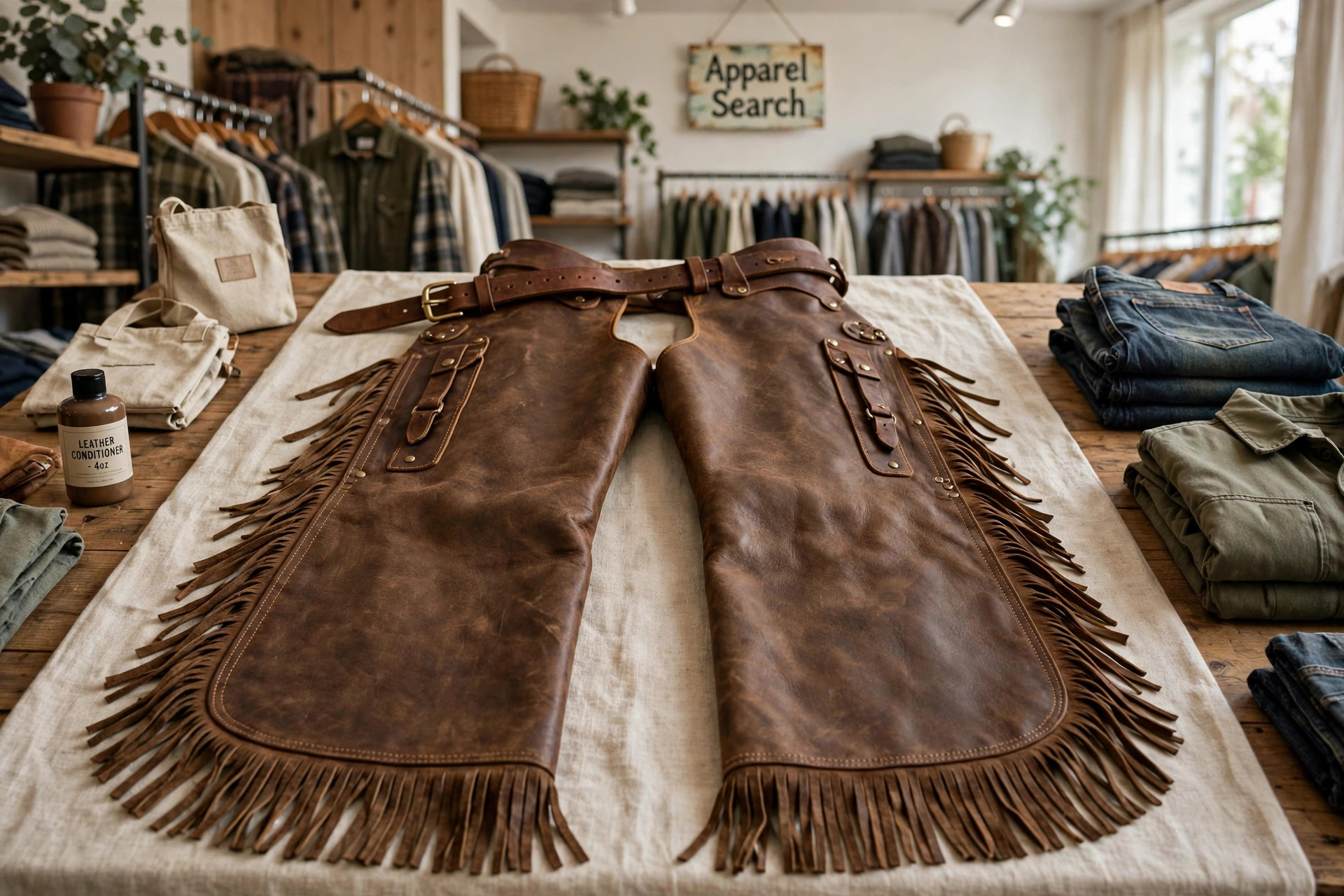
Built as Separate Legs
The most sturdy chaps are made from single pieces of leather that wrap around to protect the fronts and sides of each leg. Since the legs need not be joined at the back, chaps are considerably cooler than one might imagine from a full leather garment, and the open seat leaves the rider's own trousers to do the sitting. Zippers, snaps and conchos along each leg are not decoration alone: they are the fastening system that lets each leather leg be put on quickly, over boots, without removing anything else.
The purpose is protection against the daily environmental hazards of work with cattle and horses: the thorns of cacti and other thorny vegetation on the open range, the horns of cattle being herded or rounded up, rope burns, brush and weather. Farriers wear chaps — in their case often a leather apron form — to protect their legs from scratches and cuts while shoeing or treating horses' hooves. In every trade the principle is the same: the chaps take the damage so the legs and the clothing under them do not.
Batwing, Shotgun and Chinks
Batwing chaps have a wide, flared leg that fastens with snaps or buckles and gives broad coverage; the flare also makes them easier to put on over boots. Shotgun chaps are narrower, cut to fit the leg closely and usually zipped along their full length, suiting work in thick brush where a loose flap would snag. Chinks are a shorter version ending below the knee, often fringed, popular for warmer weather and range work. Rodeo chaps are a decorative offshoot — brightly coloured and fringed, made to be seen in the arena — but they descend directly from the working garment and keep its belted, open-seat construction.
Leather weight is the other main choice. Heavy hides shrug off thorny brush and last for years; lighter, softer chaps are cooler for long days and easier to move in. Traditional pairs were often made of buckskin — clothing cut from buckskin leather — and the garment remains a signature piece of Western wear long after its working role became only one of its uses.
Fit, Fastening and Care
Chaps are bought by waist and inseam much like trousers, but the fit is checked mounted: a pair that feels right standing may pull when the leg bends in the saddle. A working pair is fitted at the waist and thigh and long enough to cover the boot top when mounted, so brush and rope ends cannot slip underneath; working riders often prefer a slightly longer leg that covers the boot to the heel.
Care is leather care: brush off dirt, condition the hide before it dries and cracks, and store the chaps hung by the belt so the legs keep their shape. Looked after that way, chaps outlast the jeans worn under them many times over — which was the point of the design from the start. The leather shield is renewable and repairable in a way the clothing beneath it is not, and a good pair is measured in decades of work rather than seasons.
The design has travelled well beyond the ranch. Motorcycle riders wear leather chaps for the same reason cowboys do — abrasion and weather protection for the legs, in a garment that goes on quickly over ordinary trousers and comes off at the destination. Chainsaw and forestry chaps adapt the form in modern safety fabrics, with fibres designed to clog a chain's sprocket and stop it. Each version keeps the original's essential logic: separate, belted leg coverings that take the hazards of the work so the wearer and the clothing underneath do not have to.
Not to Be Confused With
Chaps are not trousers. Each leg is a separate leather covering hung from a belt, open at the seat and crotch, and always worn over trousers or jeans. That open construction keeps the rider cooler, allows full movement in the saddle, and lets the replaceable leather take the wear instead of the clothing beneath.
Common Questions
How do you pronounce chaps?
Chaps is pronounced 'shaps.' The word is a shortening of the Spanish chaparajos, the leather leg coverings of Mexican vaqueros, named for the chaparral brush the leggings protected riders against.
How are chaps different from trousers?
Chaps are not a complete garment: each leg is a separate leather covering hung from a belt, open at the seat and crotch, and always worn over trousers. That open construction keeps the rider cool, allows full movement in the saddle, and lets the leather take the wear instead of the clothing beneath.
What are the main styles of chaps?
Batwing chaps have a wide, flared leg that fastens with snaps or buckles and gives broad coverage; shotgun chaps are narrower, zip close along the leg and suit work in thick brush; chinks are a shorter version ending below the knee, often fringed, popular for warmer weather and range work.