Jumper Dress
Clothing Definitions — definitions of garments and clothing terms from Apparel Search
Search Apparel Search
At a Glance
Definition: A jumper dress is a sleeveless, collarless dress designed to be worn over a blouse or sweater.
Also known as: Pinafore dress, pinafore or pinny (British English)
Category: Clothing Definitions
A jumper dress — or simply a jumper — is defined by what goes underneath it. It is a sleeveless, collarless dress, cut to be worn over a blouse or sweater: the layer beneath supplies the sleeves and the collar, and the jumper supplies the body of the outfit. In British English the same garment is a pinafore dress — pinafore, or pinny, for short — a name that records its descent from the protective over-dress. The word carries a famous trap, set out in the sections below: in Britain a jumper is not this dress at all, but a woollen sweater. This page covers the American garment, its layering logic, and the neighbouring dresses it is confused with.
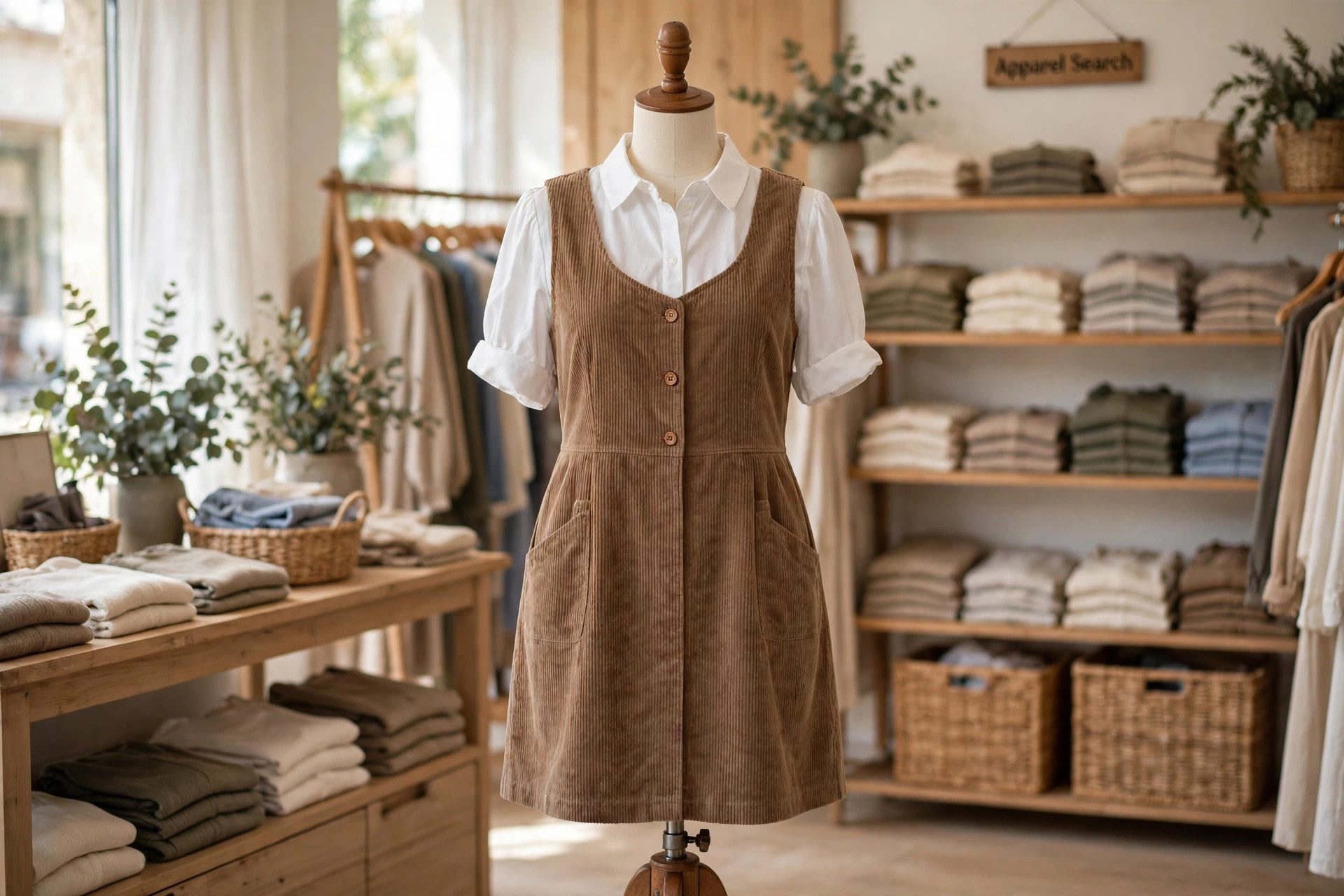
A Dress Built for Layering
Every feature of the jumper dress serves the layer beneath. It has no sleeves because the blouse or sweater provides them, and no collar because the under-layer's collar is meant to show. The neckline and armholes are cut generously — scooped, squared or V-shaped at the front — so the garment underneath is framed rather than hidden, and the dress fastens at the back, the side or not at all, pulling on as a shell over the layers below. A shirt or blouse beneath gives one outfit; a fine sweater or a cardigan worn under or over gives others.
That layering is the style's practical genius. One jumper dress worn over different blouses and sweaters becomes several outfits, and the combination adjusts across the whole year: a light blouse in spring, a warm sweater in winter. It is also why the jumper belongs to any season, unlike its nearest summer neighbour, the sundress — sleeveless in the same way, but designed as a complete dress to be worn alone in hot weather, with nothing beneath it.
Fabrics and Uses
Jumper dresses are traditionally made in substantial fabrics — wool, corduroy, denim and other dress-weight cloth. The weight is a consequence of the sleeveless cut: a fabric that would make a heavy, warm sleeved dress is comfortable in a sleeveless layer, because the arms are covered only by the blouse or sweater beneath. Firmer fabrics also hold the clean, simple silhouette the style depends on, since a jumper has little internal structure beyond its seams.
The form became a wardrobe staple and a standard school and work dress, especially under its British pinafore name: practical, modest, hard-wearing and endlessly re-combinable. Its ancestry shows in that practicality. The pinafore began as a protective over-garment — kin to the apron — worn to keep the dress beneath clean, and the jumper dress keeps the over-dress idea while dropping the protective purpose: what it protects is the wardrobe budget, by making one dress do the work of several outfits.
Modern jumpers vary the shell while keeping the layering idea. Necklines run from round and square to deep V shapes that frame a blouse collar; lengths run from above the knee to full length; and denim, linen and jersey versions sit alongside the traditional wool and corduroy. Buttons down the front, patch pockets and adjustable straps borrowed from overalls all appear, but the test of the category never changes: if the dress is cut to be worn over another top, it is a jumper, whatever the season's details do to its surface.
The Two Jumpers
The naming confusion is genuine and worth stating plainly. In American English, jumper means this sleeveless dress. In British English, a jumper is a knitted woollen sweater — a pullover — and the dress is a pinafore dress. The same word therefore names the layer beneath the dress in one country and the dress itself in the other, and catalogues, patterns and shopping pages written for one market are regularly misread in the other.
The apron dress is the third term in the family. The distinction between a jumper dress and an apron dress is not clear-cut, and for some dresses either term is correct; the working rule is one of design source. If the dress is directly inspired by an apron — bib front, ties, cross-over back — it is an apron dress. If it simply takes the sleeveless over-dress form, it is a jumper. A related name trap is the jumpsuit, a one-piece trouser garment that shares only the first syllable; the guide's jumpsuit versus catsuit answer separates that pair.
Not to Be Confused With
Three names circle this dress. In American usage a jumper is the sleeveless dress on this page; in British usage a jumper is a knitted woollen sweater — see the Sweater Definition — and the dress is a pinafore dress. A sundress shares the jumper's sleeveless cut but is a complete dress worn alone in hot weather, while a jumper dress is incomplete by design and needs its blouse or sweater beneath. An apron dress is the closest relative of all: where a jumper's design is directly inspired by an apron, apron dress is the better name, and for some dresses either term is correct.
Common Questions
What is a jumper dress?
A jumper dress, or simply a jumper, is a sleeveless, collarless dress intended to be worn over a blouse or sweater. In British English the same dress is a pinafore dress, pinafore or pinny.
How does a jumper dress differ from a sundress?
A sundress is sleeveless like a jumper dress, but it is a complete dress worn alone in hot weather. A jumper dress is designed to be worn over a blouse or sweater and can be worn at any time of year.
What does jumper mean in British English?
In British English, a jumper is a knitted woollen sweater. The sleeveless dress called a jumper in American English is called a pinafore dress in Britain.