Pinafore Apron
Clothing Definitions — definitions of garments and clothing terms from Apparel Search
Search Apparel Search
At a Glance
Definition: A pinafore apron is a full apron covering the front and sides of the dress beneath, in its strict sense with two holes for the arms and a fastening at the back, worn to protect the clothing under it.
Category: Clothing Definitions
Word Origin
A worn-down compound of pin afore — "pinned before." The bib of an early apron was often fastened to the chest with pins, pinned in front of (afore) the dress, and the pinned-on bib gave the whole apron its name. The pins have gone; the name preserves them.
A pinafore apron — usually shortened to pinafore — is a type of apron: a washable protective layer worn over a dress so that the dress itself is spared the splashes and wear of work. The name records how the garment began, with its bib pinned to the chest. The word is used in more than one sense today, and the senses are worth separating: this page gives the strict definition, the looser uses that cause confusion, and the separate garment — the pinafore dress — that borrowed the apron's shape and name.
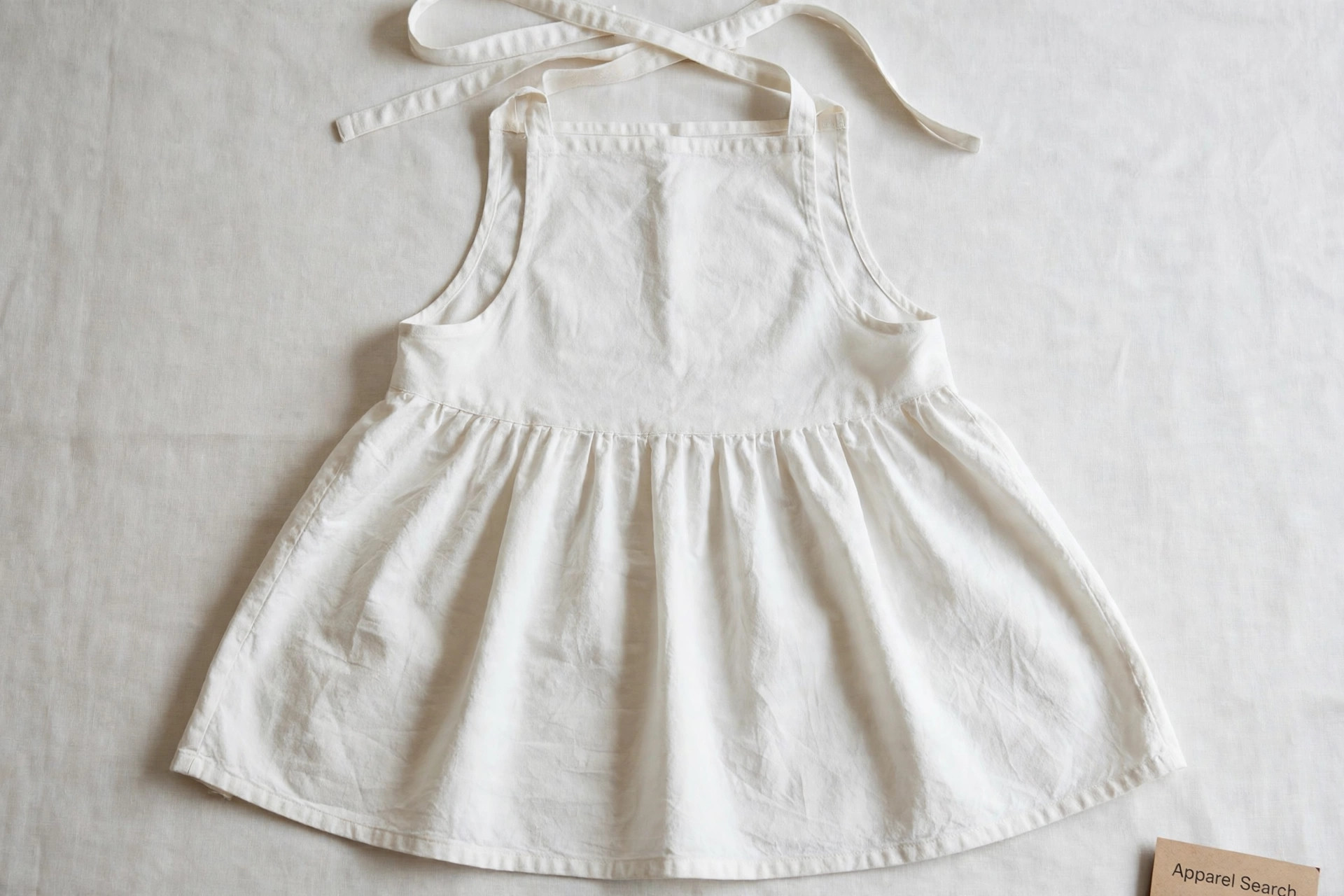
The Strict Sense, and the Looser Ones
In the narrow sense, a pinafore is a full apron with two holes for the arms, tied or buttoned at the back, usually below the neck. It covers the front and sides of the dress beneath — more than a waist apron, more than a bib — and it can be changed in a moment between tasks. Garments of this pattern were worn by women of all ages, and most familiarly by girls in America and Western Europe in the late nineteenth and early twentieth centuries.
The term is also applied, more loosely, to a frilly bib apron with shoulder straps that criss-cross at the back and tie in a ribbon — the recognised dress of domestic service. Ordinary bib aprons are sometimes called pinafore aprons as well, but that usage is confusing and best avoided: a bib apron covers the front only, hangs from neck and waist straps, and has no armholes or back fastening. The distinctions are set out in the box below.
Protection First: Work and Children's Wear
The pinafore began as economics. A dress was expensive and washing was labour, so a washable apron covering the body took the dirt of cooking, cleaning and work instead. Cotton was the standard cloth — plain for work, checked in gingham for everyday wear — because it boiled clean and wore hard. The full pinafore covered front, sides and shoulders, where a waist apron left the bodice exposed.
It was as children's wear that the pinafore had its longest life. A girl's dress was routinely covered by a pinafore, white or light-coloured, changed daily or as it soiled, so the dress beneath went longer between washings. School and Sunday versions took embroidery, lace and fine tucks, making the protective layer decorative in its own right. As dresses became cheaper and washing easier, the pinafore's protective duty faded — and its shape passed into the dress itself, in the sleeveless pinafore dress worn over a blouse, and in related styles such as the apron dress.
Two details mark the working pinafore across all its versions. The first is pockets: large patch pockets on the front, sized for the tools of the task in hand, appear on work and household pinafores from the nineteenth century onward and survive on modern aprons of the pattern. The second is the checked cloth: gingham — the small even check that shows soil less than plain white and needs no ironing to look tidy — became so standard for school and household pinafores that the check itself reads as the garment's uniform. Service pinafores added a cap and cuffs to the same system, each piece washable, each piece replaceable, the dress underneath protected by all of them together.
The Apron That Never Disappeared
The protective apron itself never went away. Cooks, cleaners, carers and craftworkers still wear bib and full aprons on the pinafore pattern, in cotton, linen and modern wipe-clean fabrics, sized by length and coverage rather than by dress size. A household pinafore is washed with the household cottons and checked at the ties and armholes, where the stitching takes the strain; full length is chosen for wet work, shorter cuts for the table and kitchen. Judged as a design, the pinafore is one of the most durable ideas in clothing: a sacrificial outer layer, pinned on in its first form, that kept the real garment clean.
That durability is also why the pinafore survived in institutions long after it left the home: schools, hospitals and service trades kept it as a uniform layer well into the twentieth century, because a workforce could be kept presentable by changing the apron rather than the uniform beneath it — the same economy that created the garment in the first place, applied at the scale of an institution rather than a household.
Not to Be Confused With
Three garments share one name's history. A pinafore apron, strictly, is a full protective apron with armholes and a back fastening, worn over a dress to keep it clean. An apron in the general sense — waist and bib aprons included — is any protective front worn over clothing, usually with straps and ties rather than armholes. A pinafore dress is not an apron at all: it is a sleeveless jumper dress worn over a blouse, which borrows the apron's bib front and open sides as a style.
Common Questions
Why is it called a pinafore?
The name comes from pin afore. The bib part of the apron was earlier often secured to the chest using pins, pinned before, or afore, the dress, and the pinned-on bib gave the whole apron its name.
What is a pinafore apron in the strict sense?
In the narrow sense it is a full apron with two holes for the arms, tied or buttoned in the back, usually below the neck, covering the front and sides of the dress beneath. Standard bib aprons are sometimes called pinafore aprons, but that usage is confusing and best avoided.
What is a pinafore dress?
In British English, a pinafore dress is a sleeveless dress worn over a blouse or top, corresponding to the American English term jumper dress. It is a dress, not an apron, though it takes its name and its bib-front shape from the pinafore apron.