Pouch Bag
Clothing Definitions — definitions of garments and clothing terms from Apparel Search
Search Apparel Search
At a Glance
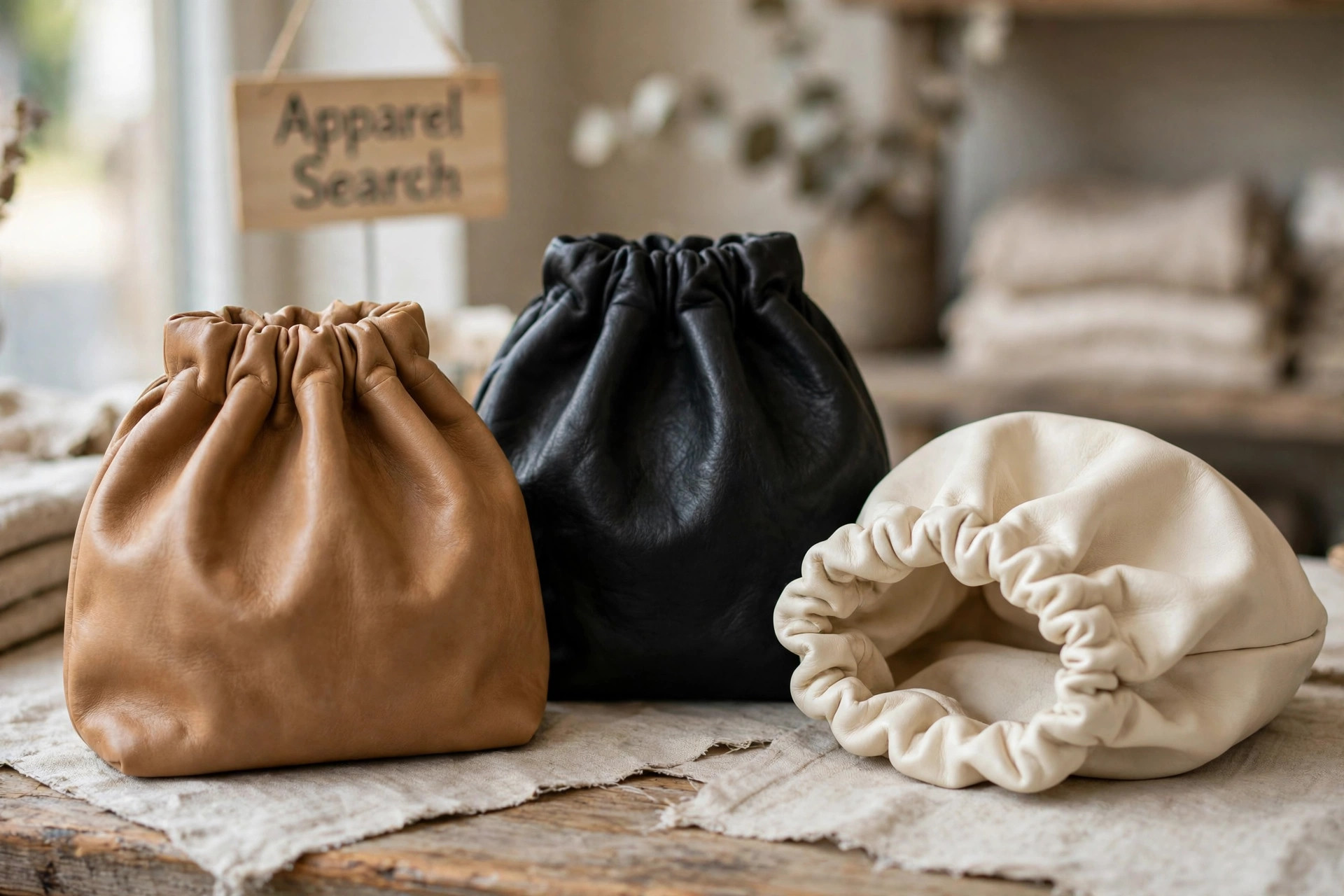
Definition: A pouch bag is a bag made with no rigid structure at all — no frame, board or stiffened base — so its material gathers at the opening and the body slouches into soft folds.
Category: Clothing Definitions
Word Origin
Middle English pouche, from Old North French pouche, a bag or pocket — the ordinary medieval word for a small sack carried on the person, which is exactly what the first pouches were.
A pouch bag is a handbag defined by what it does not have: no frame, no board, no stiffened base — no rigid structure of any kind. The leather, suede or fabric is gathered at the opening, and the body slouches into soft folds instead of holding a shape. The word is old and general, and for centuries it meant any small soft bag. In 2019 it acquired a precise modern fashion sense — the oversized gathered clutch — and this page covers both meanings, and separates the pouch from the clutch and the drawstring bucket bag.
The Old Word: Pouches Before Pockets
A pouch is, in the oldest sense, any small soft bag. Before pockets were sewn into clothing, the pouch carried at the belt was how money and small necessities travelled: the coin pouch, the money pouch, the tobacco pouch, and, in Scottish dress, the sporran worn at the front of the kilt. As a handbag term the word kept that small, soft meaning for centuries, used mostly for drawstring or gathered evening bags — bags whose softness was the point, since they could be drawn closed, carried in the hand and tucked away in a way no framed bag allows.
The construction follows from the definition. With no frame to open against and no base to stand on, a pouch closes by gathering: a drawstring, a ruched channel, or folds of the material itself drawn together. Empty, it collapses flat. That collapse is not a defect but the design — the bag takes the shape of what is put into it, and no other. It is also why the pouch survived every change of fashion around it: a framed bag declares a shape the maker chose, while a pouch declares nothing, and so it has fitted every century's idea of what a small bag should look like, from a medieval belt pouch to a modern clutch, without its construction changing at all.
2019: The Pouch as a Fashion Bag
The word's modern fashion sense dates from 2019, when Bottega Veneta, under Daniel Lee, launched The Pouch: an oversized clutch of butter-soft leather ruched into a slim hidden magnetic frame. The frame is the exception that proves the definition — it sits only at the opening, as a closure, while the body of the bag remains entirely unstructured, slouching and folding as a pouch should.
The design's success was large enough to reset the term. A pouch bag in a present-day shop listing means that bag's kindred: an unstructured gathered clutch, carried in the hand or tucked under the arm, in sizes from oversized down to mini. Trend lists for 2026 record the slouchy pouch as a continuing style rather than a one-season revival, and the product side of the style — its construction, leathers and sizes — is covered in the Fashion Influence guide to pouch bags.
Carrying and Caring for an Unstructured Bag
An unstructured bag asks a little more of its owner than a framed one. Contents show through soft leather as lumps, so pouches are usually lined and carried with their contents in small cases; sharp objects can mark or pierce an unprotected body. Storage matters for the same reason: a pouch kept stuffed lightly with tissue holds its intended slouch, while one stored crushed flat under other bags takes creases that soft leather shows. Suede pouches are brushed and kept from rain; smooth leather is wiped and conditioned as ordinary leather care directs. The neighbouring bag forms — the purse, the bucket bag and the crossbody bag — each solve one of the pouch's problems, with structure, a base or a strap, at the cost of the pouch's softness.
Sizes and materials follow the two senses of the word. The old pouch was small by definition — a hand's span of leather, suede or fabric, closed with a drawstring and made to hold coins, keys or tobacco. The modern fashion pouch runs from that mini scale up to the oversized original, large enough for documents and a paperback, and is made in the softest leathers the trade uses, precisely because a stiff leather would fight the design: the material must be willing to gather, ruche and fold. Suede and fabric versions trade some of that drape for lightness and price. In every size the test of the type is the same — set the bag down empty, and a true pouch subsides into folds instead of standing.
Not to Be Confused With
Three bag words that classify on different lines. A pouch bag is defined by having no structure: no frame, no stiffened base, the material gathered and slouching. A purse is defined by its use — the bag carried for money and everyday essentials; most purses have structure, and handles or a strap. A clutch is defined by its carry — held in the hand, with no handles or strap — and most clutches are structured envelopes or boxes. The modern pouch is carried like a clutch, which is why the words overlap in shop listings, but a structured clutch is not a pouch, and a pouch with a firm flat base has become a bucket bag.
Common Questions
What is a pouch bag?
A pouch bag is a bag made without frame or stiffening, so the material gathers at the opening and slouches into soft folds. Historically the word means any small soft bag — a coin pouch, a money pouch, a sporran; in present-day fashion it means the oversized gathered clutch popularised in 2019.
What is the difference between a pouch and a clutch?
A clutch is defined by its carry — held in the hand, without handles or a strap — and is usually a structured envelope or box shape. A pouch is defined by its lack of structure. The modern pouch is carried like a clutch, which is why the two words overlap in shop listings.
Is a drawstring pouch the same as a bucket bag?
No. A drawstring pouch is soft throughout and collapses when empty. A bucket bag has a firm, flat base that holds it upright. The gathered tops look alike, but the bodies do not.