Bias (Cross-Grain)
Fabric Definitions — definitions of fabrics, cloths, laces and textile materials from Apparel Search
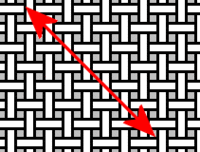
The bias (US) or cross-grain (UK) direction of a piece of woven fabric is at 45 degrees to its warp and weft threads. Every piece of woven fabric has two biases, perpendicular to each other. Woven fabric is more elastic and more fluid in the bias direction than on the grain, which suits garments and details that require extra elasticity, drapability or flexibility.
The bias (US) or cross-grain (UK) direction of a piece of woven fabric, usually referred to simply as "the bias" or "the cross-grain", is at 45 degrees to its warp and weft threads. Every piece of woven fabric has two biases, perpendicular to each other.
Woven fabric is more elastic as well as more fluid in the bias direction, compared to the on-grain direction. This property facilitates garments and garment details that require extra elasticity or drapability or flexibility, such as bias-cut skirts and dresses, neckties, piping trims and decorations, bound seams, etc.
A garment made of woven fabric is said to be "cut on the bias" when the fabric's warp and weft threads are at 45 degrees to its major seam lines.
Learn about the grainline in our glossary.
Learn more about fabric.
Learn about knit fabrics.
Learn about woven fabrics.
|
| Fashion Industry |
The True Bias and the Trade-Offs of Cutting ThereThe true bias sits exactly halfway between warp and weft, and it is the point of maximum give in both of the fabric's diagonal directions. Pattern cutting on the true bias is a deliberate exchange: the cutter gives up the stability of the straight grain and a good deal of yardage — pieces must be laid diagonally across the cloth, wasting the corners — in return for drape that no straight-grain cut can imitate. Bias-cut cloth also behaves differently over time. A bias skirt is normally left hanging before hemming, because the sheared weave keeps relaxing under its own weight and the hem drops unevenly; hemming immediately would leave one side longer than the other within days. Handling Bias in SewingThe same mobility that makes bias drape makes it demanding to sew. Bias edges stretch under the presser foot and under their own weight, so seams are stay-stitched, handled flat, and allowed to feed without pulling; a seam pulled taut during sewing ripples permanently when the garment is worn. Bias bindings and facings exploit the opposite behavior — a narrow bias strip can be eased around a tight curve or stretched slightly along a straight edge to prevent gaping, which is why bias tape is a standard notion even for garments that are otherwise cut entirely on the straight grain. Understanding the bias is therefore not a refinement: grain direction is the first decision in cutting any woven garment, and the bias is the direction that changes what the finished cloth can do. Common QuestionsWhy is woven fabric stretchier on the bias?On the grain, pulling loads the warp or weft threads themselves, and threads barely stretch. At 45 degrees the load falls across the thread grid, and the squares of the weave can shear into diamonds, letting the cloth extend and flow. The fabric is not stretching thread by thread; the weave geometry is changing shape. What does cut on the bias mean for a garment?The fabric's warp and weft run at 45 degrees to the garment's major seam lines. Skirts and dresses cut this way cling, swirl and settle into fluid folds instead of standing away from the body, because the sheared weave moulds itself under gravity — at the cost of using considerably more fabric per garment. Where is bias used besides bias-cut garments?Neckties are cut on the bias so they knot smoothly and hang straight without twisting. Bias strips make piping and bound edges that can curve around necklines and armholes, because a straight-grain strip cannot bend around a curve without buckling, while a bias strip stretches and compresses along its two edges as needed. More to ExploreMore from Apparel Search: Fabric Definitions | Clothing Industry Glossary | Fashion Terms | Apparel Search Home
|