Bias Tape
Miscellaneous Definitions — the 45-degree strip for binding, piping and finishing edges, from Apparel Search
Search Apparel Search
At a Glance
Definition: Bias tape, or bias binding, is a narrow strip of fabric cut on the bias, with its fibres at 45 degrees to the length of the strip, making it stretchier, more fluid and more drapeable than a strip cut on grain.
Also known as: Bias binding
Category: Miscellaneous Definitions
Bias tape, or bias binding, is a narrow strip of fabric cut on the bias — known in the United Kingdom as cross-grain. The strip's fibres, being at 45 degrees to the length of the strip, make it stretchier as well as more fluid and more drapeable compared to a strip that is cut on grain. Widths vary from about half an inch to about three inches depending on the application. Bias tape is used in making piping, binding seams and finishing raw edges, and it is sold as simple, single-fold and double-fold tape. This page covers why the 45-degree cut behaves as it does, how widths and lengths are adapted to the job, and how the folded forms differ — the three things a sewer needs to choose and use the right tape.
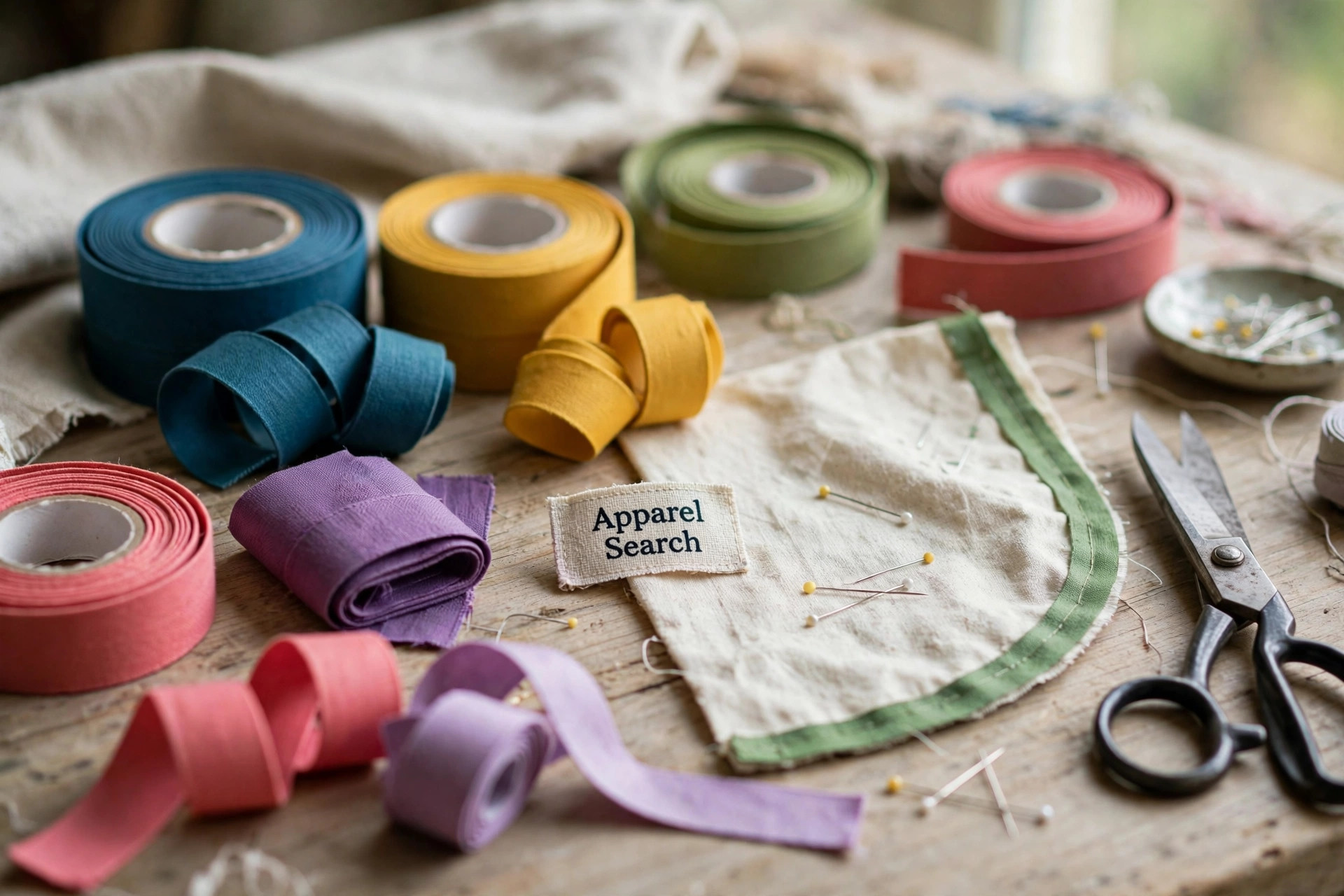
Cut at 45 Degrees for Stretch and Drape
That angle is the whole definition. A strip cut along the grain follows the straight threads of the fabric and resists curving, while a bias strip can bend, stretch slightly and settle around a curve without puckering. This is why bias tape is chosen for edges that are not straight: necklines, armholes, curved hems and rounded corners all need a binding that can follow their shape, and a straight-grain strip would wrinkle or pull at exactly those points. The bias cut trades a little stability for that flexibility, so the tape must be handled without stretching it out of shape as it is sewn — pulled tight while stitching, a bias edge will ripple once it is released.
The same behaviour explains both the tape's strengths and its limits. On a curve, the fibres at 45 degrees shift against each other and let the strip lengthen on one side and shorten on the other, which is what following a curve requires. On a long straight edge, that same give is a disadvantage, because the edge can stretch and sag where a stable finish is wanted. Bias tape is therefore a specialist trim: chosen where movement and drape are needed, and passed over where a firm, unmoving edge is the goal. Understanding the cut explains the choice in every case — whenever an edge curves, stretches or needs a smooth wrap, a bias strip will lie flatter and move more naturally than any straight-cut alternative.
Widths, Lengths and Ready-Made Tape
Width and length are adaptable to the job. The tape's width varies from about half an inch to about three inches depending on applications, with narrow tape used for fine edges and piping and wider tape used where a broader binding or facing is wanted. Many strips can be pieced together into a long tape, because a single width of fabric yields only limited bias length; joining strips end to end, with the joins spread around the work, produces the continuous length needed to bind a whole garment edge without a join landing at a conspicuous point.
Commercially available bias tape is sold ready-made for convenience, in colours and fabrics chosen to match or contrast with the garment. Making tape at home from the garment fabric itself gives an exact match, while bought tape saves the cutting and joining work and gives a consistent, pressed fold that is ready to stitch. The choice is practical rather than a matter of quality: a sewer binding a neckline in the garment's own fabric will cut tape, while a sewer who wants a contrasting outline, or who is binding many edges the same way, will usually buy it. Either way, the finished tape is the same object — a bias-cut strip, folded and pressed, ready to wrap an edge.
Single-Fold, Double-Fold and Uses in Sewing
Bias tape is available in distinct folded forms, and the names describe exactly how the strip has been prepared. Commercially available bias tape is available as simple bias tape, single-fold bias tape and double-fold bias tape. Single-fold bias tape is bias tape that is folded in half lengthwise on its centre line, wrong side together, and pressed, so it presents one folded edge and two raw edges that are enclosed as it is applied. Double-fold bias tape is single-fold bias tape where each half is again folded in half lengthwise, wrong sides together, and pressed, tucking the raw edges inside so the tape can wrap an edge cleanly with no raw fabric showing.
Choosing between them depends on the finish required: single-fold suits facings and edges that will be enclosed, while double-fold suits visible binding where both sides of the edge will be seen. The uses follow directly from the construction. Bias tape is used in making piping, binding seams, finishing raw edges and other sewing tasks where a neat, flexible edge is needed. For piping, the tape wraps a cord and is stitched into a seam so a raised, defined line appears along the edge. For binding, the tape encloses a raw edge completely, protecting it from fraying and giving it a clean outline that can match or contrast with the main fabric. For finishing, it replaces a turned hem on a curve where a straight hem would not lie flat. Bias tape belongs with related sewing trims and notions such as twill tape, which is cut on grain for strength rather than stretch, and with the wider family of trimmings used by dressmakers and in tailoring.
Common Questions
What is bias tape?
Bias tape, or bias binding, is a narrow strip of fabric cut on the bias, at 45 degrees to the length of the strip. That angle makes it stretchier, more fluid and more drapeable than a strip cut on grain.
What is bias tape used for?
Bias tape is used in making piping, binding seams and finishing raw edges. Many strips can be pieced together into a long tape for a continuous finish.
What is the difference between single-fold and double-fold bias tape?
Single-fold bias tape is folded in half lengthwise on its centre line, wrong side together, and pressed. Double-fold bias tape is single-fold tape where each half is again folded in half lengthwise, wrong sides together, and pressed.