Bias Binding Tape Manufacturers
Bias-cut tape that folds around raw edges to finish, bind and decorate garments.
Bias binding tape is a narrow strip of fabric cut on the bias — diagonally across the weave, at 45 degrees to the warp and weft — and folded so it can wrap cleanly around a raw edge. Cutting on the bias is what gives the tape its defining property: it stretches and curves. A straight-grain strip fights every curve it meets, while a bias strip eases around necklines, armholes, scallops and rounded hems, lying flat without puckering. Factories buy it ready-made on rolls and spools so that edge finishing becomes a fast, repeatable sewing operation instead of a cutting-room task.
This page is a guide to bias binding tape for garment manufacturers: how it is cut and folded, the difference between single-fold and double-fold constructions, the fibers and widths it is sold in, where it is used, and what to specify when ordering. The manufacturer listings below supply bias tape and related ribbons and trimmings to the clothing industry, and the tape guides at the bottom of the page cover the rest of the tapes family, from cotton and twill tapes to ribbon and satin tapes.
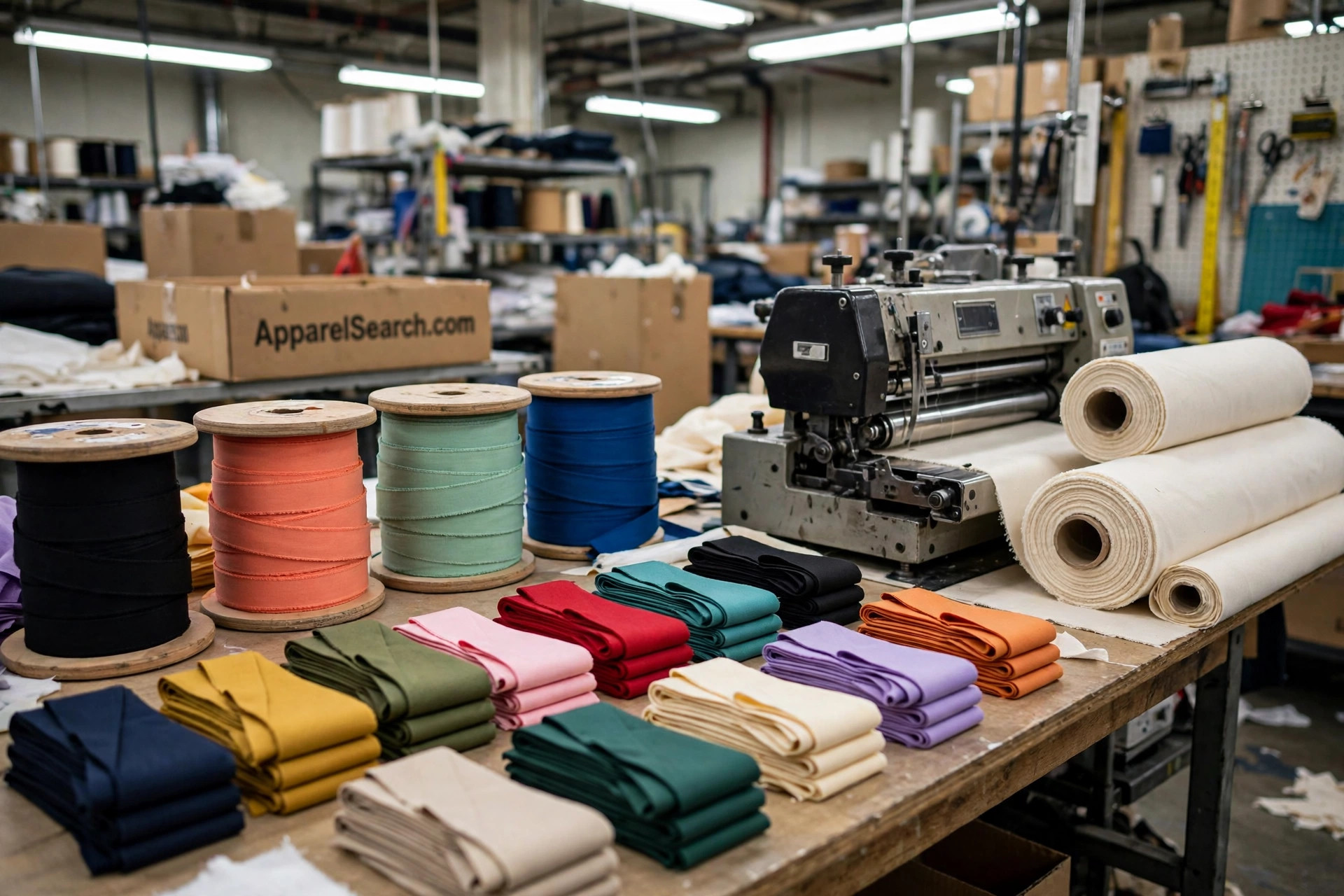
Tape & Trim Resources
Cut on the Bias: Why the Angle Matters
Woven fabric is stable along its lengthwise and crosswise grains but gives diagonally, because the warp and weft yarns can shift against each other on the diagonal. Bias tape exploits that give. Strips are cut at a true 45-degree angle, joined end to end with diagonal seams that distribute bulk, and the long continuous strip is then fed through folding equipment. The result is a binding that can be eased around a tight curve, stretched slightly over a convex edge, or fed through a binder attachment at production speed while staying smooth.
The trade-off is that bias strips are less stable than straight-grain tapes: they can stretch out of shape if handled roughly, and they consume more fabric per metre than a straight cut. That is why ready-made bias binding is a manufactured product in its own right rather than something most garment factories cut for themselves — specialist makers control the cutting angle, the joins and the folding, and deliver a consistent tape that sewing operators can trust.
Single-Fold and Double-Fold Constructions
Single-fold bias binding has both raw edges folded to the centre, so the tape presents one folded edge to each side of the fabric it binds. It is the workhorse construction for binding a single layer of fabric — the classic edge finish on quilts, placemats, bibs and light garments — and it is also used flat, as a decorative trim or casing, where only one folded face shows. Double-fold bias tape is folded again along its centre, hiding the folded edges inside, which produces a narrower, more substantial binding with a clean finished edge on both faces.
Widths are quoted for the unfolded or the folded state depending on the maker, which is a common source of ordering errors: a tape sold by its cut width finishes considerably narrower once folded. Buyers should confirm whether a quoted width is the strip width, the single-fold width or the finished double-fold width, and should sample the tape on the actual fabric weight it will bind — a binding that is perfect on quilting cotton can be too light for denim or too stiff for chiffon.
Fibers, Colors and Garment Uses
Cotton and cotton-rich blends are the most common bias binding fibers because they press crisply, sew easily and match the cotton garments they usually finish. Polyester and polycotton bindings add abrasion resistance and colorfastness for workwear and uniforms, satin bindings give a glossy decorative edge for lingerie, eveningwear and baby garments, and makers also offer prints, checks and lace-edged versions for visible decorative binding. Because binding is often the most visible trim on a finished edge, color matching to the shell fabric — or a deliberate contrast — is part of the specification.
In garment production the tape finishes necklines and armholes on dresses and tops, binds the edges of jackets and wrap garments, edges aprons, bibs and children's wear, finishes seams inside unlined garments, and forms straps, ties and casings. Outside apparel it is the standard binding for quilts and home textiles. In every case the working principle is the same: the folded tape encloses the raw edge completely, is stitched through all layers in one or two passes, and protects the edge from fraying while giving it a clean, deliberate line.
Specifying and Ordering Bias Binding
A complete order states the construction (single-fold or double-fold), the finished width, the fiber, the color and how it is to be matched, and the put-up — rolls, spools or cut pieces — the sewing line expects. State the garment fabric and end use as well: a maker who knows the binding must curve around a neckline and survive industrial laundering will recommend a different tape than one supplying decorative binding for a christening gown. Ask how joins are made and how frequent they are on a roll, because a badly placed join inside a bound edge shows.
Check a production sample the way the sewing room will use it: feed it through the binder attachment if one is used, bind a curved test edge, press it, and wash it with the garment fabric to confirm the binding neither shrinks away from the edge nor bleeds color onto it. Confirm minimum order quantities per color, since dyed-to-match colors commonly carry higher minimums than stock black and white.
Bias Binding Tape Manufacturers
Manufacturers and exporters supplying bias binding tape, ribbon and related tailoring trimmings to the clothing industry.
Ningbo MH Industry Co. Ltd.
Manufacturer and exporter of tailoring materials. Their main products are polyester and embroidery thread, laces, zippers, bias binding tape, ribbon, various buttons and more.
Bias Binding Tape · Ribbon · Elastic Tape · Reflective Tape · Trimming
Ningbo XWZ Ribbon Manufacturer
Ningbo XWZ Ribbon Manufactory, established in 1998, is a manufacturer of all kinds of bias tape, silk ribbon, zigzag, curtain tape, Christmas ribbon, UU lace, Samosa lace, elastic tape, satin ribbon, trimming and many kinds of decorative ribbons. They also supply many kinds of threads and other related items. Presently, they employ just over 200 skilled and diligent workers at their factory.
Bias tape · Velvet ribbon · Satin ribbon
More Tape Guides
- Cotton Tape
- Curing & Wrapping Tape
- Elastic Tapes
- Gripper Tapes
- Hook & Eye Tapes
- Hook & Loop Tapes
- Jacquard Tapes
- Kevlar Tapes
- Knitted Tape
- Leather Suede Tapes
- Multi Color Tape
- Name Tapes
- Nylon Tapes
- Organza Tape
- Packing Tapes
- Piping Tapes
- Plain Tapes
- Polyester Tapes
- Rayon Tapes
- Reflective Tapes
- Ribbon Tapes
- Rubber Tape
- Satin Tapes
- Seam Tapes
- Teflon Tapes
- TPU Elastic Reverie Tape
- Twill Tape
- Velvet Tapes
- Woven Polyester Tapes
Common Questions
What is bias binding tape?
A narrow strip of fabric cut diagonally across the weave (on the bias) and folded so it can wrap around a raw edge. The bias cut lets the tape stretch and curve smoothly around necklines, armholes and rounded edges where a straight-grain strip would pucker.
What is the difference between single-fold and double-fold bias tape?
Single-fold tape has both raw edges folded to the centre and is used to bind one layer of fabric or as a flat trim. Double-fold tape is folded again along the centre, hiding the edges for a narrower, more substantial binding with a clean finish on both sides.
What should a buyer specify when ordering bias binding tape?
The construction (single- or double-fold), the finished width — confirming whether a quoted width is cut, folded or finished — the fiber, the color and matching method, the put-up (rolls or spools), and the garment fabric and end use it must suit.