Gripper Tape Manufacturers
Waistband tapes with a grip surface that keeps shirts tucked and waistbands seated.
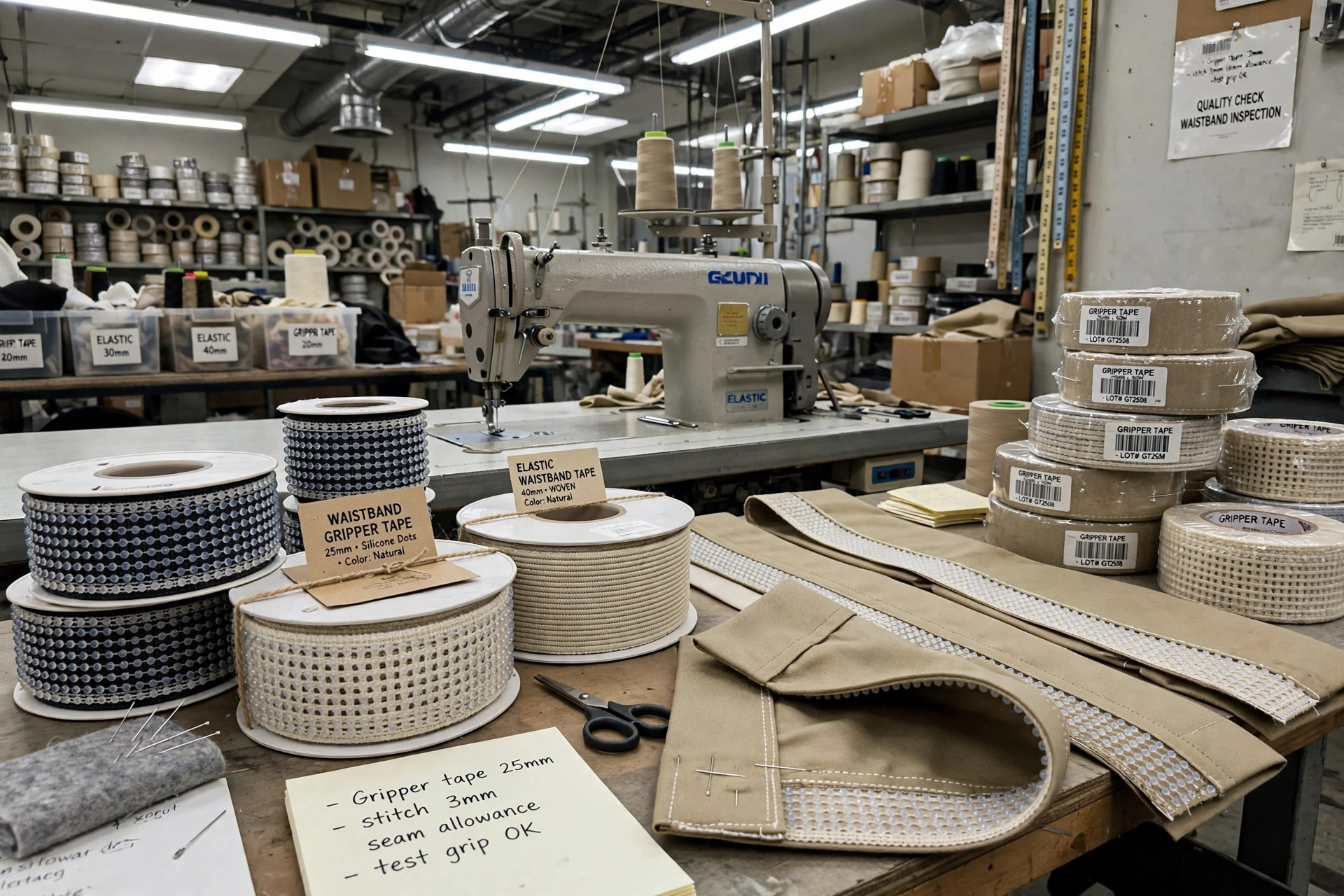
Gripper tape is the functional strip sewn inside a waistband to stop two things moving against each other: the shirt, which wants to pull out and billow, and the waistband itself, which wants to roll, slip and creep on the body. The tape carries a high-friction gripping element — traditionally fine rubber threads or a rubberised surface woven into or applied to a woven band, and in modern versions printed or extruded silicone dots, ribs or strips. Pressed between waistband and shirt by the wearer's belt and body, that grippy face holds the shirt tail down and keeps the waistband sitting where it was fitted.
The tape is a standard component of tailored trousers, uniform pants, skirts and formal hire wear, and it is bought as a production material with a performance job to do. This page explains how gripper tapes are constructed, where they are used, what separates a tape that still grips after a year of laundering from one that gives up in a month, and how to specify an order. The manufacturers below supply gripper tape within their narrow-fabric and industrial tape ranges, and the guides at the bottom cover the wider tapes family.
Tape & Trim Resources
How a Gripper Tape Works
A gripper tape is a woven waistband tape — commonly polyester, cotton or a blend, woven firmly so it can be sewn into the waistband construction without stretching — with its gripping element on the face that will sit against the shirting. In woven constructions, fine rubber or elastomeric threads are worked into the surface so thousands of tiny grippy points engage the shirt fabric. In coated constructions, silicone or rubber is printed or extruded onto the band in dots, bars or continuous ribs, which lets the maker tune how aggressive the grip feels.
The mechanism is friction under light pressure, nothing more exotic: the waistband closes over the tucked shirt, the grip face resists the sliding that walking and sitting would otherwise cause, and the shirt stays anchored far longer than against a smooth waistband lining. The same friction keeps the waistband itself from rotating on the wearer's waist or sliding down over the hips, which is why gripper tape is also specified for skirts and for trousers worn without a belt.
Where Gripper Tapes Are Used
Tailored and uniform trousers are the home ground: suit trousers, school and corporate uniform pants, police and service dress trousers, band and formal-hire trousers — any garment whose wearer is expected to stay tucked and tidy through a working day. Skirts use waistband gripper for the same anti-slip purpose, and gripper elements also appear in strapless and structured garments, where a gripped edge helps a bodice stay in place, and in waistbands designed to hold holsters, tools or medical devices steady, where the anti-slip job is functional rather than neatness-driven.
Placement follows the garment: the tape is usually sewn into the waistband curtain or facing so the grip face stands against the shirt around most or all of the waist, sometimes as a full circuit and sometimes as panels at the sides and back where pull-out starts. Makers supply the tape ready for the waistband construction the factory uses, so the tape choice and the waistband make-up should be settled together rather than independently.
Grip That Survives Laundering
The failure mode of a cheap gripper tape is rarely tearing — it is the grip dying first. Rubber elements can perish, oxidise and lose their tack; coatings can crack, peel or be scoured away by repeated hot washing and tumble drying; and a woven grip face can polish smooth with wear. Uniform and workwear buyers, whose trousers are industrially laundered, should treat wash durability as the headline specification and test the tape through the actual laundry cycle the garment will face, checking grip afterwards rather than only when new.
Silicone grip elements are generally chosen where long wash life and consistent grip matter, because silicone keeps its friction and flexibility through repeated laundering and heat. Woven rubber-thread constructions remain common in traditional tailoring. Either way, the tape base must also survive: a firm, sewable weave that does not fray at the needle line or shrink the waistband out of shape in the wash, matched in shrinkage to the waistband fabric it is sewn into.
Specifying and Ordering Gripper Tape
Specify the grip construction (woven rubber thread, silicone dots, ribs or strip), the tape width to suit the waistband depth, the base fiber and color — black, white and grey cover most tailored work — and the wash regime the grip must survive. State the garment and placement: full-circuit trouser waistband, skirt waistband or bodice edge. Ask for the maker's recommended sewing method, since grip faces can drag under a standard presser foot and factories often use a roller or walking foot, or stitch through the tape's plain margins where the construction provides them.
Test on a made-up waistband, not on a bare sample: sew the tape into the real waistband construction, tuck a shirt, wear-test or simulate movement, then launder the garment repeatedly and re-test. Grip is a system property of tape, shirt fabric and waistband fit together, so approval on the finished garment is the only approval that predicts wearer experience.
Gripper Tape Manufacturers
Narrow-fabric and industrial tape manufacturers offering gripper tapes within their tape and webbing ranges.
Elastix Australasia Pty Ltd
Head Office is located in Australia and their factory is in China. The company was established in 1948 and currently employs over 3,000 people. They design and produce over 15,000 accessories, with narrow fabrics their primary focus and specialty, including elastics, laces, tapes and webbings. Their products are predominantly produced on Swiss, German and Italian machinery, and they are ISO 9001 Certified.
They sell to manufacturers and distributors worldwide, and a large part of their sales are to the domestic market in Mainland China, where they are based for manufacturing. With Western, European and Chinese management, they seek new distributors in many markets; interested agents or distributors should forward full details, experience and an expression of interest directly to the General Manager, Mr Jeremy Quittner.
Narrow fabrics · TPU Elastic Reverie Tapes · Lanyards · Elastics / Webbings · Cords · Ribbons · Tapes — cotton tape, satin tape, twill tape, velvet tape, gripper tape, polyester tape
Euro
The company manufactures a variety of industrial tapes such as seam tapes and PTFE tapes, which are used for packing, wrapping, and gripping. Ribbons made of cotton, rayon, nylon, polyester, staple fibre, terelene, satin, velvets, zari etc. find wide application in garment industries.
Seam Tapes · Cotton Tapes · Rayon Tapes · Nylon Tapes · Polyester Tapes · Satin Tapes · Velvet Tapes · Gripping Tapes / Gripper
Shivam Narrow fabrics
Located in India, Shivam Narrow fabrics is an upcoming company that prides itself on producing superior products with faultless deliveries. They have made a distinctive mark for themselves by producing export quality products that are at par with international standards.
Cotton Tape · Elastic Tape · Jacquard Tape / Jacquard Name Tape · Multi Color Tape · Satin Tapes · Curing & Wrapping Tape · Reflective Tape · Knitted Tape · Organza Tape · Gripper tape · Narrow fabric
More Tape Guides
- Bias Binding Tape
- Cotton Tape
- Curing & Wrapping Tape
- Elastic Tapes
- Hook & Eye Tapes
- Hook & Loop Tapes
- Jacquard Tapes
- Kevlar Tapes
- Knitted Tape
- Leather Suede Tapes
- Multi Color Tape
- Name Tapes
- Nylon Tapes
- Organza Tape
- Packing Tapes
- Piping Tapes
- Plain Tapes
- Polyester Tapes
- Rayon Tapes
- Reflective Tapes
- Ribbon Tapes
- Rubber Tape
- Satin Tapes
- Seam Tapes
- Teflon Tapes
- TPU Elastic Reverie Tape
- Twill Tape
- Velvet Tapes
- Woven Polyester Tapes
Common Questions
What does gripper tape do in trousers?
Sewn inside the waistband with its high-friction face against the shirt, it resists the sliding that pulls a shirt out during wear, keeping the shirt tucked and the waistband seated and unrolled. The grip comes from rubber threads woven into the tape or from silicone dots, ribs or strips applied to its surface.
Is gripper tape the same as elastic?
No. Gripper tape is a firm, non-stretch waistband tape whose job is friction, not stretch. Some waistband constructions combine a gripper tape with elastic elsewhere in the waistband, but the grip element itself does not provide the fit — the waistband does.
How long does the grip last?
It depends on the grip element and the laundering. Silicone elements generally keep their friction through many washes; rubber elements can perish or polish smooth over time. For laundered uniforms, test grip on a made-up garment after repeated cycles of the actual wash process.