Polyester Tape Manufacturers
Strong, colorfast synthetic tape that shrugs off moisture, washing and hard wear.
Polyester tape is the synthetic workhorse of the tapes family: a narrow woven tape made from polyester yarn, bought where strength, colorfastness and indifference to water matter more than a natural hand feel. Polyester does not rot, does not mildew, absorbs very little moisture, holds dyed color through sun and repeated laundering, and keeps its strength wet or dry. Those properties have made polyester the default tape fiber for uniforms, workwear, outdoor clothing, webbing and straps, and for industrial sewing far beyond apparel.
This page explains polyester tapes for garment and product manufacturers: how woven polyester tape and webbing are constructed, where the fiber's strengths and limits show up in a garment, the finishes and forms in trade use, and how to specify an order. The background guides at the top of the page cover the polyester fiber itself and polyester pricing. The manufacturers below include engineered narrow-fabric mills and tape exporters offering polyester tapes, and the guides at the bottom cover the wider tapes family, including the dedicated woven polyester tapes guide.
Tape & Trim Resources
Why Polyester Became the Default Synthetic Tape
A tape fails in service by breaking, by stretching out of shape, by fading, or by rotting — and polyester resists all four better than most fibers at its price. Its tensile strength is high for its weight, its stretch is low and recoverable, its colors are dyed into a fiber that holds them through washing and sunlight, and because it absorbs almost no water it dries fast, does not swell or weaken when wet, and gives mildew nothing to feed on in storage. For a component that is expected to outlast the garment around it, that combination is hard to argue with.
The honest limits belong in the same paragraph. Polyester has a harder, smoother hand than cotton and can feel synthetic against skin; it melts rather than chars under extreme heat, so pressing and heat-sealing settings must respect it; and its smooth surface can slip in a knot where a cotton tie would hold. None of these disqualify it — they define where it belongs: in structure, straps, reinforcement and hard-washed garments, rather than as a soft next-to-skin tie.
Woven Tapes, Webbing and Engineered Narrow Fabrics
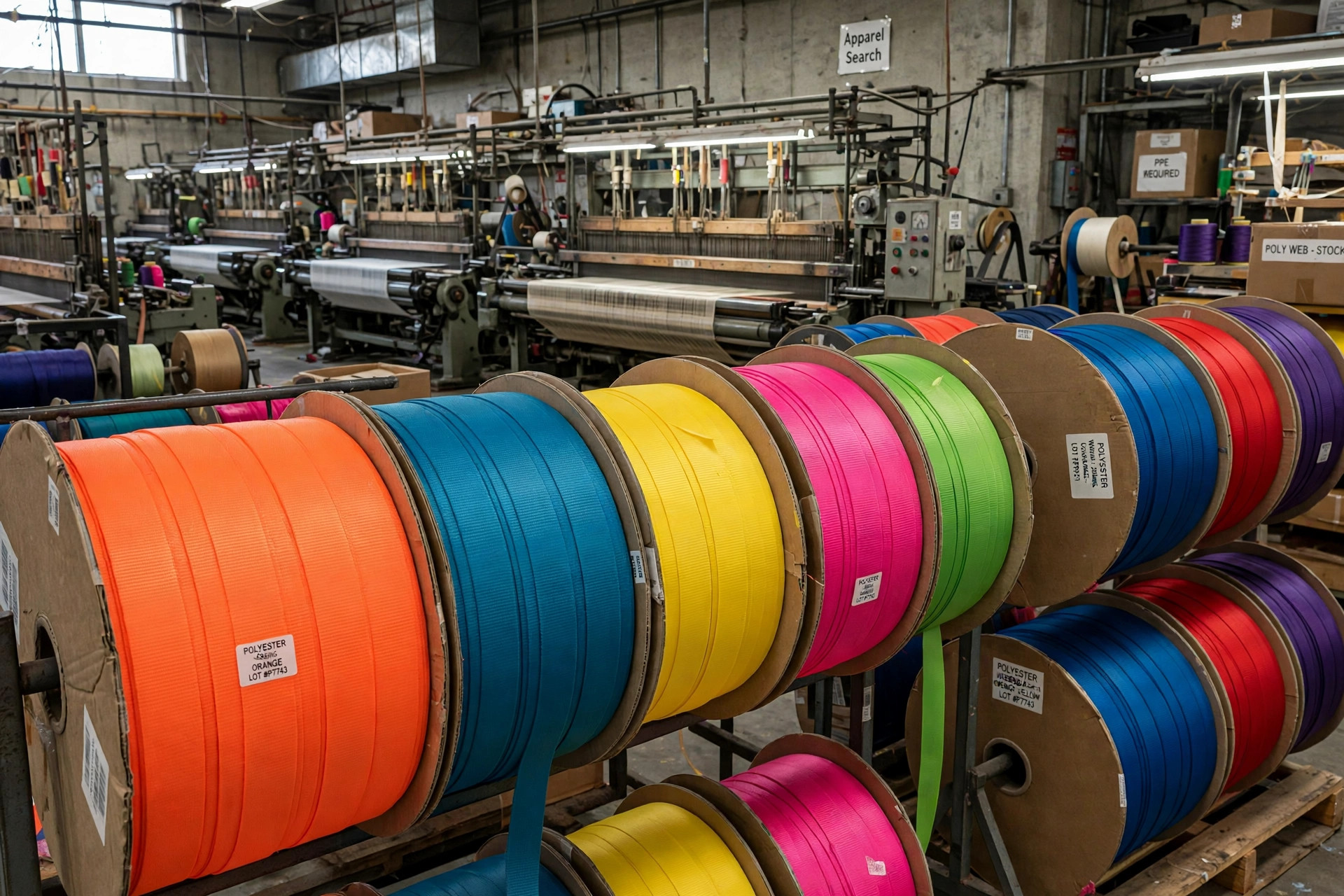
Garment-weight polyester tapes are plain- or twill-woven in narrow widths for binding, staying, ties and reinforcement, woven with firm selvedges so cut ends behave. Heavier polyester webbing is woven thicker and denser for straps, belts, bag handles, pet leads, and load-bearing uses where the tape is the structure. Specialist mills engineer woven narrow fabrics well beyond apparel — tapes, webbing and tubulars for medical, military, safety, industrial and aerospace work, woven from polyester alongside nylon, aramid and other performance fibers where the specification demands them.
Construction details decide performance within the same fiber name. Yarn denier and weave density set strength and thickness; heat-setting stabilises width and shrinkage; and edge construction decides whether a cut length frays, needs sealing, or can be heat-cut cleanly — polyester's thermoplastic nature is an advantage here, since a hot knife cut seals as it cuts. A buyer comparing two polyester tapes should compare those construction facts, not just the fiber label both rolls share.
Where Polyester Tape Is Used
In apparel, polyester tape reinforces and binds uniforms, workwear and sportswear that are laundered industrially, forms straps and adjusters on bags, packs and outdoor clothing carried as part of a garment system, and serves as webbing for belts, suspenders and equipment carriers. Its weather indifference suits outdoor and marine clothing, and its colorfastness suits branded work where a tape carries a corporate color that must still match after a hundred washes.
The same properties carry polyester tape into the categories that surround the clothing trade — luggage and pet products, furniture and bedding strapping, safety and lifting webbing in engineered grades, and medical and military narrow fabrics. Garment buyers benefit from that breadth: stock ranges are deep and colors are standardised, but they should confirm the grade being quoted is a garment grade, since an industrial webbing's stiffness and edge can be wrong for a clothing seam even at the same width.
Specifying and Ordering Polyester Tape
Specify the construction (tape or webbing), the width, the thickness or weight, the breaking strength where the tape carries load, the color and its fastness requirement, any finish — softened for garment use, stiffened for feeding, flame-retardant or water-repellent where the garment standard requires it — and the put-up. Name the end use and the laundering regime, since industrial washing is the condition that separates a suitable tape from a merely cheap one.
Test by sewing and abusing a sample: stitch it into the real construction, load straps to the garment's working load, wash repeatedly at care temperature, and check color against the standard and edges for fray or slip. Polyester raw material pricing moves with the fiber market — the polyester pricing guide linked at the top of this page tracks that background — so for large programmes confirm quotation validity and whether recycled-polyester yarn is acceptable or required for the buyer's own sustainability standard.
Polyester Tape Manufacturers
Narrow-fabric mills and tape manufacturers offering polyester tapes and webbing for garment and industrial use.
Bally Ribbon Mills
Producing quality narrow woven fabrics since 1923, Bally Ribbon Mills has used innovation in design and manufacturing to become a highly respected leader in the woven narrow fabrics industry. Bally Ribbon, located in Bally, Pennsylvania, specializes in engineered woven narrow fabrics, specialty broadcloth and woven structures for medical, military, safety, industrial, aerospace, and commercial applications.
Manufacturing capabilities include tapes, webbing, tubulars, broadcloth, multi-dimensional woven shapes, nylon, Nomex, Kevlar, polyester, Teflon, graphite, fiberglass, ceramic, Spectra, PBI/kevlar, rayon and acrylic fibergroups.
Ribbon Manufacturer · Teflon Tapes · Polyester Tapes · Woven Polyester Tape
Elastix Australasia Pty Ltd
Head Office is located in Australia and their factory is in China. The company was established in 1948 and currently employs over 3,000 people. They design and produce over 15,000 accessories, with narrow fabrics their primary focus and specialty, including elastics, laces, tapes and webbings. Their products are predominantly produced on Swiss, German and Italian machinery, and they are ISO 9001 Certified.
They sell to manufacturers and distributors worldwide, and a large part of their sales are to the domestic market in Mainland China, where they are based for manufacturing. With Western, European and Chinese management, they seek new distributors in many markets; interested agents or distributors should forward full details, experience and an expression of interest directly to the General Manager, Mr Jeremy Quittner.
Narrow fabrics · TPU Elastic Reverie Tapes · Lanyards · Elastics / Webbings · Cords · Ribbons · Tapes — cotton tape, satin tape, twill tape, velvet tape, gripper tape, polyester tape
Euro
The company manufactures a variety of industrial tapes such as seam tapes and PTFE tapes, which are used for packing, wrapping, and gripping. Ribbons made of cotton, rayon, nylon, polyester, staple fibre, terelene, satin, velvets, zari etc. find wide application in garment industries.
Seam Tapes · Cotton Tapes · Rayon Tapes · Nylon Tapes · Polyester Tapes · Satin Tapes · Velvet Tapes · Gripping Tapes / Gripper
Yuyao Warp&Weft Tape Weaving Co., Ltd.
Yuyao Warp&Weft Tape Weaving Co., Ltd. (China), the former Yuyao Tape Weaving Mill, is a professional dyeing and weaving enterprise located in an area amid Ningbo and Hangzhou. Established in 1998, its occupying area is 13,000 square meters and its construction area is 5,000 square meters. Employing over 200 clerks including 20 technicians, it is equipped with workshops of dyeing, finishing, weaving, seaming and packaging. They manufacture polyester belts and cotton belts.
Manufacturer of Belts · Manufacturer of Tapes (cotton & polyester)
More Tape Guides
- Bias Binding Tape
- Cotton Tape
- Curing & Wrapping Tape
- Elastic Tapes
- Gripper Tapes
- Hook & Eye Tapes
- Hook & Loop Tapes
- Jacquard Tapes
- Kevlar Tapes
- Knitted Tape
- Leather Suede Tapes
- Multi Color Tape
- Name Tapes
- Nylon Tapes
- Organza Tape
- Packing Tapes
- Piping Tapes
- Plain Tapes
- Rayon Tapes
- Reflective Tapes
- Ribbon Tapes
- Rubber Tape
- Satin Tapes
- Seam Tapes
- Teflon Tapes
- TPU Elastic Reverie Tape
- Twill Tape
- Velvet Tapes
- Woven Polyester Tapes
Common Questions
Why choose polyester tape over cotton tape?
Polyester is stronger for its weight, holds dyed color through sun and repeated laundering, absorbs almost no water, and resists rot and mildew. Cotton is softer against skin and presses more easily, so polyester is chosen for structure, straps and hard-washed garments, cotton for comfort and natural-fiber clothing.
What is the difference between polyester tape and polyester webbing?
They are the same fiber family at different constructions. Tape is the lighter, narrower woven form used for binding, staying and reinforcement; webbing is woven thicker and denser to carry load as straps, belts and handles. Width, thickness and breaking strength separate them in a specification.
Does polyester tape shrink or fade in industrial laundering?
Properly heat-set polyester tape is dimensionally stable and its colors are notably wash- and light-fast, which is why it is the default for uniforms and workwear. Buyers should still wash-test bulk tape at the actual care temperature and check color against the approved standard.