Name Tapes
Woven and printed name tapes and labels for garments, uniforms, camps and institutions.
Name tapes are narrow fabric tapes that carry a person's name, made to be sewn or ironed into clothing so the garment can be identified in a shared laundry, a locker room or a lost-property box. They are one of the oldest and simplest products in the tape family: a strip of cotton or woven tape, a name repeated along its length, and ink or weaving that survives the wash often enough to outlast the garment itself.
This page is a sourcing guide for name tapes. It covers the two ways names get onto tape — printing and weaving — the roll formats and widths buyers choose between, where schools, camps, care homes and uniform services use them, and how garment manufacturers use the same product for low-cost brand identification. The manufacturer listed below supplies printed fabric name tapes on continuous rolls.
Name Tape & Label Resources
Printed and Woven Name Tapes
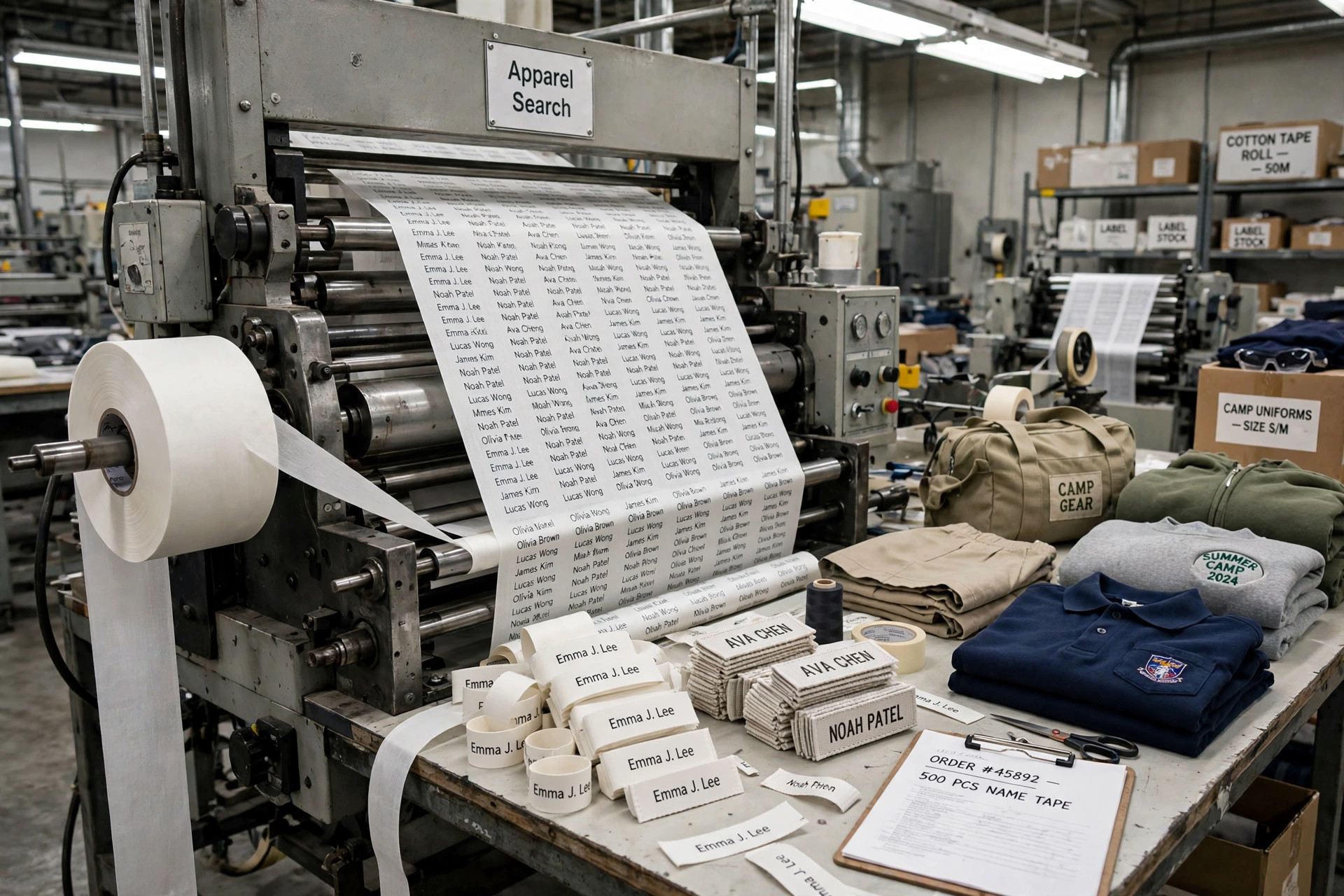
Printed name tapes carry the name in indelible ink on a woven cotton tape. They are economical, quick to produce for a single name, and the standard choice for families and institutions labeling personal clothing: the tape arrives as a continuous roll of repeated imprints, ready to cut apart and sew or iron into each garment. Ink color is typically a choice of black, blue or red, and the print is formulated to stay legible through repeated laundering.
Woven name tapes work the name into the fabric itself on a jacquard-type loom, so the lettering is part of the tape's structure and cannot fade or wash away. Woven tapes cost more and suit longer production runs — uniform suppliers, schools ordering for a whole intake, and garment brands that want a woven name or brand tape sewn into every piece. Choosing between the two is a volume and permanence decision, not a quality verdict on either.
Formats, Widths and Lettering
Printed fabric name tapes are commonly offered in a narrow one-line width and a wider width that takes several lines of text. A typical narrow format is 5/16 inch for a single line, while a wide format of 11/16 inch can carry one, two, three or four lines — enough for a name plus a school, camp or room detail. A single line holds roughly two dozen letters, numerals and spaces, with a short gap of about half an inch between each repeated imprint so the tapes can be cut apart cleanly.
Woven tapes are specified by width, ground color, lettering color and typeface style, and are supplied on rolls for factory application or pre-cut for institutional use. In both printed and woven forms, buyers should proof the exact spelling and spacing of the name before production: a name tape repeats its text hundreds of times, and so does any mistake in it.
Where Name Tapes Are Used
Institutions are the core market. Nursing homes and care facilities label residents' clothing so communal laundry returns each garment to the right person; schools and boarding programs require labeled uniforms and sports kit; summer camps ask parents to name every item a child brings. Parents use the same tapes at home for camp, school and sleepovers — anywhere a child's clothing mixes with a roomful of identical garments.
Garment and uniform manufacturers are the second market. A name tape format gives small makers a cost-efficient way to put brand identification inside a garment without ordering woven brand labels in large quantities, and uniform services use name tapes and emblems to identify both the wearer and the account a garment belongs to through industrial laundering.
Applying Name Tapes: Sew-In and Iron-On
Sew-in tapes are the most durable fixing: a short stitch at each end, or around the folded tape, holds through the life of the garment and through institutional laundry. Iron-on versions carry a heat-activated backing that bonds the tape to the fabric in seconds with a domestic or press iron, which is why they suit parents and camp preparation — but the bond should be checked against the fabric, since very smooth synthetics and heavily textured weaves hold less reliably than plain cotton.
Placement follows the garment: inside the back neck of tops, inside the waistband of bottoms, and on the inside of socks, hats and gloves where a small strip still fits. For institutional orders, agree the fixing method with the laundry that will process the garments, because industrial wash temperatures are the real test of both ink and adhesive.
Name Tape Manufacturers
Suppliers of printed and woven name tapes for personal, institutional and garment use.
Name Maker Inc
Fabric Name Tapes are white cotton material on a continuous roll, available in two widths, 5/16" one line narrow tapes, or 11/16" 1, 2, 3, or 4 line wide tapes, printed with indelible ink. You may select either black, blue, or red ink, with a maximum of 24 letters, numerals and spaces per line. There will be approximately 1/2" between each imprint. No special spacing is available.
Their fabric Name Tapes are used by many institutions such as nursing homes, schools and camps. Parents also use them for labeling clothes for camp, school or even just for a kids sleepover. Garment and various manufacturers have also found their name tapes to be a cost efficient way for brand identification.
References & Further Reading
More Tape Guides
- Bias Binding Tape
- Cotton Tape
- Curing & Wrapping Tape
- Elastic Tapes
- Gripper Tapes
- Hook & Eye Tapes
- Hook & Loop Tapes
- Jacquard Tapes
- Kevlar Tapes
- Knitted Tape
- Leather Suede Tapes
- Multi Color Tape
- Nylon Tapes
- Organza Tape
- Packing Tapes
- Piping Tapes
- Plain Tapes
- Polyester Tapes
- Rayon Tapes
- Reflective Tapes
- Ribbon Tapes
- Rubber Tape
- Satin Tapes
- Seam Tapes
- Teflon Tapes
- TPU Elastic Reverie Tape
- Twill Tape
- Velvet Tapes
- Woven Polyester Tapes
Common Questions
What are name tapes used for?
Name tapes identify the owner of a garment. They are sewn or ironed into clothing for schools, summer camps, nursing homes and uniform services, so shared laundry and lost-property systems can return each item to the right person.
What is the difference between printed and woven name tapes?
Printed name tapes carry the name in indelible ink on cotton tape — economical and ideal for individual names. Woven name tapes weave the lettering into the tape itself, so it cannot fade or wash away; they suit longer runs such as uniforms and brand identification.
How wide are name tapes?
Printed fabric name tapes commonly come in a narrow one-line width of 5/16 inch and a wide 11/16 inch width that takes up to four lines of text, with about 24 characters per line and roughly half an inch between repeated imprints on the roll.