Satin Tape Manufacturers
Glossy satin tapes with woven edges, for straps, binding, trimming and labels.
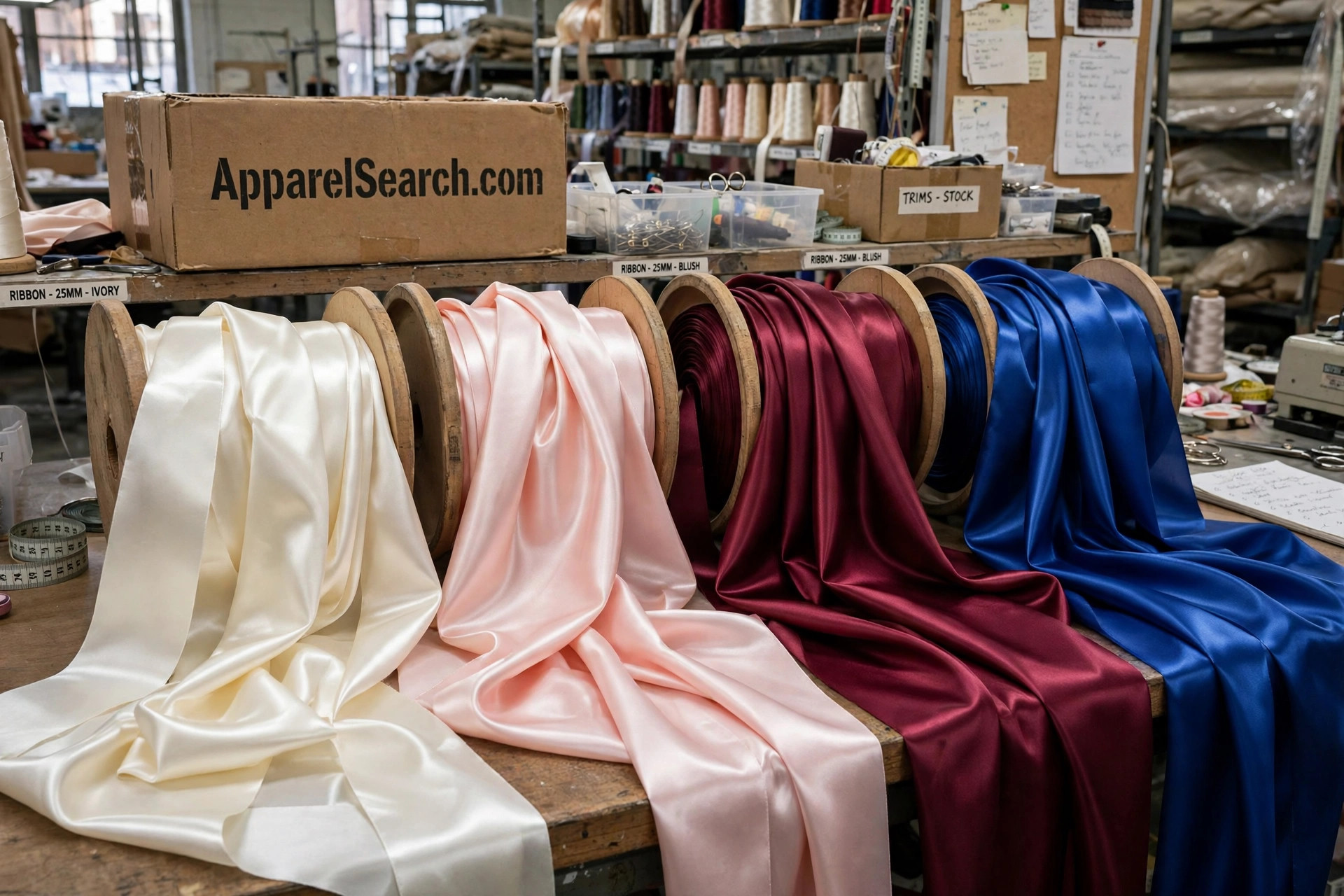
Satin tape is ribbon with a job to do in production. Woven in a satin weave — the face yarns floating across the surface so light runs along them in a continuous sheen — it arrives as a narrow tape with finished woven edges, ready to be sewn as a strap, a binding, a tie or a trim where a garment needs gloss as well as function. Where a matte tape disappears into a garment, satin tape is meant to be seen: it catches light at a neckline, finishes a lingerie edge, and prints cleanly when a brand wants its name on a smooth, lustrous ground.
This page is a guide to satin tapes for clothing factories: the single-sided and double-sided constructions makers offer, how the woven edge and the choice of fiber govern quality, where satin tape is used from lingerie to labels, and what to specify when ordering. The manufacturer listings below include narrow-fabric mills offering satin tapes in their wider tape ranges and a maker specialising in single and double sided satin tapes with woven edges in printable quality. The tape guides at the bottom of the page cover the rest of the tapes family.
Satin & Trim Resources
Single-Face and Double-Face Satin
Single-sided satin tape carries its gloss on one face; the back is matte, which is no drawback where the tape is sewn down flat — as a binding, a printed label tape or an applied trim, only the face ever shows. Double-sided, or double-face, satin is woven so both faces shine, and it is the correct choice wherever the tape moves freely or turns over in wear: straps, ties, bows, drawstrings and hanging loops, where a dull back would look like a mistake every time the tape twisted.
The distinction is a common ordering error because both products are sold simply as satin tape. Buyers should state single or double sided explicitly, and check the sample by turning it over and tying it, not by looking at a flat face. Weight matters alongside construction: a heavier satin holds a strap or a bow with body, while a light satin drapes for soft trims — and the woven edge, specified by one of the makers below as a feature of its satin range, is what keeps both forms clean-edged without folding or binding.
Fiber, Sheen and the Woven Edge
Most production satin tape is polyester, because polyester yarn takes the satin weave crisply, holds deep dyed color, resists abrasion at the edge, and can be heat-cut so ends seal instead of fraying. Silk and rayon satins offer a softer, more liquid luster for bridal, lingerie and heritage work at higher cost and with more delicate handling; acetate satin sits between in price and feel. The sheen itself comes from the float length of the satin weave, which is also the tape's vulnerability: long floats snag and abrade more readily than a plain weave, so tape destined for straps under load or for children's wear should be sampled for snagging and edge wear, not just admired for gloss.
A woven edge — the selvedge formed on the loom — keeps the tape's width true and its edges smooth against skin, which matters in lingerie and next-to-skin uses where a cut edge would scratch. Printed satin depends on the same smooth face: printable-quality satin presents an even, lustrous ground that takes a brand name or care text sharply, which is why satin tape doubles as a label material as well as a trim.
Where Satin Tape Is Used
In garments, satin tape forms lingerie and camisole straps, binds the edges of lingerie, nightwear and baby garments where a soft glossy finish is wanted against skin, trims necklines and hems on dresses and blouses, makes ties, sashes and bows, edges blankets and christening wear, and provides the hanging loops inside garments. As bias-cut satin binding it finishes curved edges with a decorative gloss, linking it to the bias binding family covered in the guides below.
As a branding material, printable satin tape becomes printed labels, ribbon-style brand tapes sewn into side seams, and the printed ribbons used in packaging and presentation. One maker in the listings manufactures satin tapes alongside name tapes, twill tapes, tabular tapes and piping tapes as a complete garment-accessory range — a reminder that satin is usually bought as one line in a trim package, matched in color to the garment's other tapes and trims rather than specified in isolation.
Specifying and Ordering Satin Tape
Specify single or double sided first, then width, fiber, weight, color and its matching standard, edge construction, and put-up. For printed work, state that printable quality is required and approve a printed strike-off on the actual tape: registration, ink adhesion and legibility at production width. For dyed-to-match orders, approve the color under the lighting the garment will be sold in — satin's moving sheen makes it shift appearance with light angle more than matte tapes do, and a match approved flat under one lamp can drift at an angle under another.
Test on the garment: sew straps and bindings into a sample, check that the tape neither slips in the seam nor puckers the shell fabric, snag-test the face, and wash the garment at its care temperature to confirm the sheen, color and edge survive. Confirm minimums per color — dyed satin colors commonly carry higher minimums than stock shades — and confirm whether cut ends will be heat-sealed at the factory or need a folded finish in the garment construction.
Satin Tape Manufacturers
Narrow-fabric manufacturers and trim suppliers offering satin tapes — single sided and double sided, with woven edges — within their tape, ribbon and garment-accessory ranges.
Elastix Australasia Pty Ltd
Head Office is located in Australia and their factory is in China. The company was established in 1948 and currently employs over 3,000 people. They design and produce over 15,000 accessories, with narrow fabrics their primary focus and specialty, including elastics, laces, tapes and webbings. Their products are predominantly produced on Swiss, German and Italian machinery, and they are ISO 9001 Certified.
They sell to manufacturers and distributors worldwide, and a large part of their sales are to the domestic market in Mainland China, where they are based for manufacturing. With Western, European and Chinese management, they seek new distributors in many markets; interested agents or distributors should forward full details, experience and an expression of interest directly to the General Manager, Mr Jeremy Quittner.
Narrow fabrics · TPU Elastic Reverie Tapes · Lanyards · Elastics / Webbings · Cords · Ribbons · Tapes — cotton tape, satin tape, twill tape, velvet tape, gripper tape, polyester tape
Euro
The company manufactures a variety of industrial tapes such as seam tapes and PTFE tapes, which are used for packing, wrapping, and gripping. Ribbons made of cotton, rayon, nylon, polyester, staple fibre, terelene, satin, velvets, zari etc. find wide application in garment industries.
Seam Tapes · Cotton Tapes · Rayon Tapes · Nylon Tapes · Polyester Tapes · Satin Tapes · Velvet Tapes · Gripping Tapes / Gripper
Ningbo XWZ Ribbon Manufacturer
Ningbo XWZ Ribbon Manufactory, established in 1998, is a manufacturer of all kinds of bias tape, silk ribbon, zigzag, curtain tape, Christmas ribbon, UU lace, Samosa lace, elastic tape, satin ribbon, trimming and many kinds of decorative ribbons. They also supply many kinds of threads and other related items. Presently, they employ just over 200 skilled and diligent workers at their factory.
Bias Tape · Velvet Ribbon · Satin Ribbon
Shivam Narrow fabrics
They are the manufacturers of different types of satin tapes — single sided and double sided, (with woven edges) printable quality — name tapes, twill tapes, tabular tapes, piping tapes and all accessories that are used in garments.
Satin Tapes · Leather Labels · Trimming
Address: 34-Q, Laxmi Industrial Estate, New Link Road, Andheri (w), Mumbai-400053 (INDIA) · Tel: 26335010 / 56922244
Super Trim
A United States trim supplier listed for satin tapes and garment production.
Satin Tapes · Trimming
References & Further Reading
More Tape Guides
- Bias Binding Tape
- Cotton Tape
- Curing & Wrapping Tape
- Elastic Tapes
- Gripper Tapes
- Hook & Eye Tapes
- Hook & Loop Tapes
- Jacquard Tapes
- Kevlar Tapes
- Knitted Tape
- Leather Suede Tapes
- Multi Color Tape
- Name Tapes
- Nylon Tapes
- Organza Tape
- Packing Tapes
- Piping Tapes
- Plain Tapes
- Polyester Tapes
- Rayon Tapes
- Reflective Tapes
- Ribbon Tapes
- Rubber Tape
- Seam Tapes
- Teflon Tapes
- TPU Elastic Reverie Tape
- Twill Tape
- Velvet Tapes
- Woven Polyester Tapes
Common Questions
What is the difference between single-sided and double-sided satin tape?
Single-sided satin is glossy on one face and matte on the back — fine for bindings, applied trims and printed label tape that is sewn down flat. Double-sided (double-face) satin shines on both faces and is the right choice for straps, ties, bows and loops that move and turn over in wear.
Why does a woven edge matter on satin tape?
The woven selvedge keeps the tape’s width true and its edges smooth, so the tape needs no folding or binding, lies cleanly in seams, and feels smooth against skin in lingerie and next-to-skin uses where a cut edge would scratch or fray.
Can satin tape be printed with a brand name?
Yes. Printable-quality satin presents a smooth, even, lustrous face that takes names and text sharply, so satin tape is used for printed labels and brand tapes as well as trims. Approve a printed strike-off on the actual tape width before bulk production.