Knitted Tape
Soft knitted narrow tapes for reinforcing knitwear, sportswear and stretch garments.
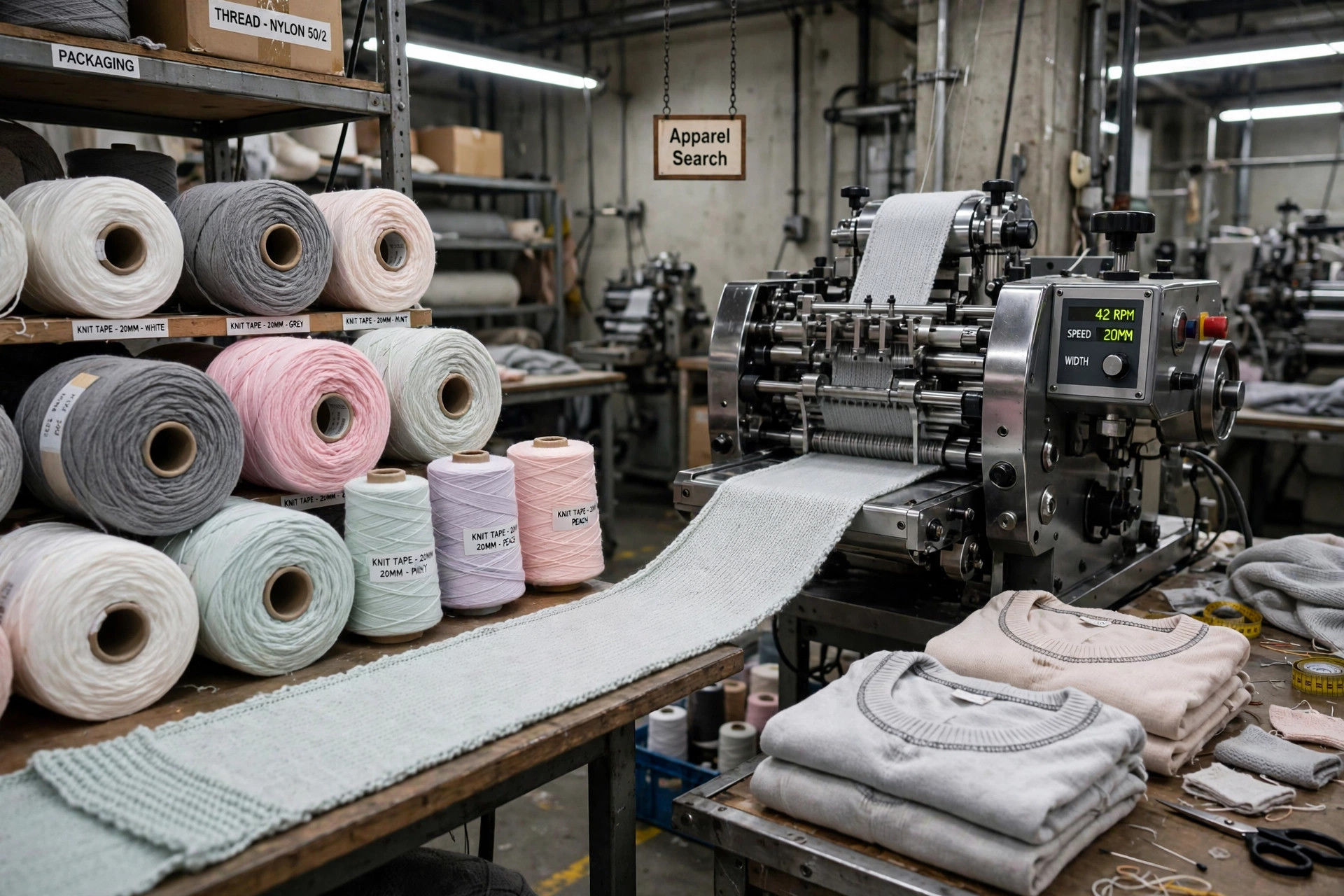
Knitted tape is a narrow fabric made by knitting rather than weaving: instead of warp and weft yarns crossing at right angles, the yarns form interlocking loops, and that loop structure gives the tape its character — soft against the skin, flexible in every direction, and able to stretch and recover along with the garment it is sewn into. It is the tape a factory reaches for when a stiff woven tape would fight the fabric instead of moving with it.
This page is a sourcing guide for knitted tape in garment manufacturing. It explains how the construction behaves, where knitwear and sportswear factories use it to stabilize necklines, shoulders and edges, and what to specify when ordering. The manufacturer listed below produces knitted tape among its narrow fabric range.
Knitted Tape & Narrow Fabric Resources
Knitted Construction, and How It Differs From Woven Tape
A woven tape is stable because its warp yarns are held in a grid by the weft; a knitted tape is stable in a different way. The looped structure lets the tape extend and recover, curve around a neckline without puckering, and fold over an edge without the hard crease a woven tape makes. Knitted tapes are commonly produced on warp-knitting and crochet-type narrow fabric machines, in cotton, polyester, nylon and blended yarns, sometimes with an elastic component where active stretch is required.
The trade-off is edge behavior and firmness. A knitted tape will not match a firm woven tape for crisp, non-stretch reinforcement, and cut edges need to be enclosed in a seam or finished so the loops do not run. Choosing between knitted and woven tape is therefore a garment-engineering decision: match the tape's give to the fabric's give, and the seam will keep its shape through wear and washing instead of twisting or rippling.
Where Knitted Tape Is Used in Garments
The classic use is stabilizing knit garments. A strip of knitted tape sewn into a shoulder seam stops the seam stretching out of shape under the garment's own weight. Applied inside a neckline, collar or armhole, it keeps the edge at its patterned length while still letting the garment pull on over the head. The same tape reinforces plackets, pocket openings and side vents in T-shirts, polo shirts, sweatshirts and other jersey garments.
Sportswear and underwear use knitted tape for the same reasons plus comfort: it sits flat and soft at edges that touch skin, binds hems and edges without a hard ridge, and moves with stretch fabrics instead of restricting them. It also serves as a soft casing and edging tape in children's clothing and nightwear, where a rough woven edge would be a quality complaint waiting to happen.
Applying Knitted Tape in the Factory
Knitted tape is usually sewn in during seam construction rather than added afterward: fed into the shoulder or neckline seam as the seam is closed, or applied with a folder attachment when it is used as binding. Because the tape itself has give, machinists control its tension carefully — a tape applied under too much stretch will gather the garment, and one applied too loosely does no stabilizing work at all.
Buyers should match fiber to garment: cotton knitted tape for cotton jersey, synthetic knitted tape where the garment is polyester or nylon and needs matching wash and dye behavior. Where the tape will be visible, as in binding, color matching and a sample sew-out on the actual garment fabric are worth insisting on before bulk production.
Specifying and Buying Knitted Tape
Specify width, fiber, color and the amount of stretch the tape should have — a nearly stable stabilizing tape and an elastic knitted tape are different products that happen to share a construction. State the application (shoulder stabilization, neckline, binding, casing) so the supplier can recommend the right weight, and ask whether the tape is supplied on rolls suited to your machines' feed and folder attachments.
As with any narrow fabric, confirm shrinkage behavior and colorfastness against your garment's wash standard, and test-sew before committing. The manufacturer listed below produces knitted tape within a broader narrow fabrics range that also includes cotton tape, elastic tape, jacquard tape and multi color tape.
Knitted Tape Manufacturers
Producers of knitted tape and related narrow fabrics for garment factories.
Shivam Narrow fabrics
Located in India, Shivam Narrow fabrics is an upcoming company that prides itself on producing superior products with faultless deliveries. They have made a distinctive mark for themselves by producing export quality products that are at par with international standards.
More Tape Guides
- Bias Binding Tape
- Cotton Tape
- Curing & Wrapping Tape
- Elastic Tapes
- Gripper Tapes
- Hook & Eye Tapes
- Hook & Loop Tapes
- Jacquard Tapes
- Kevlar Tapes
- Leather Suede Tapes
- Multi Color Tape
- Name Tapes
- Nylon Tapes
- Organza Tape
- Packing Tapes
- Piping Tapes
- Plain Tapes
- Polyester Tapes
- Rayon Tapes
- Reflective Tapes
- Ribbon Tapes
- Rubber Tape
- Satin Tapes
- Seam Tapes
- Teflon Tapes
- TPU Elastic Reverie Tape
- Twill Tape
- Velvet Tapes
- Woven Polyester Tapes
Common Questions
What is knitted tape used for in clothing?
Knitted tape stabilizes and finishes knit garments: it is sewn into shoulder seams and necklines to stop them stretching out of shape, reinforces plackets and pocket openings, and binds edges in sportswear, underwear and childrenswear where a soft, flexible tape is needed.
What is the difference between knitted tape and woven tape?
Woven tape is made of warp and weft yarns in a grid, so it is firm and stable with very little stretch. Knitted tape is made of interlocking loops, so it is softer, curves easily around necklines and stretches and recovers with knit fabrics.
Does knitted tape stretch?
It has natural give from its looped construction, and some knitted tapes are made with an elastic component for active stretch. A stabilizing knitted tape is made to have only limited give, so the stretch required should always be stated when ordering.