Piping Tape Manufacturers
Corded tape sewn into a seam so the edge stands out in a clean, raised line.
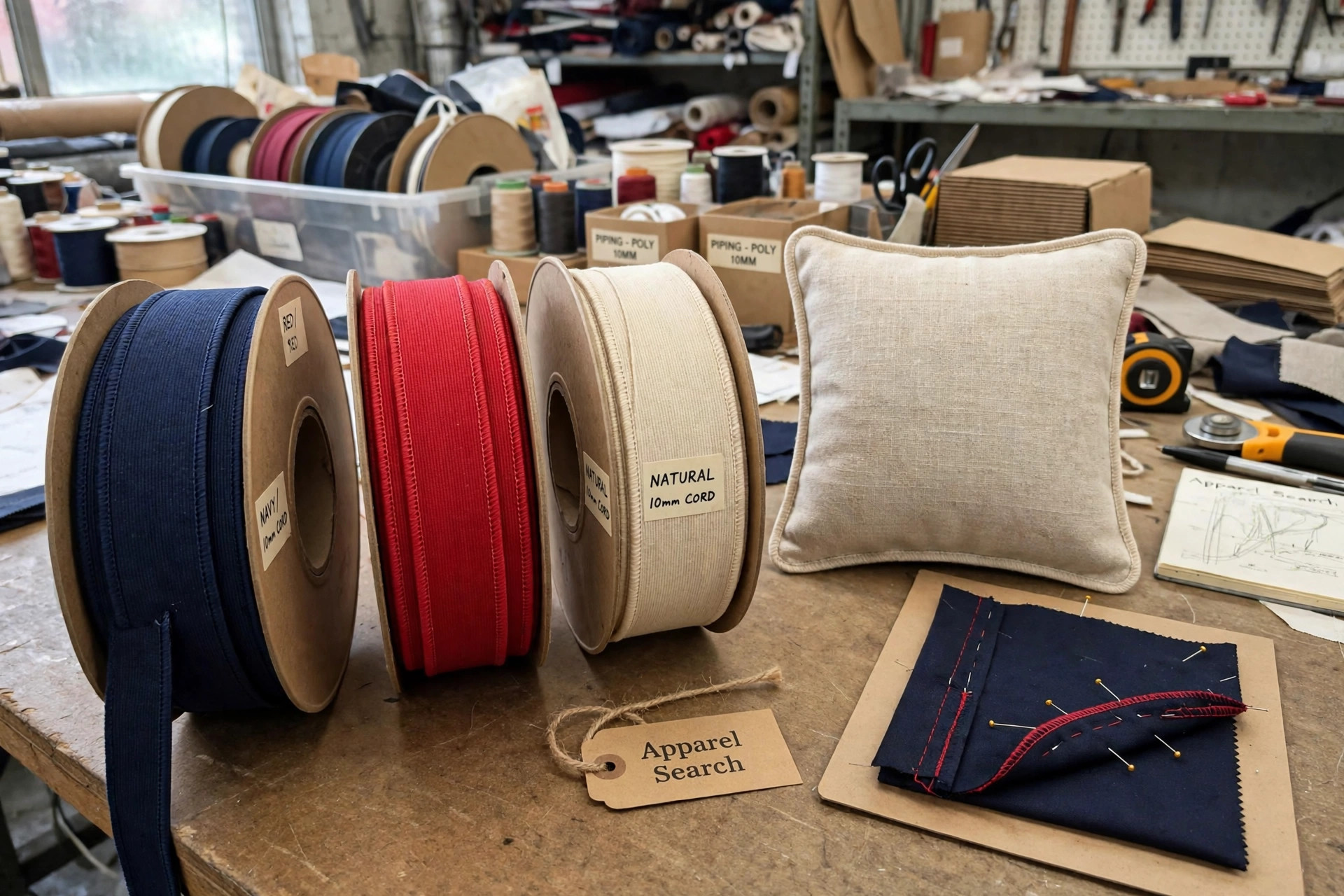
Piping tape is a narrow tape built around a cord: a soft filler cord is enclosed in a strip of fabric, and the fabric extends to one side as a flat flange, or tape, that is placed in a seam and stitched through. When the seam is closed and turned, only the corded part shows — a smooth, raised bead running exactly along the seam line. That bead is the point of piping: it outlines a collar, a cuff, a pocket, a cushion or a bag panel with a deliberate line, reinforces the edge it follows, and can carry a contrasting color around a garment without any visible stitching on the outside.
This page explains piping tapes for garment and product manufacturers: how the cord-and-flange construction works, ready-made tape versus piping a factory makes in-house, the fibers and cord sizes in trade use, and how to specify an order. The listing below is a tape manufacturer whose range includes seam and piping work for outerwear, and the guides at the bottom of the page cover the rest of the tapes family.
Tape & Trim Resources
Cord and Flange: How Piping Tape Is Built
Every piping tape has two working parts. The cord — cotton, polyester or a soft synthetic filler — sets the diameter and roundness of the finished bead, and the covering fabric, wrapped around the cord, sets its color, texture and behaviour in the seam. Beside the cord the cover extends into a flat flange wide enough to be caught securely in the seam allowance. The flange is the tape part of the product: it is what the sewing operator handles, positions and stitches, usually with a piping or zipper foot that rides against the cord.
Because the flange goes inside the seam, its fabric can be lighter than the cover that shows, and on bias-cut piping the cover is cut diagonally so the bead can travel around curves — armholes, necklines, rounded cushion corners — without puckering. Straight-grain piping is cheaper and is fine for straight seams, but a specification that will run around a curve should state bias construction explicitly, since the two products look alike on a roll and behave very differently on a collar.
Ready-Made Tape or Made In-House?
Large factories often buy ready-made piping tape for standard work: stock colors, common cord sizes, consistent quality, and no cutting-room time spent making it. Fashion work in a self fabric — piping that must match the garment exactly — is usually made in-house from the shell fabric and bought-in cord, or ordered dyed-to-match where a maker offers that service. The buying decision turns on color: where a contrast or stock color serves, ready-made tape is almost always the economical route; where the piping must disappear into, or precisely match, a fashion fabric, it must be made from that fabric.
Ready-made ranges cover the repeat work of several industries at once: tailored jackets and waistcoats, shirts and blouses, children's wear, uniforms, and the soft-furnishings work — cushions, throws and upholstery — that uses the same construction at larger cord sizes. A garment buyer can therefore draw on a deep stock range, but should confirm the cord size and flange width suit garment-weight fabrics, since furnishing piping is built heavier than a blouse seam wants.
Fibers, Cord Sizes and Colors
Cover fabrics follow the garment: cotton and polycotton for everyday clothing, polyester for uniforms and workwear that are washed hard, satin and silk-look covers for evening and bridal piping, and leather- and suede-look piping for jackets and bags. Cord diameter is the sizing language of the trade — fine cords for shirt and blouse detail, medium cords for jackets, collars and cushions, heavy cords for upholstery and luggage — and the finished look depends as much on cord firmness as on size: a soft cord gives a gentle roll, a firm cord a sharp, tailored bead.
Color strategy is part of the design: self-color piping gives tailored structure without contrast, a contrast color turns the piping into the garment's graphic outline, and a metallic or printed cover makes it a feature trim. For contrast work the flange and cord must not shadow through light shell fabrics, so sample the piping sewn into the actual fabric, pressed and held to the light, before committing a bulk order.
Specifying and Ordering Piping Tape
Specify the cord diameter and firmness, the cover fabric and color, bias or straight-grain construction, the flange width, and the put-up the sewing line expects. State the seam it will sit in and the fabric weight it must travel with — a maker who knows the bead must round a collar on a soft jacket will not quote the same construction as one supplying straight cushion seams. Ask how the cover is joined along a roll, since a stiff join inside a curved seam shows as a kink in the bead.
Approve piping in a sewn sample, never on the roll: stitch it into a curved test seam in the real fabric, turn and press it, and check that the bead is even, the flange stitches do not grin through, and the cord does not twist. Wash or clean the sample with the garment's care method — a cover and a cord that shrink at different rates will pucker a piped seam after its first clean, however perfect it looked on the table.
Piping Tape Manufacturers
Tape manufacturers supplying piping and seam tapes to clothing and outerwear manufacturers.
Bemis
Seam tape (heat sealing tape) is a thermoplastic adhesive film applied to sewn seams of fabrics to prevent water from leaking through the seams. It can be applied by using any of the commercially available hot air taping machines, laser or ultrasonic machinery.
Their in-house printing capability allows you to customize the tape to suit your needs. You can match an existing pattern on a fabric, enhance branding with color logos or taglines, or simply be creative with a unique design. Seam tape has always been the critical link in the chain of waterproof protection, with customized printing it now plays an important role in the aesthetic evolution of outerwear.
Seam Tapes · Heat Sealing Tape
More Tape Guides
- Bias Binding Tape
- Cotton Tape
- Curing & Wrapping Tape
- Elastic Tapes
- Gripper Tapes
- Hook & Eye Tapes
- Hook & Loop Tapes
- Jacquard Tapes
- Kevlar Tapes
- Knitted Tape
- Leather Suede Tapes
- Multi Color Tape
- Name Tapes
- Nylon Tapes
- Organza Tape
- Packing Tapes
- Plain Tapes
- Polyester Tapes
- Rayon Tapes
- Reflective Tapes
- Ribbon Tapes
- Rubber Tape
- Satin Tapes
- Seam Tapes
- Teflon Tapes
- TPU Elastic Reverie Tape
- Twill Tape
- Velvet Tapes
- Woven Polyester Tapes
Common Questions
What is piping tape?
A tape built around a filler cord: the cord is enclosed in fabric, and the fabric extends into a flat flange that is stitched into a seam. Turned out, only the corded bead shows, outlining the seam with a raised, rounded line.
Why is some piping cut on the bias?
Bias-cut cover fabric stretches and eases, so the piped bead can travel smoothly around curves such as necklines, armholes and rounded cushion corners. Straight-grain piping suits straight seams but puckers when forced around a curve.
What should a buyer specify when ordering piping tape?
Cord diameter and firmness, cover fabric and color, bias or straight-grain construction, flange width, and the garment fabric and seam it will be sewn into — then approve it in a sewn, pressed and washed curved seam sample.