Twill Tape Manufacturers
Diagonal-weave tape for ties, drawstrings, binding and seam reinforcement.
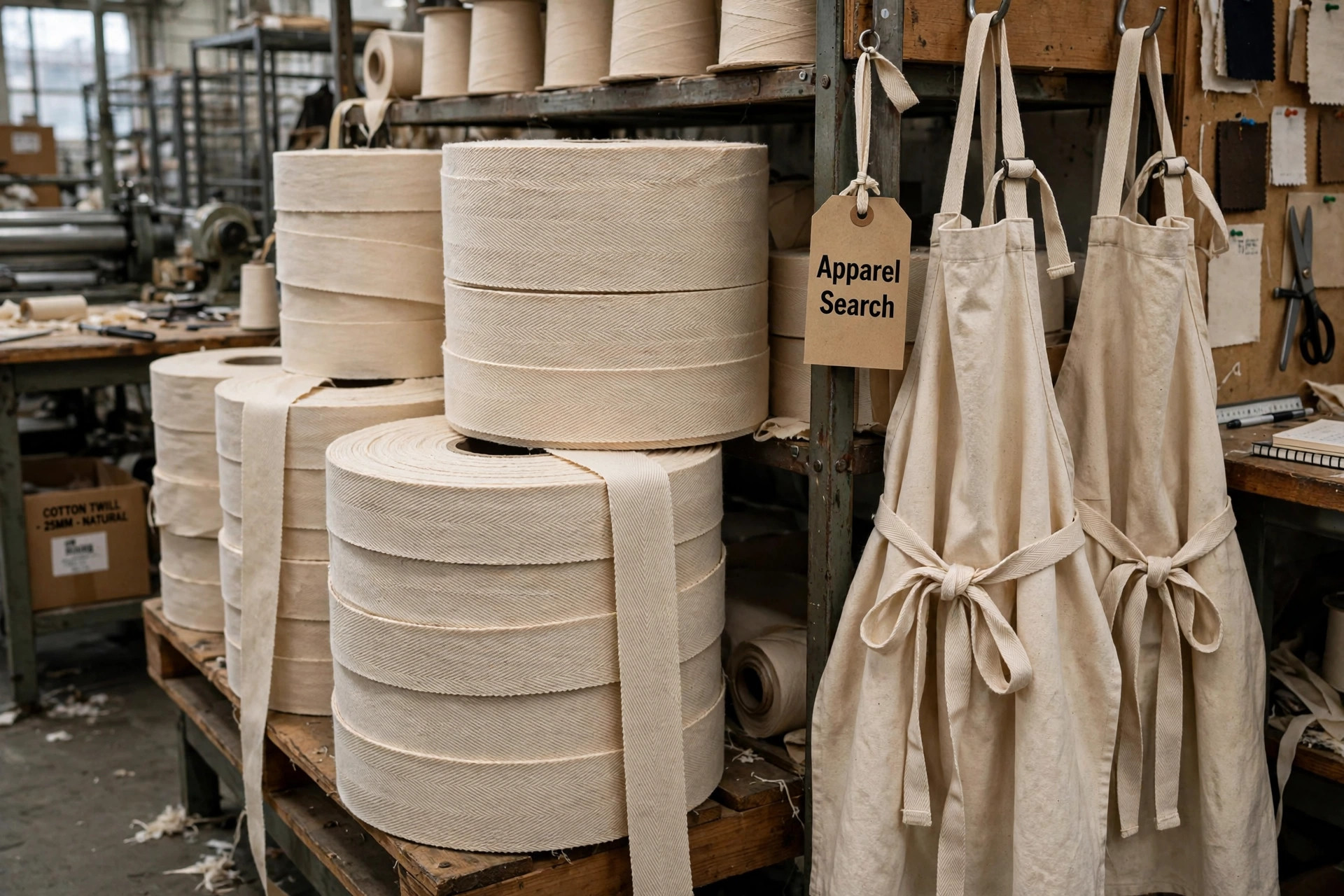
Twill tape is woven with a diagonal twill line running along its length, and that small change of weave makes it the workhorse of the garment tapes family. The diagonal structure drapes better, knots better and eases along seams and curves more willingly than a plain-weave tape of the same fiber, while staying firm, sewable and hard-wearing. In its herringbone form — the diagonal reversing regularly to form a broken zigzag — it is the familiar tape of apron ties, bunting and stay tape, recognised at a glance in cutting rooms everywhere.
This page is a directory and guide to twill tape for garment manufacturers: how the weave behaves, where factories use it inside and outside garments, the fibers it is woven from, and how to specify it. The listings below include an Indian maker of garment tapes and ribbons, a Los Angeles label and trim supplier offering cotton twill, a large narrow-fabrics maker, and a fifth-generation American mill that has woven tape and binding in Philadelphia since 1910.
Tape & Trim Resources
The Diagonal Weave, Including Herringbone
In a twill weave the weft yarn passes over and under the warp in a stepped pattern, producing the visible diagonal rib that gives twill tape its name. That structure is slightly more supple than plain weave: the tape bends along its length, follows a curve without buckling, and forms a knot that sits flatter and holds. Herringbone twill reverses the diagonal direction at regular intervals, creating the chevron pattern most buyers picture as classic twill tape; the reversal also balances the tape, discouraging the twist a one-way diagonal can develop.
Weave weight separates the family into working grades. Light twill tapes bind edges, stay seams and form casings. Medium tapes become ties, drawstrings and straps that hands pull daily. Heavy twill webbings carry loads as apron neck straps, bag handles and belts. When a specification says only twill tape, the first conversation with a maker is about which grade the job needs — the weave name alone does not fix thickness, strength or hand.
Where Twill Tape Works in Garments
Visible uses lead: apron ties and neck straps, drawstrings for hoods and waists, wrap-garment ties, hanging loops, and the straps and handles of bags and accessories. Cotton twill is the standard choice where the tie meets skin and a knot must hold through a working day and a hot wash. Inside garments the tape works unseen as a stay: it stabilises shoulder seams so knits do not grow, reinforces armholes, backs plackets and pocket corners, and forms the armhole and shoulder reinforcement tape that tailoring suppliers sell in fine widths for shirt and blouse production.
Twill tape also binds and finishes: it edges blankets, quilts and workwear, cases boning and elastic, and trims uniforms and sportswear as a flat decorative stripe. Printed twill tapes carry logos and text along the diagonal ground, and reflective versions serve safety garments — both offered by mills in the listings below, which is why twill tape orders often combine plain production tape and a printed or reflective line in one purchase.
Cotton, Polyester and Blended Twill Tapes
Cotton twill tape is the traditional form: soft, matte, easy to sew and press, comfortable as a tie, and ready to dye with the garment or accept print. It is the right choice for natural-fiber garments, chef wear, aprons and workwear that face hot laundering. Polyester twill tape trades some of that softness for strength, abrasion resistance, colorfastness and indifference to moisture and mildew, suiting uniforms, outdoor clothing and industrial workwear. Polycotton blends sit between the two on both price and behaviour.
Fiber choice should follow the garment, not habit. A tape that will be piece-dyed with a cotton garment must be cotton or dye-compatible; a tape on a garment laundered industrially must survive the same chemistry and temperature as the shell; a tape carrying load outdoors should not be a fiber that weakens when wet and stored damp. Makers in this category typically weave several fibers on the same looms, so the weave and width can stay fixed while the fiber is matched to the end use.
Specifying and Ordering Twill Tape
Specify the fiber, the weave grade or weight, the width, the color — natural ecru, bleached white, stock colors or dyed to match — any finish such as pre-shrinking, and the put-up. Name the end use plainly: a mill told the tape will stay a shoulder seam quotes a different construction from one told it will tie aprons, and reinforcement tapes are sold in the fine widths shirt factories use, down to a few millimetres. For printed twill, supply the artwork and confirm repeat length and ink durability through laundering.
Approve the tape in the garment: sew it into the seam it will stay, tie and untie it if it will be tied, and launder the made-up garment at its care temperature to check shrinkage against the shell, knot security, edge behaviour and color bleed. Twill tape is inexpensive per metre and expensive per remake — a width or weight mistake discovered at bulk production costs a garment run, so the sample approval is the cheapest step of the order.
Twill Tape Manufacturers
Garment tape, label and narrow-fabric manufacturers offering twill tapes within their tape and trimming ranges.
Century Distribution
Garment Tapes / fabrics, Tapes / Ribbon Tapes. The company manufactures a variety of industrial tapes such as Seam tapes, PTFE tapes which are used for packing, wrapping, and gripping. Ribbons made of cotton, rayon, nylon, polyester, staple fibre, terelene, satin, velvets, zari etc. find wide application in garment industries. They are leading manufacturers of garment tapes from India.
Euro PTFE coated fibre glass fabrics, tapes and conveyor belts are used in various garment and packaging industries for fusing, steam pressing and sealing machines. Euro Hotmelt seam tapes are used for sealing the stitch and seams for rainwear, sportswear, tents, marine suits and PVC/PU waterproof cloth by heat press. Euro Ribbon tapes, woven and non woven, are available in cotton, rayon, nylon, polyester, staple fibre, terelene, satin, velvets and zari in different colors for garment industries. Euro double sided tissue and cotton tapes are widely used in leather garment and shoe industries.
Garment Tapes · Ribbon Tapes · Seam Tapes · PTFE Tapes
Cruz Label
At Cruz, they believe that their great customer service, fast turnaround, and competitive pricing makes them stand out from the rest of the label pack. They do thorough quality control in-house to ensure the colors and quality of your labels or hang tags are perfect. They love working with start up companies and helping them brand their new clothing venture, but they also will work expediently getting larger volumes done for bigger companies.
They supply eco-friendly labels and hangtags and many other promotional items.
Woven Garment Labels / Printed Labels · Hangtags · PVC Badges / Silicone Badges · Cotton Twill · Zipper Pulls · Trimming
Address: 3250 Wilshire Blvd, Ste 1910, Los Angeles, CA 90010 · Phone: 213-389-7658 · Fax: 213-232-3318 · Email: inquiry@cruzlabel.com · Contact: Sales department
Elastix Australasia Pty Ltd
Head Office is located in Australia and their factory is in China. The company was established in 1948 and currently employs over 3,000 people. They design and produce over 15,000 accessories, with narrow fabrics their primary focus and specialty, including elastics, laces, tapes and webbings. Their products are predominantly produced on Swiss, German and Italian machinery, and they are ISO 9001 Certified.
They sell to manufacturers and distributors worldwide, and a large part of their sales are to the domestic market in Mainland China, where they are based for manufacturing. With Western, European and Chinese management, they seek new distributors in many markets; interested agents or distributors should forward full details, experience and an expression of interest directly to the General Manager, Mr Jeremy Quittner.
Narrow fabrics · TPU Elastic Reverie Tapes · Lanyards · Elastics / Webbings · Cords · Ribbons · Tapes — cotton tape, satin tape, twill tape, velvet tape, gripper tape, polyester tape
Wayne Mills
Wayne Mills Co. Inc. is a family owned and operated textile mill in our fifth generation. We have been weaving tape, binding, and light webbing at our Philadelphia factory since 1910. Armhole and shoulder reinforcement tape is available in 3/16 inch, 1/4 inch, 3/8 inch, 1/2 inch, and 5/8 inch widths. They also provide printed tapes and reflective tapes.
Twill Tape · Reflective Tape
More Industry Resources
More Tape Guides
- Bias Binding Tape
- Cotton Tape
- Curing & Wrapping Tape
- Elastic Tapes
- Gripper Tapes
- Hook & Eye Tapes
- Hook & Loop Tapes
- Jacquard Tapes
- Kevlar Tapes
- Knitted Tape
- Leather Suede Tapes
- Multi Color Tape
- Name Tapes
- Nylon Tapes
- Organza Tape
- Packing Tapes
- Piping Tapes
- Plain Tapes
- Polyester Tapes
- Rayon Tapes
- Reflective Tapes
- Ribbon Tapes
- Rubber Tape
- Satin Tapes
- Seam Tapes
- Teflon Tapes
- TPU Elastic Reverie Tape
- Velvet Tapes
- Woven Polyester Tapes
Common Questions
What is twill tape?
A woven tape with a diagonal twill rib — often in a herringbone pattern where the diagonal regularly reverses. The twill weave makes the tape more supple than plain-weave tape, so it drapes, knots and eases along seams better while staying firm and sewable.
What is twill tape used for?
Apron ties and neck straps, drawstrings, wrap-garment ties, binding and casings, and inside garments as stay tape stabilising shoulder seams, armholes, plackets and pocket corners. Heavier grades serve as straps and light webbing.
Should twill tape be cotton or polyester?
Cotton is soft, matte and comfortable for ties and natural-fiber garments and tolerates hot washing. Polyester is stronger and more abrasion- and moisture-resistant for uniforms, outdoor and industrial garments. Match the fiber to the garment care and end use, and wash-test tape and shell together.