Hook & Eye Tape Manufacturers
Hooks and eyes pre-set on tape, ready to sew as a complete garment closure.
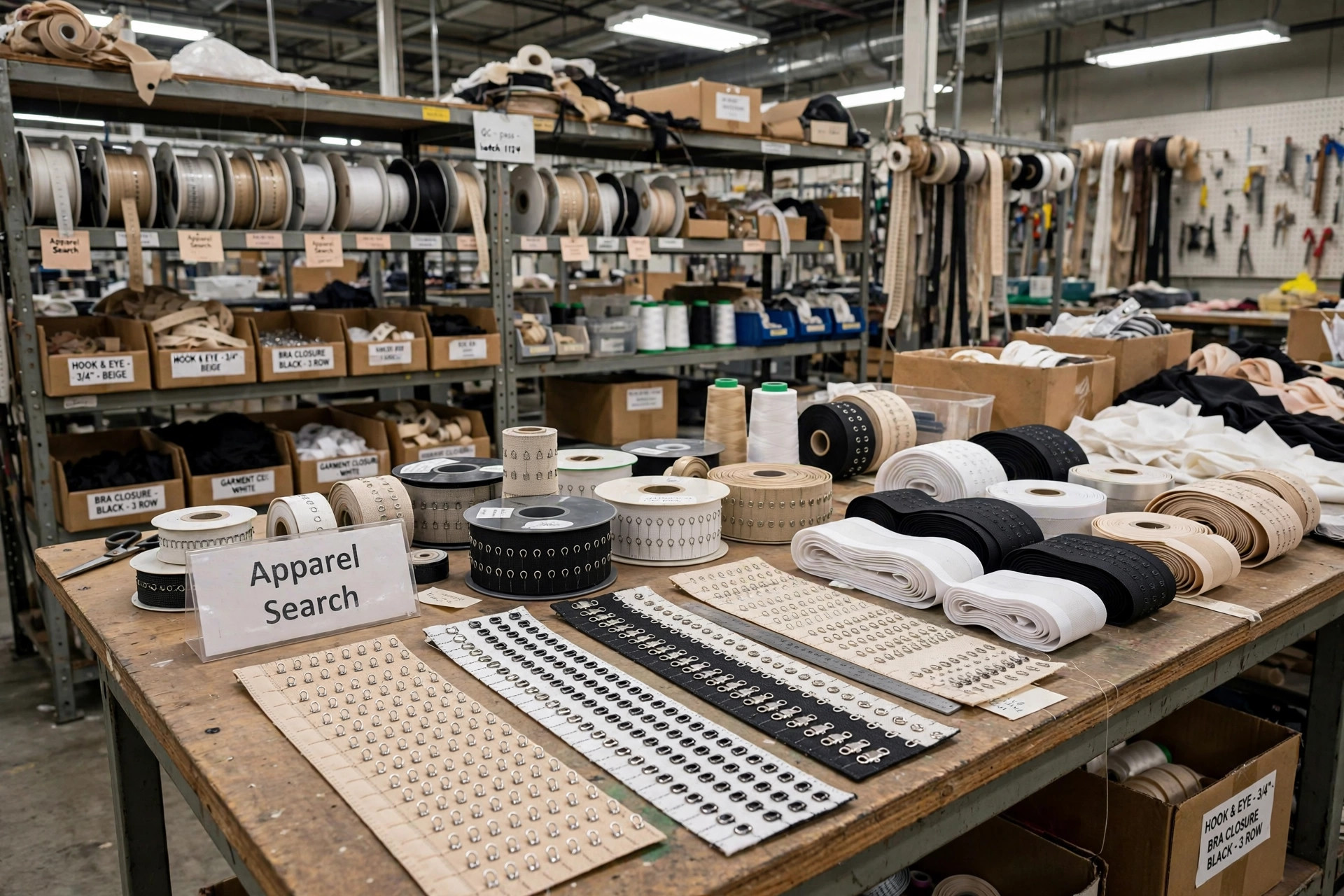
Hook and eye tape turns one of the slowest hand operations in a sewing room — setting individual hooks and eyes one garment at a time — into a single sewn seam. The metal hooks and their matching eyes are fastened at regular, pre-set spacings onto two continuous tapes, one carrying the hooks and one carrying the eyes. The factory cuts the length it needs, sews each tape into its garment edge, and the wearer closes the garment by engaging any hook with its eye. The closure is adjustable where several columns of eyes are provided, flat against the body, and strong in the direction closures are actually loaded.
The tape is the standard production closure for brassieres, and it serves intimate apparel, sportswear, medical garments and children's wear wherever a flat, adjustable, repeatedly opened closure is needed. This page explains the constructions a buyer will be offered — spacing, columns, tape bases and finishes — and how to specify them. The listings below include a specialist hook and eye tape manufacturer and a maker of hook and eye findings, and the guides at the bottom of the page cover the rest of the tapes family.
Tape & Trim Resources
Why Closures Are Bought on Tape
A loose hook and eye is a finding; a hook and eye tape is a production system. Setting loose findings demands marking, positioning and fastening every piece, with spacing accuracy left to each operator. On tape, the maker has already done the positioning: hooks and eyes arrive evenly spaced, aligned and permanently attached to a sewable base, so garment quality stops depending on hand placement and the sewing line gains a fast, inspectable operation — one seam per side, with the closure complete.
The tape form also changes the closure's strength and comfort. Load is spread along the sewn tape rather than concentrated at individually stitched points, the tape base cushions the metal against the wearer's skin, and the closure lies flatter than a row of hand-set findings. For garments opened and closed daily — a bra, a medical binder, a child's garment — that combination of speed in production and durability in use is why tape is the default industrial form.
Spacing, Columns and Adjustability
Two measurements define a hook and eye tape for ordering: the spacing between successive hooks along the tape, which decides how fine the length graduation of the closure is, and the number of eye columns across the tape, which decides adjustability. A brassiere tape classically offers several columns of eyes so the wearer can tighten the band as elastic relaxes with age; a single-column tape simply closes. Hook size follows the garment's load: fine hooks for lingerie, heavier hooks for support garments, medical wear and anything that closes under tension.
The hook and eye tapes themselves are supplied as a matched pair, and the pair must be ordered and kept together: hook spacing and eye spacing are made to correspond, and mixing tapes from different makers or lots can produce closures that engage unevenly. Buyers should also settle how the closure finishes — whether the tape is cut between settings for individual garments, and whether cut ends are sealed, folded or bound in the garment construction so no raw tape edge or metal end touches skin.
Tape Bases, Metals and Comfort
The base tape is usually a soft woven or brushed fabric chosen to sit against skin: smooth and low-profile for lingerie, softer and more cushioned for medical garments worn for long periods, and firmer where the tape must carry a structured closure. Color is normally matched to the garment families the tape serves — white, black and skin tones cover most intimate apparel — with dyed-to-match production available for fashion colors. The metal findings themselves are finished against corrosion and laundering; for garments with metal-sensitive wearers or medical requirements, covered and non-metal alternatives should be raised with the maker at specification stage.
Comfort is engineered at the edges as much as at the closure. Better tapes keep hooks and eyes slightly recessed or covered by the tape's folded construction so metal does not bear directly on the body, and the sewing margins are placed so stitching does not ride over the findings. When sampling, close the tape on the body or on a form, not just in the hand: a closure that feels fine flat can dig or gap on a curve.
Specifying Hook & Eye Tape
A complete specification names the garment and its closure length, the hook size, the spacing, the number of eye columns, the tape base and color, and whether the tape is needed as continuous lengths or cut pieces. State the laundering the closure must survive and any skin-contact or metal-content requirements for the market the garment is sold into. Because the closure is a matched system, approve the hook tape and eye tape together, sewn into a sample garment and closed at every column.
On the production floor, check engagement along the whole closure, not at one point: every hook should meet its eye without forcing, the closed edges should meet without gaping or overlap, and repeated opening should not loosen findings from the tape. Confirm roll put-up and how the tape feeds and cuts, since a tape that frays at the cut will cost the factory a finishing operation the quotation may not have allowed for.
Hook & Eye Tape Manufacturers
Manufacturers of hook and eye tapes, snap tapes and hook and eye findings for the apparel industry.
Remarkable Rhinestone
Remarkable Rhinestone is a premier manufacturer of rhinestone products for the apparel markets. They manufacture buckles, buttons, hook & eyes and ornaments in all types of rhinestone crystals. They also manufacture a full-line of fabric covered buttons for the domestic and Canadian markets.
They have a rhinestone factory in China to ship direct to your overseas factories and a factory in NY to ship domestically and Canada. They have a large collection of open styles and are happy to make samples, and are willing to develop custom designed rhinestone items based on your designs.
Rhinestone Manufacturer · Buckle Manufacturer · Hook & Eye Tape Manufacturer · Fabric Covered Buttons Manufacturer · Trimming Manufacturer
Address: 242 West 36th Street-#1011 New York, NY 10018 · Phone: 212 810-4050 · Fax: 646 289-3987
Yale Hook & Eye Co., Inc.
Manufacturer of hook & eye tapes and snap tapes for the brassiere, intimate apparel, sportswear, medical garment, and children's wear industries. Manufacturing facilities located in Newark, NJ. Established in 1914.
Hook & Eye Tapes · Brassiere Components · Trimming
Address: 380 Jelliff Ave. Newark, NJ 07108 USA · Phone: 973-824-1440 · Fax: 973-824-3136 · Toll free: 800-562-9459
More Tape Guides
- Bias Binding Tape
- Cotton Tape
- Curing & Wrapping Tape
- Elastic Tapes
- Gripper Tapes
- Hook & Loop Tapes
- Jacquard Tapes
- Kevlar Tapes
- Knitted Tape
- Leather Suede Tapes
- Multi Color Tape
- Name Tapes
- Nylon Tapes
- Organza Tape
- Packing Tapes
- Piping Tapes
- Plain Tapes
- Polyester Tapes
- Rayon Tapes
- Reflective Tapes
- Ribbon Tapes
- Rubber Tape
- Satin Tapes
- Seam Tapes
- Teflon Tapes
- TPU Elastic Reverie Tape
- Twill Tape
- Velvet Tapes
- Woven Polyester Tapes
Common Questions
What is hook and eye tape?
A production closure material: metal hooks are fastened at regular spacings along one continuous tape and matching eyes along another. A factory cuts the length needed and sews each tape into a garment edge, producing a flat, strong, adjustable closure without setting individual findings by hand.
Why do bra tapes have several columns of eyes?
The extra columns make the closure adjustable. The wearer starts on a looser column and moves to tighter columns as the band elastic relaxes with wear and washing, extending the useful life and fit of the garment.
What should be specified when ordering hook & eye tape?
Hook size, the spacing between settings, the number of eye columns, tape base material and color, closure length or continuous put-up, and the laundering and skin-contact requirements. The hook and eye tapes are a matched pair and should be approved together in a sample garment.