Seam Tape Manufacturers
Heat-sealed and fusible tapes that waterproof, reinforce and finish garment seams.
A waterproof fabric with stitched seams is not yet a waterproof garment. Every needle hole in every seam is a leak path, and seam tape is the material that closes them: a thermoplastic adhesive film applied over the sewn seam so water cannot pass through the stitching. Heat-sealing tape has always been the critical link in the chain of waterproof protection — the shell fabric gets the attention, but the taped seam is what decides whether a rain jacket actually keeps its wearer dry in sustained rain.
This page is a guide to seam tapes for garment manufacturers: how heat-sealing tape works and is applied by hot-air, laser and ultrasonic machinery, the difference between waterproof seam sealing and the fusible tapes that reinforce and stabilise seams, how printed seam tape has become part of outerwear design, and what to specify when ordering. The manufacturer listings below include a specialist in thermoplastic seam tape with in-house printing, and an industrial tape maker offering seam tapes within a wider range. The guides at the bottom of the page cover the rest of the tapes family.
Seam & Tape Resources
Heat-Sealing Tape: Waterproofing the Stitched Seam
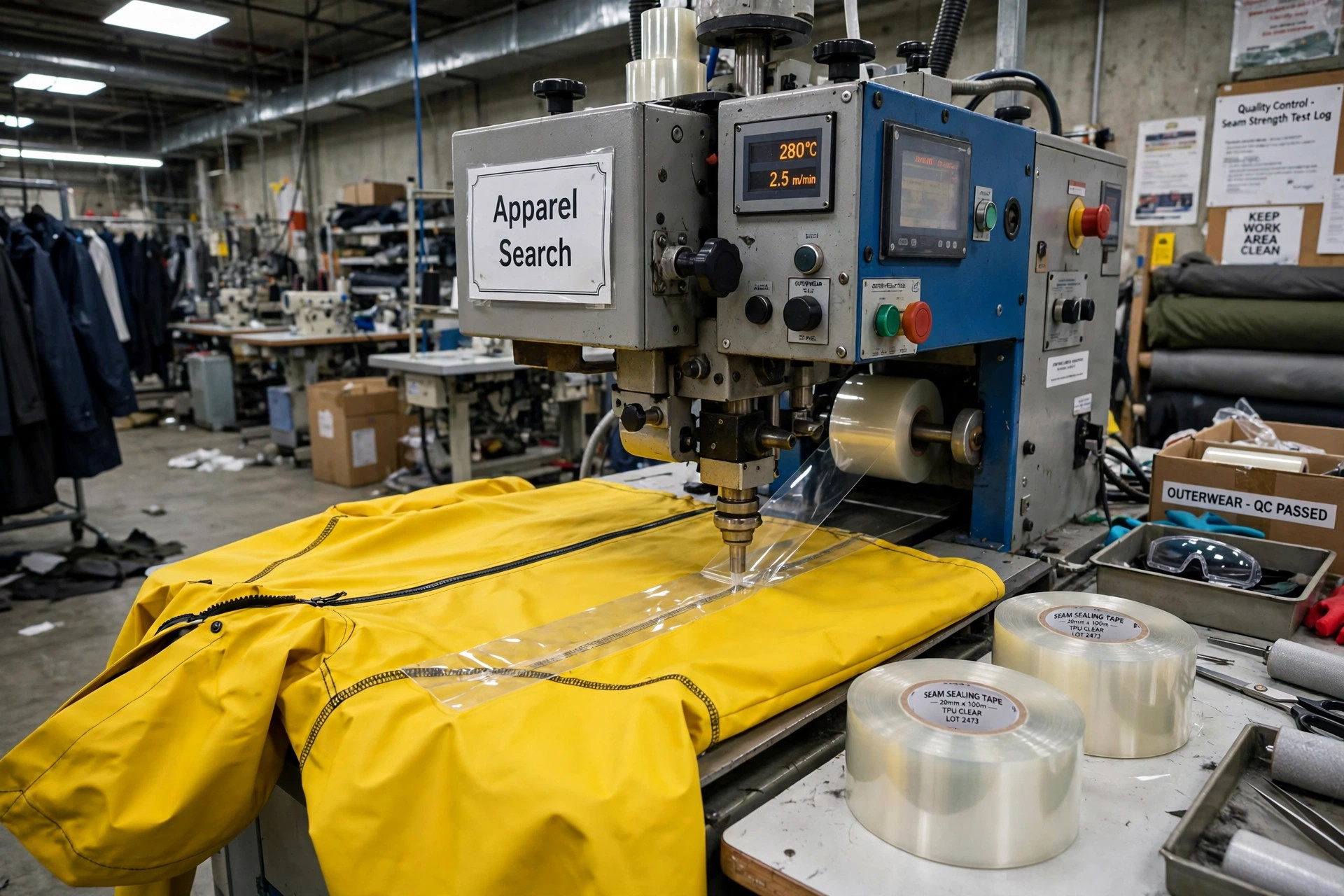
Heat-sealing seam tape is a thermoplastic adhesive film, supplied on rolls in widths chosen to cover the seam allowance and its stitch lines with margin to spare. Applied over the inside of the sewn seam, heat softens the adhesive layer so it flows into the needle holes and around the threads, pressure bonds it to the fabric and its waterproof coating or membrane, and cooling sets a continuous waterproof barrier across the seam. Multi-layer tapes add a fabric or film face over the adhesive where abrasion resistance or a softer hand is needed inside the garment.
Compatibility is the governing specification. The tape's adhesive must bond to the specific shell — its fiber, its coating or laminate, and any durable water-repellent finish — at temperatures the shell can tolerate, and stay bonded through flexing, washing and the garment's service life. A tape that peels from a particular membrane is not a defective tape; it is a mismatched system. That is why seam tape is always approved on the production shell fabric, in a taped seam sample, and never from a catalogue description alone.
Application: Hot Air, Laser and Ultrasonic
The tape can be applied using any of the commercially available hot air taping machines, laser or ultrasonic machinery. A hot-air taping machine blows heated air at the tape-and-seam junction while rollers feed and press the tape on — the standard production method, where the operator guides the seam and the machine's temperature, speed and pressure settings decide bond quality. Laser and ultrasonic systems deliver energy more precisely at the bond line and suit automated or delicate constructions where hot air would disturb lightweight shells.
Whatever the machine, the production discipline is the same: settings are established on the real fabric-and-tape combination, seam intersections — where several taped seams cross and thickness builds — get deliberate handling so no gap opens at the junction, and taped seams are inspected and tested as production proceeds rather than only at the end. A waterproof test on finished garments, spray or immersion as the product standard requires, is the final proof that tape, fabric and settings worked as one system.
Beyond Waterproofing: Reinforcement and Printed Tape
Not every seam tape is about rain. Fusible tapes reinforce and stabilise seams in ordinary garment production: a narrow fusible tape fused into a shoulder seam stops knitted fabric growing, tape along a curved seam prevents stretching and distortion during sewing, and fusible seam tape stiffens edges that must hold a line. These tapes share the heat-bonding principle with waterproof tape but are specified for stability and handling rather than hydrostatic performance — buyers should state which job, sealing or reinforcement, a tape order is for.
Seam tape has also moved from hidden engineering to visible design. In-house printing capability allows the tape to be customised to suit the garment: a buyer can match an existing pattern on a fabric, enhance branding with color logos or taglines, or simply be creative with a unique design. With customised printing, seam tape plays an important role in the aesthetic evolution of outerwear — the inside of a jacket, and taped outer seams on performance styles, now carry deliberate color and branding instead of anonymous clear film.
Specifying and Ordering Seam Tape
Specify the shell fabric precisely — fiber, coating or membrane, and finish — the tape width against the seam allowance, the tape construction (adhesive film alone or multi-layer), the application machinery the factory runs, and the performance the finished garment must meet. State printed or plain, and for printed tape approve artwork on taped seam samples, since printing sits within the tape system and must survive the same bonding and flexing as the adhesive.
Approve by testing the system: tape seams on production fabric, then flex, wash and waterproof-test them, checking for peeling, bubbling, edge lift and leaks at seam intersections. Confirm roll put-up and storage conditions — thermoplastic tapes age and block if stored hot — and record the machine settings that passed testing as part of the garment's production specification, so a later production run reproduces the bond that was approved rather than rediscovering it.
Seam Tape Manufacturers
Manufacturers of thermoplastic heat-sealing seam tape — including custom printed tape — and industrial seam tapes for garment production.
Bemis
Seam tape (heat sealing tape) is a thermoplastic adhesive film applied to sewn seams of fabrics to prevent water from leaking through the seams. It can be applied by using any of the commercially available hot air taping machines, laser or ultrasonic machinery.
Their in-house printing capability allows you to customize the tape to suit your needs. You can match an existing pattern on a fabric, enhance branding with color logos or taglines, or simply be creative with a unique design. Seam tape has always been the critical link in the chain of waterproof protection; with customized printing it now plays an important role in the aesthetic evolution of outwear.
Seam Tape · Heat Sealing Tape · Custom Printed Seam Tape
Euro
The company manufactures a variety of industrial tapes such as seam tapes and PTFE tapes, which are used for packing, wrapping, and gripping. Ribbons made of cotton, rayon, nylon, polyester, staple fibre, terelene, satin, velvets, zari etc. find wide application in garment industries.
Seam Tapes · Cotton Tapes · Rayon Tapes · Nylon Tapes · Polyester Tapes · Satin Tapes · Velvet Tapes · Gripping Tapes / Gripper
References & Further Reading
More Tape Guides
- Bias Binding Tape
- Cotton Tape
- Curing & Wrapping Tape
- Elastic Tapes
- Gripper Tapes
- Hook & Eye Tapes
- Hook & Loop Tapes
- Jacquard Tapes
- Kevlar Tapes
- Knitted Tape
- Leather Suede Tapes
- Multi Color Tape
- Name Tapes
- Nylon Tapes
- Organza Tape
- Packing Tapes
- Piping Tapes
- Plain Tapes
- Polyester Tapes
- Rayon Tapes
- Reflective Tapes
- Ribbon Tapes
- Rubber Tape
- Satin Tapes
- Teflon Tapes
- TPU Elastic Reverie Tape
- Twill Tape
- Velvet Tapes
- Woven Polyester Tapes
Common Questions
Why do waterproof garments need seam tape?
Stitching punches rows of needle holes through waterproof fabric, and each hole is a leak path. Seam tape — a thermoplastic adhesive film heat-bonded over the sewn seam — flows into the needle holes and bonds across the seam, restoring a continuous waterproof barrier.
How is seam tape applied?
Most commonly on a hot air taping machine, which heats the tape-and-seam junction while rollers press the tape on; laser and ultrasonic machinery apply the same bond with more precisely delivered energy. Settings for temperature, speed and pressure are set on the actual fabric-and-tape combination.
Can seam tape be printed or branded?
Yes. Makers with in-house printing can match an existing fabric pattern, add color logos or taglines, or produce a unique design on the tape, so the tape contributes to the garment’s branding and appearance as well as its waterproofing.