Kokoshnik
Fashion Definitions — fashion history and style definitions from Apparel Search
Search Apparel Search
At a Glance
Definition: The kokoshnik is the traditional headdress of Russian women: a stiff, arched or crescent-shaped crown, often richly embroidered with gold thread and pearls, that frames the face and rises above the forehead.
Pronunciation: koh-KOSH-nik
Category: Fashion Definitions
Word Origin
The name derives from the Old Russian word for a hen — a reference to the headdress's comb-like silhouette, the smooth arch rising above the forehead like a hen's comb.
The kokoshnik is the traditional headdress of Russian women: a stiff, arched or crescent-shaped crown, often richly embroidered, that frames the face and rises above the forehead in a smooth, halo-like curve. Its name derives from the Old Russian word for a hen, a reference to the comb-like silhouette. For centuries it was the crowning element of festive dress, from peasant villages to, eventually, the imperial court itself. This page belongs to the wider Fashion History Guide, and the kokoshnik earns its place in it: few headdresses carry so much national meaning, or survived so many changes of regime and taste, while keeping an instantly recognisable shape.
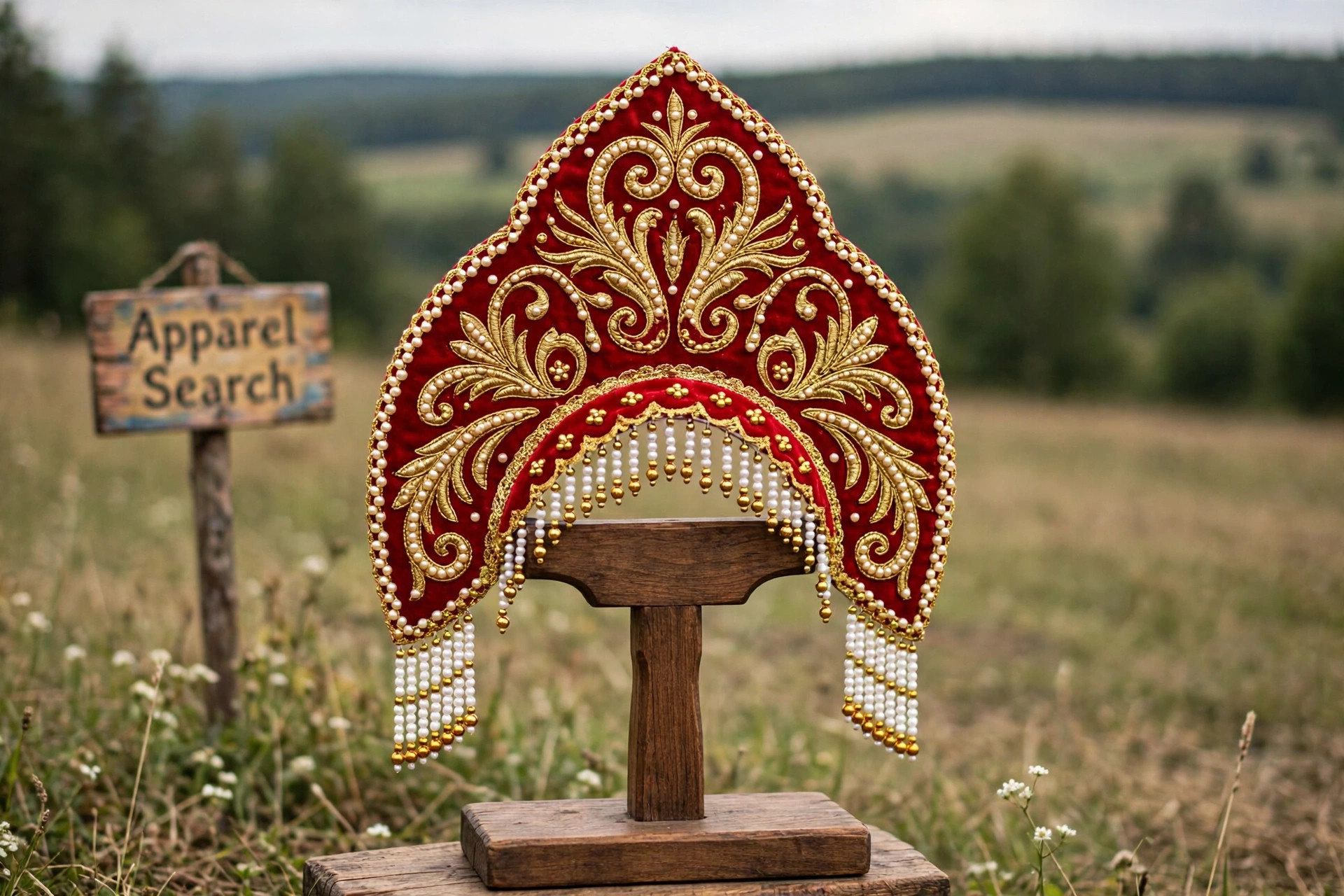
Medieval Roots and Regional Forms
Headdresses of the kokoshnik type have roots in medieval Russia, with related forms documented from the 10th to the 13th centuries and the mature style established by the 16th and 17th centuries. Traditionally, a kokoshnik was worn by married women — hair fully covered was a mark of married status — over a soft cap, and festive examples were family treasures, passed from mother to daughter and stored with a household's best textiles.
Regional forms varied strikingly. Northern kokoshniks were often a single high arch or a rounded shield shape, worked in gold embroidery and river pearls on velvet or brocade; other regions favoured two-horned, saddle-shaped, or pointed forms. The base was stiffened with birch bark, canvas, or metal, then covered and ornamented with gold thread, seed pearls, mother-of-pearl, beads, and later factory-made spangles. A beaded forehead net and temple pendants often completed the effect.
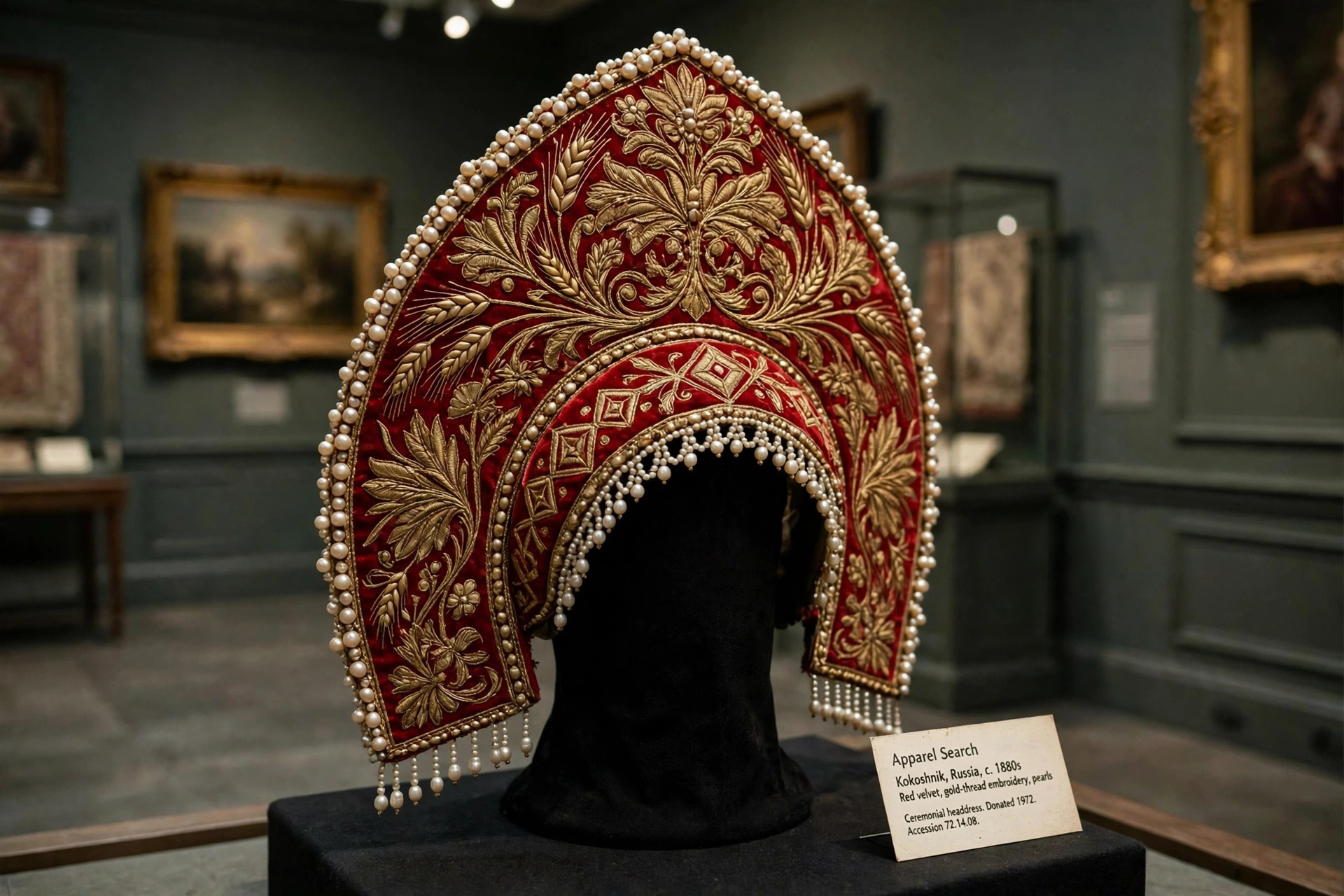
Court Revival and the Imperial Era
In the 19th century the kokoshnik made an extraordinary journey upward. As Russian court culture embraced national styles, a regulated court dress was introduced in 1834 that paired a velvet gown in national colours with a kokoshnik-style headdress and veil for ladies of the court. Under Nicholas II the association deepened: grand duchesses were painted and photographed in jewelled kokoshnik tiaras, and Fabergé and the imperial jewellers translated the folk arch into diamond tiaras that could also be worn as necklaces.
Like Europe's hennin, the kokoshnik shows how a tall, formal headdress can become the visual signature of an entire culture. Its silhouette also entered Western fashion in the early 20th century through Russian émigré influence, Ballets Russes spectacle, and the vogue for Russian-style embroidery and headbands in the 1920s.
Legacy
After 1917 the kokoshnik survived in folk costume, dance ensembles, and ceremonial dress, and it remains the standard headdress of Russian folk performance. Jewelled kokoshnik tiaras survive in royal collections across Europe, and the arched form still inspires bridal crowns, couture headpieces, and national dress — a medieval village headdress that became, and remains, an emblem of Russia itself.
Common Questions
What is a kokoshnik?
A kokoshnik is a traditional Russian women's headdress: a stiff, arched or crescent-shaped crown, often embroidered with gold thread and pearls, worn for festive dress and later adopted in imperial court dress.
Who traditionally wore a kokoshnik?
Traditionally, married women wore the kokoshnik, since covered hair marked married status. Festive examples were valuable heirlooms, and in the 19th century ladies of the Russian court wore kokoshnik-style headdresses with regulated court dress.
What is a kokoshnik made from?
A kokoshnik has a stiffened base of material such as birch bark, canvas, or metal, covered with velvet or brocade and ornamented with gold embroidery, seed pearls, beads, and mother-of-pearl.