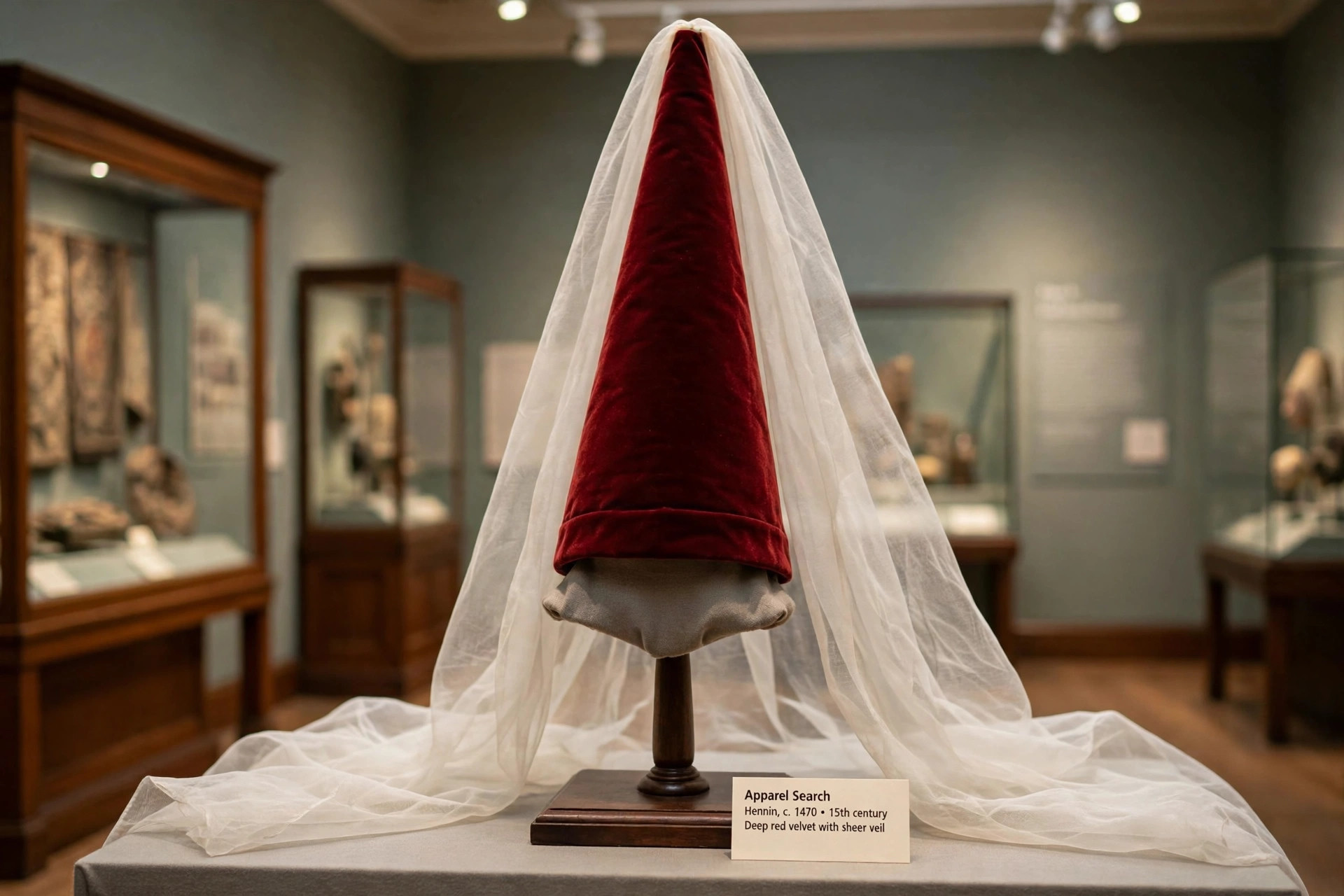
The hennin was the tall, conical headdress worn by fashionable women in 15th-century France, Burgundy, and neighbouring courts — a steep cone or truncated steeple of rich fabric, often finished with a long sheer veil floating from its tip. It is the headdress modern imagination assigns to every medieval princess, and for once the imagination is accurate: at the height of fashion, hennins rose a remarkable distance above the wearer's head.
The hennin belonged to the same late-medieval world as the fitted bliaut tradition that preceded it, the voluminous houppelande, and the layered kirtle — a wardrobe of long lines and high, smooth foreheads in which the cone of the hennin was the crowning vertical accent.
Forms of the Hennin
The classic hennin, fashionable from about the 1430s to the 1480s, was a cone of stiffened material covered in silk, velvet, or brocade, worn tilted slightly back and secured over a close cap and a forehead loop. Contemporary moralists measured its height with disapproval, and the tallest examples at the Burgundian court approached genuinely extravagant proportions. The veil — of fine linen or silk gauze — streamed from the point or fell over the cone, softening its geometry.
Not every hennin was a steeple. The family included truncated cones, heart-shaped and butterfly headdresses built over wire frames, and two-horned forms, all sharing the period's ideal: hair drawn completely back, a high plucked forehead, and a smooth, elongated silhouette. Paintings by Rogier van der Weyden and Petrus Christus preserve the type with jeweller's precision.
Wearing It
A hennin required preparation. Hair was dressed tightly back, foreheads were shaved or plucked to the fashionable height, and the cone was anchored with pins and a frontlet band across the brow. Doorways were a genuine hazard — chroniclers enjoyed stories of ladies ducking — and the headdress signalled a wearer who did not perform manual work. Only wealthy and noble women wore the tallest forms; simpler versions in plainer cloth filtered down to prosperous townspeople.
By about 1500 the extreme cone was fading, replaced by lower hoods, coifs, and the gable headdress in England. The hennin's retirement was gradual and regional, but its reign as the defining silhouette of late-medieval feminine fashion was complete.
Legacy
The hennin's afterlife has been longer than its fashion life. Romantic painters, illustrators, and film designers revived the cone as the universal sign of the medieval, and it remains the standard headdress of the storybook princess. Among historic headdresses it stands with the Russian kokoshnik as proof that a single, bold silhouette can come to represent an entire era of dress.
Common Questions
- What is a hennin?
- A hennin was a tall, conical or steeple-shaped headdress worn by fashionable women in 15th-century France and Burgundy, usually covered in rich fabric and finished with a sheer veil from its tip.
- How was a hennin worn?
- A hennin was worn tilted slightly back over tightly dressed hair and a high, plucked forehead, secured with pins, a close cap, and a frontlet band across the brow.
- When was the hennin fashionable?
- The hennin was fashionable from about the 1430s to the 1480s, with its tallest forms at the Burgundian court. By about 1500 it had given way to lower hoods and coifs.
Historic Garments & Accessories
- Fashion History Guide
- Pelisse
- Polonaise
- Robe à la Française
- Robe à l'Anglaise
- Robe en Chemise (Chemise à la Reine)
- Justacorps
- Inverness Cape
- Kirtle
- Bliaut
- Houppelande
- Poulaine
- Pomander
- Caraco
- Banyan
- Pagoda Sleeve
- Paned Sleeve
- Kokoshnik
- Hennin
- Bergère Hat
- Capeline
- Cartwheel Hat
- Cocktail Hat
- Gainsborough Hat
- Halo Hat
- Shako