Houppelande
Fashion Definitions — fashion history and style definitions from Apparel Search
Search Apparel Search
At a Glance
Definition: The houppelande was the dominant outer robe of the late 14th and 15th centuries: a high-collared, high-belted garment of magnificent volume, worn by men and women and famous above all for its enormous sleeves.
Pronunciation: HOO-plahnd
Category: Fashion Definitions
The houppelande was the great outer robe of the late fourteenth and fifteenth centuries, a garment built on volume: belted high, finished with a tall collar, and given sleeves so large that they became the most recognisable statement in contemporary dress. Men and women wore it in closely related forms, above all at the courts of France and Burgundy, where clothing reached a pitch of theatrical splendour. It appeared around the 1360s to 1380s and flourished until about 1450, and in the history of Western fashion it marks the medieval silhouette at its most expansive — the opposite pole from the close-fitted bliaut of two centuries earlier.
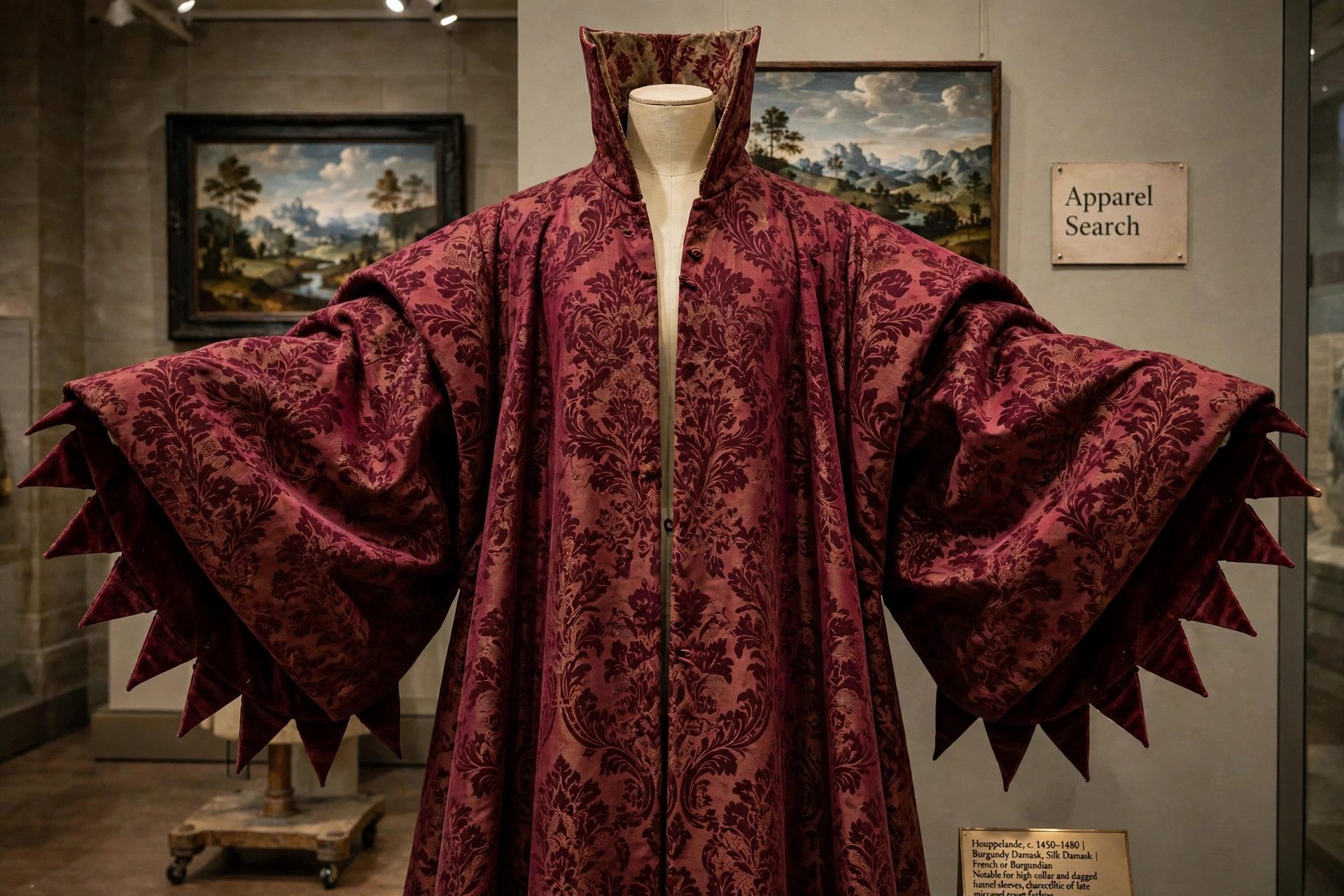
Volume, Sleeves, and Dagging
The robe was cut generously from the shoulders and pleated or gathered into a belt worn at the natural waist or higher, from which it fell in heavy folds to the ground, sometimes trailing behind the wearer. The sleeves were where the fashion lived. They took extravagant forms: the wide funnel; the bagpipe sleeve, full along the arm and gathered in at the wrist; and the mahoître, with padded rolls at the shoulder. Edges were frequently dagged — cut into leaves, scallops, and tongues — and rich examples were lined with fur, the cuffs turned back to display miniver or sable.
The materials were the heaviest luxuries the age could offer: silk damask and velvet, brocade, and fine scarlet wool. Beneath the robe, men wore the fitted doublet and hose, while women wore the houppelande over a fitted, kirtle-style gown. Moralists and sumptuary commentators complained about the sheer ocean of cloth that a single robe consumed — a complaint that was itself a measure of the garment's success.
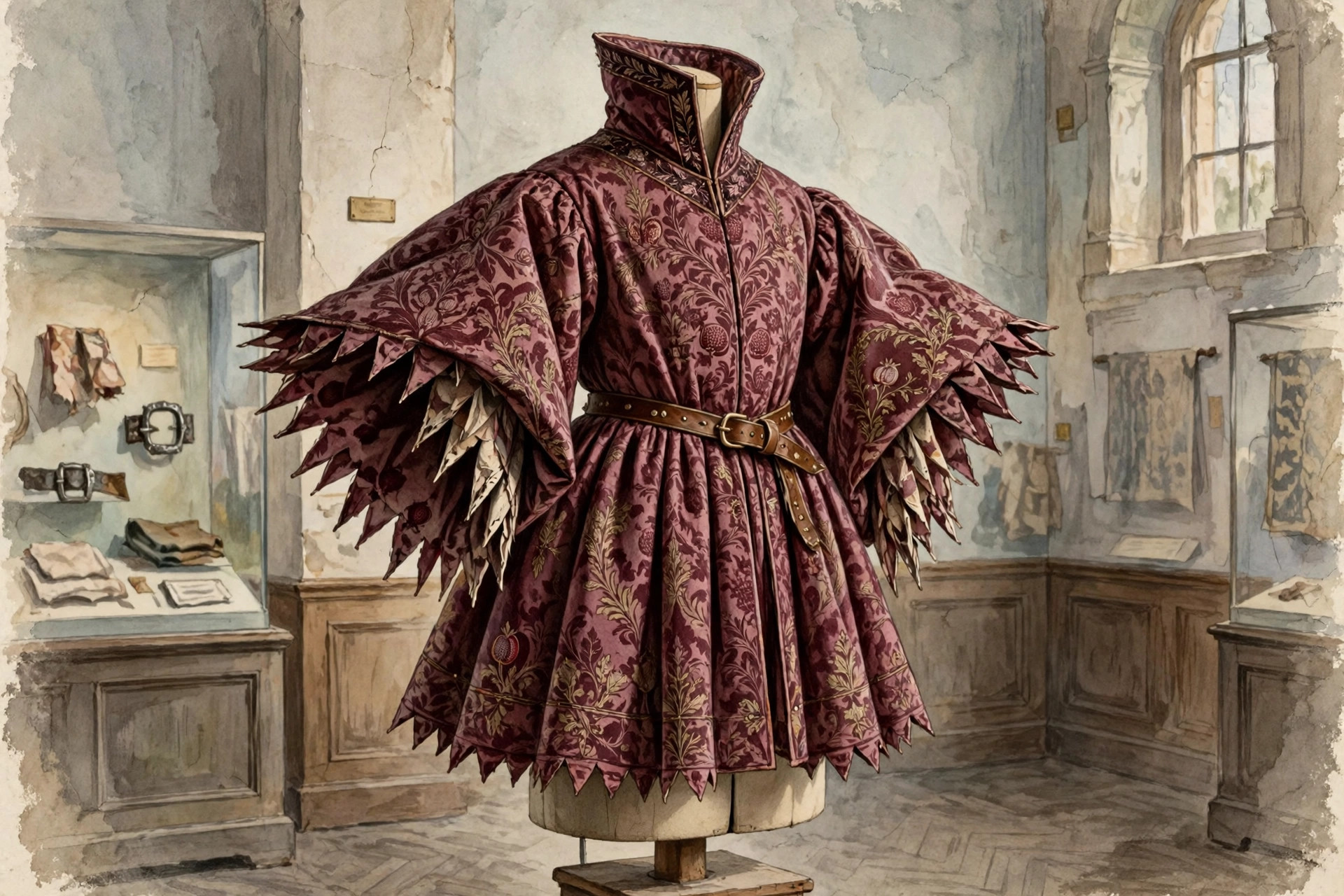
A Robe for Both Sexes and Every Ceremony
Uniquely among medieval garments, the houppelande served men and women in closely related forms, the versions differing mainly in length, belt position, and trimming. It was the dress of council chambers, weddings, dances, and state entries. The calendar miniatures of the Limbourg brothers show it in every month of the year, on dukes at the hunt and on the masters of peasants at table.
Because it was an over-robe, it also communicated office. Liveried houppelandes made in a lord's colours dressed his whole household in his allegiance, and the robe's descendants include the ceremonial gowns still worn by mayors, judges, and universities.
Decline and Descendants
After about 1450 the great volume deflated. Men's dress moved toward shorter, padded doublets, and the robe narrowed into the gown of the later fifteenth century. The houppelande itself did not wholly die; it retreated into ceremony. Academic and legal gowns, with their full bodies and hanging sleeves, preserve its cut to this day, and the oversized, sculptural coats of modern fashion quote its drama whenever volume returns to the runway.
The Limbourg brothers' calendar miniatures, painted for the Duke of Berry around 1410, remain the houppelande's finest portrait: courtiers in cloth of gold, household masters in scarlet and fur, every sleeve a statement. No other medieval garment is documented so splendidly, or shows so clearly how cloth itself was once the loudest language of rank.
Common Questions
Was the houppelande worn by men or women?
Both. The houppelande was a unisex outer robe of the late 14th and 15th centuries, with men's and women's versions differing in length, belt height, and trim.
What is dagging?
Dagging is the decorative cutting of garment edges into points, scallops, leaves, or tongues. It was used lavishly on houppelande sleeves and hems.
What modern garments descend from the houppelande?
Ceremonial academic, legal, and civic gowns preserve its full body and hanging sleeves. Fashion also revives its dramatic volume in oversized sculptural coats.