Bowler Hat
Hat & Headwear Definitions — the hard felt hat of the London city gent, known in America as the derby, from Apparel Search
Search Apparel Search
At a Glance
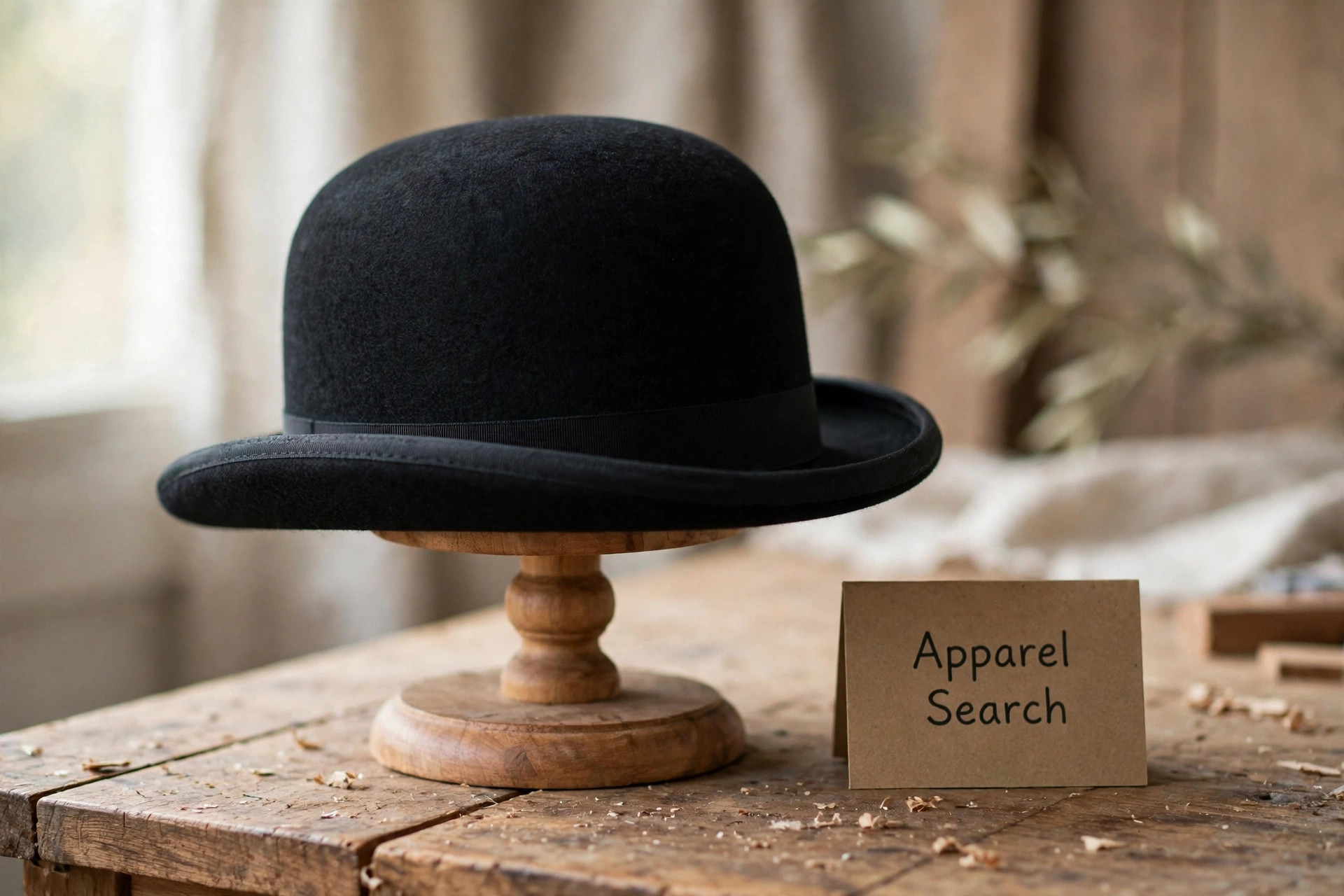
Definition: A bowler hat is a hard felt hat, created in England in 1850 and designed to be hard to protect the head, which became the traditional headwear of London city gents and is known in the United States as a derby hat.
Also known as: Derby hat (in the United States)
Category: Hat & Headwear Definitions
The bowler hat is a hard felt hat, originally created for an Englishman, James Coke, in 1850. It was designed to be hard in order to protect the head, but it evolved with its popularity in both England and the USA, and at its peak towards the end of the 1800s it offered a midway point between the formality of the top hat and the casual nature of soft felt hats. This page explains how a protective hard hat became the traditional headwear of London city gents, why the same hat is called a derby in the United States, and how it survived as a cultural image long after everyday hat-wearing ended.
A Hard Hat Before the Hard Hat
The bowler began as protection, not as a fashion statement. It is a hard felt hat, created in 1850 for James Coke, and designed to be hard to protect the head. That single decision — to make a felt hat rigid rather than soft and shapable — explains everything that followed. A hard hat keeps the shape it was made with, presents the same rounded outline every time it is put on, and stands up to daily use in a way that the soft felt hats of the period did not. From that practical start the bowler evolved with its popularity in both England and the USA, crossing the Atlantic and acquiring a second name in the process.
In the United States this hat is also known as a derby hat. Bowler and derby are not two similar hats; they are the same hard felt hat under its British and American names, and recognising that saves a good deal of confusion when reading period photographs, catalogues and costume credits from either side of the ocean. Hardness also made the bowler durable as an image: a soft hat changes with every handling, but a bowler looks the same in 1850, in 1900 and in a film a century later, which is one reason it could become a visual shorthand for a character, a class and a city, all in one rounded silhouette.
Between the Top Hat and the Soft Hat
The bowler's social position was as carefully placed as its shape. As it peaked in popularity towards the end of the 1800s, it offered a midway between the formality of the top hat associated with the upper classes and the casual nature of soft felt hats worn by the lower middle classes. That middle ground was exactly where the growing world of clerks, managers and city professionals lived, and the bowler became the traditional headwear of London city gents, so closely identified with that world that it has become something of a British cultural icon.
A second tradition carried the same hat elsewhere: it was traditionally also worn by members of the Orange Order in Northern Ireland during their 12th July annual parades, though usage has declined there, as it has in everyday dress generally. Softer, more casual styles such as the bucket hat and the fedora belong to a later, less formal world of hat-wearing than the one the bowler ruled.
Decline as Dress, Survival as an Image
The decline, when it came, was about hats in general as much as about this hat in particular. British men stopped wearing hats as a matter of course in the 1960s, and most young British people in the 21st century have never seen a bowler hat worn as part of normal dress. What survived was the bowler on screen, on stage and on canvas, where its instant readability is unmatched.
Stan Laurel and Oliver Hardy, the slapstick comedy duo Laurel and Hardy of the 1920s and 30s, and Charlie Chaplin, another comedian from the early 1900s, built part of their silhouettes on it, which is why the hat now reads as comic as readily as it once read as respectable. John Steed, of Avengers fame, wears this hat; clarinetist Acker Bilk wears this hat also; and Duckie wears this style in the 1986 film Pretty in Pink. In Waiting for Godot by Samuel Beckett, the only description of costume is that all four major characters wear them. The paintings of Belgian Surrealist artist René Magritte return to it again and again, and it appears in the movie A Clockwork Orange and on Benito Mussolini, the fascist Italian dictator — proof that the same hard dome can signal respectability, comedy, menace or absurdity depending entirely on who is placed underneath it.
Common Questions
Why was the bowler hat made hard?
The bowler was designed to be hard to protect the head. That hard felt construction, created in 1850 for James Coke, is the defining feature that separates the bowler from the softer felt hats of the period.
What is a bowler called in the United States?
In the United States this hat is also known as a derby hat. The same hard felt hat carried both names, bowler in England and derby in America, as its popularity spread in both countries.
Where did the bowler sit between other hats?
At its peak towards the end of the 1800s, the bowler offered a midway between the formality of the top hat associated with the upper classes and the casual nature of soft felt hats worn by the lower middle classes. It became the traditional headwear of London city gents.