Jacquard
Miscellaneous Definitions — accessories, trims, tools and general fashion terms from Apparel Search
Search Apparel Search
At a Glance
Definition: Jacquard is a fabric whose pattern is woven into the cloth itself on a Jacquard loom, which controls individual warp threads so the design is built into the weave rather than printed or embroidered on the surface.
Also known as: Jacquard weave.
Pronunciation: juh-KARD (US)
Category: Miscellaneous Definitions
Word Origin
"Jacquard" is an eponym — a word taken from a person's name. Joseph-Marie Jacquard (1752–1834) was a silk weaver of Lyon, France, the city whose figured silks made the problem he solved a daily one. He demonstrated an improved loom at the Paris industrial exhibition of 1801 and patented his card-controlled loom in 1804. The mechanism that bears his name built on three earlier French inventions: Basile Bouchon's perforated paper roll of 1725, Jean-Baptiste Falcon's chain of punched cards of 1728, and Jacques de Vaucanson's automated loom of 1745.
Jacquard is a fabric whose pattern is woven into the cloth itself. On an ordinary loom, warp threads are lifted in groups, which limits the weaver to stripes, checks and simple repeating geometry. A Jacquard loom lifts warp threads individually, so a flower, a crest or a whole pictured scene can be built thread by thread into the structure of the cloth. The design is not printed on the surface and not stitched on afterwards — it is the fabric, which is why jacquard patterns survive as long as the cloth does. The machine behind the method is covered in our Jacquard loom definition; this page is about the fabric and the weave it produces.
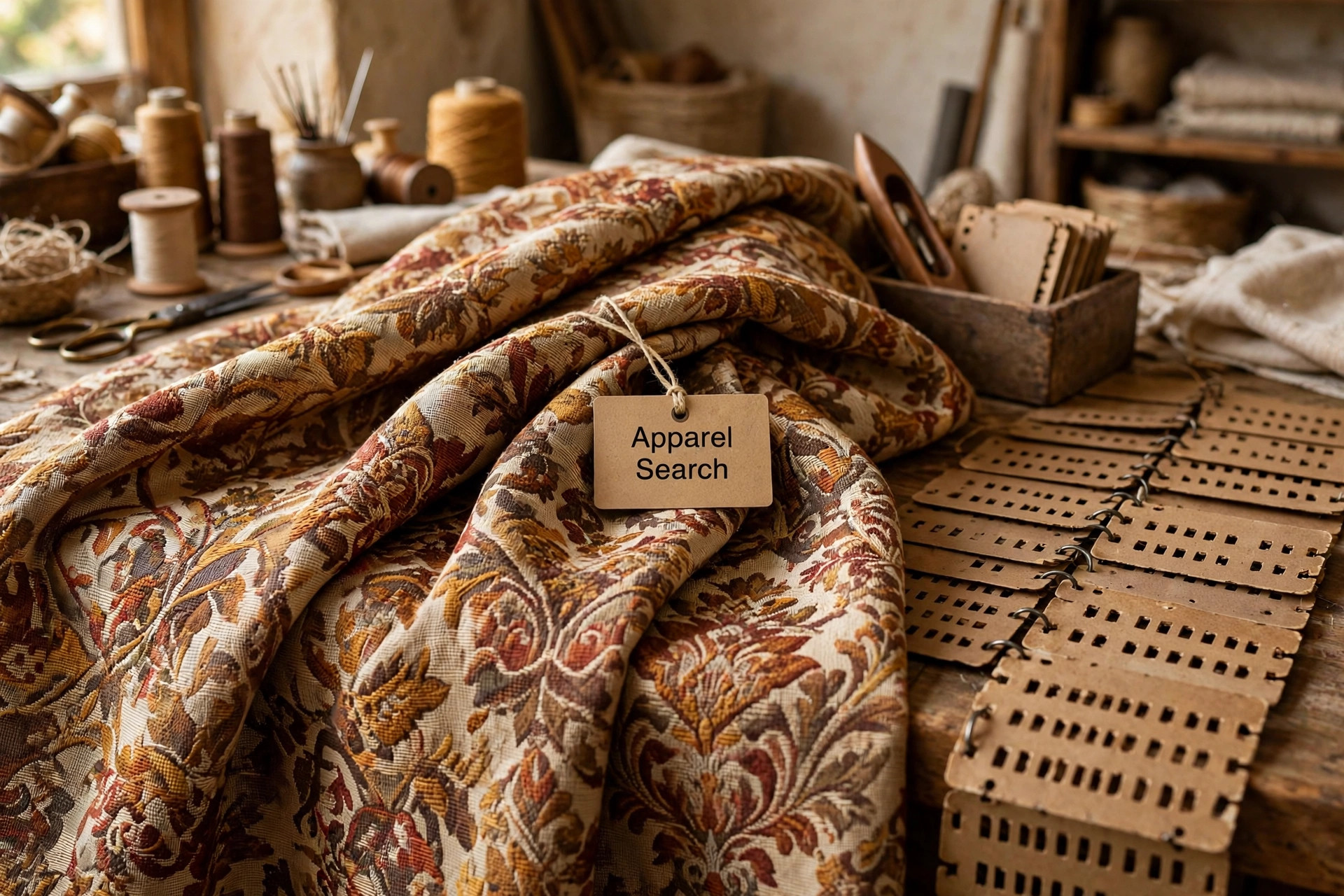
What Jacquard Weaving Is
Weaving makes cloth by interlacing two sets of threads: the warp, held lengthwise on the loom, and the weft, passed across it. A pattern appears when some warp threads are lifted over the weft and others are left under it, row by row. On a shaft loom every thread on a shaft rises or falls together, so the pattern can only repeat in small, regular units. Jacquard weaving removes that limit. Each warp thread — or each small group repeating across the width — is controlled on its own, so the lifting order can change at every row and at every position across the cloth. That individual control is the whole definition: a jacquard fabric is any cloth woven under it, whether the result is a subtle tone-on-tone leaf or a multicoloured tapestry panel. Because the pattern is structural, it shows in the cloth itself. Turn a jacquard over and the design is still there, reversed or in negative, made of the same threads — never a blank back with ink sitting on the front.
How the Pattern Gets In
The pattern begins as a designer's drawing, translated into instructions for which warp threads lift on each row of weft. In Jacquard's system those instructions were punched into pasteboard cards, one card for each row, laced together into a continuous chain. As each card pressed against the loom's needles, needles passed through the holes and let their hooks be lifted, while the solid card pushed the other needles — and their warp threads — out of the way. Hole or no hole, lift or no lift: the card chain was a stored program, and changing the pattern meant punching a new set of cards rather than re-threading the loom. Modern jacquard heads do the same job electronically. Solenoids select the hooks from a digital design file, with no cards to punch, store or lace, so patterns can be far larger, changeovers far faster, and a design can go from screen to loom in hours. The principle has not changed since 1804: select the threads, row by row, from stored instructions.
The Fabrics Jacquard Produces
Because jacquard names a method rather than one cloth, it produces a whole family of fabrics. Brocade is the most famous: a rich fabric whose raised pattern is formed by extra, supplementary weft threads. Damask builds its pattern from contrast within the weave itself — satin areas against a plainer ground — so a single-colour damask shows its motif as light and shade and reads on both faces. Tapestry-style jacquards weave pictorial designs for upholstery and wall panels, mattress ticking is woven with its stripes and motifs in the cloth, and patterned furnishing fabrics of every weight come off jacquard looms. The same control is used in knitting: jacquard knits carry multicoloured patterns worked into sweaters and other garments, a use explored in our guide to jacquard knits. Mills that specialise in this work are listed in the jacquard fabric mills directory.
Characteristics of Jacquard Fabric
A few qualities follow from the way jacquard is made. The pattern is durable, because it is the cloth: it cannot peel, crack or wash away, though raised pattern threads in fabrics such as brocade can snag and should be handled with some care. Many jacquards are effectively reversible — damask most completely, showing the same design in negative on the back — while brocade's back instead shows the floats of its extra pattern threads. Jacquard cloth tends to be stable and substantial, since figured weaving packs a great deal of interlacing into the structure, and it holds a design with a precision printing cannot match at the thread level. It is also costlier than plain cloth of the same fibre: the looms are more complex, weaving is slower, and preparing a new pattern takes skilled work, whether that means punching cards or preparing a digital file. None of these qualities depends on fibre — jacquard can be silk, cotton, wool, synthetic or a blend, and the label should always be read for fibre content separately.
Jacquard in Clothing Today
In modern dress, jacquard appears wherever a designer wants pattern with substance. Floral and paisley jacquards are staples of evening jackets, waistcoats, dresses and skirts, where the woven motif gives a garment richness that a print of the same design would not. Tone-on-tone jacquards — a leaf or stripe visible only as the light moves — are used for ties, formal shirts and linings. Heavier jacquards serve in tailored coats and in the upholstery and drapery that often share the same fabric ranges. Knitted jacquard patterns remain a standard way of putting multicoloured motifs into sweaters. The contrast to remember when shopping is with the loom's smaller cousin: a dobby loom also weaves pattern, but it lifts threads in shaft groups, so its designs stay small and geometric where jacquard's can be large, curved and pictorial.
Not to Be Confused With
Brocade. Brocade is not another name for jacquard — it is one specific fabric the jacquard method produces. A brocade's raised, often multicoloured pattern is made by supplementary weft threads added on top of a ground weave; where the motif does not need them, those threads float across the back of the cloth. Every brocade is jacquard-woven, but most jacquard is not brocade: damask, tapestry-style upholstery and mattress ticking are all jacquards with no supplementary-weft pattern at all. See the brocade fabric definition for the fabric itself.
Common Questions
What is jacquard fabric?
Jacquard fabric is cloth whose pattern is woven into the fabric itself on a Jacquard loom. Because the loom controls individual warp threads, the design is part of the cloth's structure rather than printed or embroidered on the surface, so it cannot fade, crack or wash off the way a print can.
Is jacquard a fiber or a weave?
Jacquard is a weave — more precisely, a way of weaving. The word names the pattern-control method and the loom that performs it, not a fiber. Jacquard cloth can be woven from silk, cotton, wool, polyester or blends, and the fiber content is a separate choice from the woven pattern.
What is the difference between jacquard and brocade?
Brocade is one specific fabric woven by the jacquard method, not a synonym for it. Brocade's raised pattern is made with supplementary weft threads that float on the back of the cloth. Every brocade is jacquard-woven, but jacquard also produces damask, tapestry-style upholstery, mattress ticking and many other fabrics that are not brocade.