Spinning Wheel
Miscellaneous Definitions — accessories, trims, tools and general fashion terms from Apparel Search
A spinning wheel is a device for making thread or yarn from fibrous material such as wool or cotton, invented somewhere in China or India between 500 and 1000 AD as an advancement on the concept of the spindle. Rather than relying on finger-twisting or on gravity as a hanging spindle does, the wheel is turned continuously by hand or by a treadle foot pedal, and a drive band transfers that motion to a much smaller wheel and spindle, twisting the thread steadily, which is then wound on a post still called the spindle after its predecessor.
A spinning wheel is a device for making thread or yarn from fibrous material such as wool or cotton.
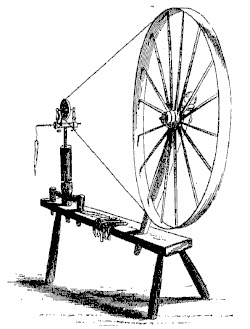 The spinning wheel was an advancement on the concept of the spindle, invented somewhere in China or India between 500 and 1000 AD ; like the spindle, it worked by spinning the material - twisting the fibers into a long continuous strand. Rather than relying on finger-twisting or gravity, however, the spinning wheel was turned by hand or by a treadle (a foot pedal) (or other motivation, such as water or electric power) to turn a large wheel, which, by the use of a drive band, turned a smaller wheel.
The motion of the wheel twisted the thread, which was then wound on a post called (after its predecessor) the spindle.
Numerous types of spinning wheels have existed, including the great wheel or wool wheel for rapid long-draw spinning of woolen-spun yarns; the flax wheel, with its bobbin and flyer assembly, for spinning linen and worsted-spun yarns; and the charka, a small, portable, hand-cranked wheel for spinning cotton and other fine, short-staple fibers.
In the fairy tale Rumpelstiltskin, a young woman is expected to use a spinning wheel to spin straw into gold.
Sleeping Beauty: The evil fairy is very angry about having been forgotten, and as her gift, enchants the infant princess so that she will one day prick her finger on a spindle of a spinning wheel and die. The seventh fairy, who hasn't yet given her gift, attempts to reverse the evil fairy's curse. However, she can only do so partially. Instead of dying, the Princess will fall into a deep sleep for 100 years and be awakened by a kiss from a king's son. This is her gift of protection. The King orders that every spindle and spinning wheel in the kingdom to be destroyed, to try to save his daughter from the terrible curse. Fifteen or sixteen years pass and one day, when the king and queen are away, the Princess wanders through the palace rooms and comes upon an old woman, spinning with her spindle. The princess, who has never seen anyone spin before, asks the old woman if she can try the spinning wheel. The curse is fulfilled as the princess pricks her finger on the spindle and instantly falls into a deep sleep.
| The above article is licensed under the GNU Free Documentation License. From Wikipedia, the free encyclopedia (https://en.wikipedia.org/wiki/spindle). Modified by the Apparel Search Company on 10/31/04. |
|
Apparel Search is the worlds largest and fastest growing business to business database dedicated solely to the Clothing, Fashion & Textile Industry. Through the use of cutting edge technology, and a tremendous amount of "human" effort, we will continue to expand the Apparel Search directory. Our intention is to provide information regarding all aspects of clothing and fashion. If you know of any clothing, fashion, or textile related issue that is not currently listed on Apparel Search please let us know. |
The Wheel That Kept the Spindle Turning
A drop spindle stops. Flick it, spin while it falls, then stop to wind on - the rhythm is intermittent by nature. The spinning wheel's advance was to make rotation continuous. Invented somewhere in China or India between 500 and 1000 AD as an advancement on the concept of the spindle, the wheel worked by the same principle - twisting fibers into a long continuous strand - but with a different source of motion. Rather than relying on finger-twisting or gravity, the spinning wheel was turned by hand or by a treadle, a foot pedal, or other motivation such as water or electric power, to turn a large wheel, which, by the use of a drive band, turned a smaller wheel. Because the large wheel's circumference drives the small one many times per revolution, the spindle spins far faster than a hand-flicked shaft, and it keeps spinning as long as the treadle rocks or the hand cranks. The spinner's hands are freed to manage fiber supply and draw out the strand, while the feet or crank do the turning. The finished thread is then wound on a post called, after its predecessor, the spindle - a name that preserves the lineage in everyday language.
That division of labor - treadle for power, hands for drafting - is why the wheel outproduced the spindle so decisively for household yarn. The spinner could concentrate entirely on how much fiber to release and how far to draw it back, the two judgments that decide evenness, while the wheel supplied untiring, regular twist. Sit at a treadle wheel and the work becomes a coordinated rhythm: feet alternate, hands walk backward as the strand lengthens and twists, then step forward to wind on. The machine is still human-powered and human-controlled, thread by thread, but the tiring part - keeping a spindle rotating - has been handed to a wheel and a band.
Great Wheel, Flax Wheel and Charka
Numerous types of spinning wheels have existed, each tuned to a fiber and a yarn. The great wheel, or wool wheel, served rapid long-draw spinning of woolen-spun yarns: the spinner walked backward and forward with a long draw, well suited to wool's springy staple and to soft, lofty yarn. The flax wheel, with its bobbin and flyer assembly, spun linen and worsted-spun yarns; the flyer and bobbin allowed continuous winding as well as twisting, a refinement suited to flax's long, smooth fibers and to tighter, smoother worsted yarns. The charka went the opposite way in scale: a small, portable, hand-cranked wheel for spinning cotton and other fine, short-staple fibers, light enough to carry and set up wherever the spinner sat.
The wheel's place in imagination matches its place in the cottage. In Rumpelstiltskin, a young woman is expected to use a spinning wheel to spin straw into gold - an impossible task set on the most familiar yarn-making device of its world. In Sleeping Beauty, the curse turns on pricking a finger on the spindle of a spinning wheel, and the king orders every spindle and spinning wheel in the kingdom destroyed. Both tales assume an audience for whom the wheel was ordinary household equipment. For centuries it was: one device, a large wheel, a drive band and a spindle, standing between raw wool or cotton and every woven or knitted thing a household wore.
Common Questions
What is a spinning wheel?
A spinning wheel is a device for making thread or yarn from fibrous material such as wool or cotton. It was an advancement on the concept of the spindle, invented somewhere in China or India between 500 and 1000 AD.
How does a spinning wheel turn the spindle?
The wheel is turned by hand or by a treadle, a foot pedal, and by the use of a drive band it turns a smaller wheel. The motion twists the thread, which is then wound on a post called the spindle.
What are the main types of spinning wheels?
Types include the great wheel or wool wheel for rapid long-draw spinning of woolen-spun yarns, the flax wheel with its bobbin and flyer assembly for linen and worsted yarns, and the charka, a small portable hand-cranked wheel for cotton.