Running Stitch
Sewing Definitions — stitches, seams, quilting and sewing terms from Apparel Search
The running stitch, or straight stitch, is the basic stitch in hand sewing and embroidery, on which all other forms of sewing are based. The stitch is worked by passing the needle in and out of the fabric, and running stitches may be of varying length, although typically more thread is visible on the top of the sewing than on the underside. Running stitches are used in hand sewing and tailoring to sew basic seams, in hand patchwork to assemble pieces, and in quilting to hold the fabric layers and batting or wadding in place.
The running stitch or straight stitch is the basic stitch in hand-sewing and embroidery, on which all other forms of sewing are based. The stitch is worked by passing the needle in and out of the fabric. Running stitches may be of varying length, but typically more thread is visible on the top of the sewing than on the underside.
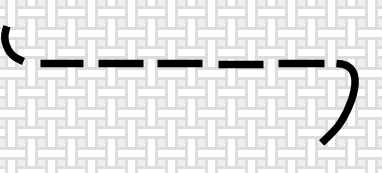
Running stitches are used
in hand-sewing and
tailoring
to sew basic seams, in hand
patchwork to
assemble pieces, and in
quilting
to hold the fabric layers
and
batting or wadding in
place.
Loosely spaced rows of short
running stitches are used
to support
padded satin stitch.
Running stitches are a component of many traditional embroidery styles, including kantha of India and Bangladesh, and Japanese sashiko quilting.
Related stitches
- Basting stitches are long running stitches used to keep two pieces of fabric or trim aligned during final sewing, or to otherwise temporarily sew two pieces together.
- Darning stitches are closely spaced parallel rows of running stitches used to fill or reinforce worn areas of a textile, or as decoration (see Darning).
- Double-running or Holbein stitches have a second row of running stitches worked in a reverse direction in between the stitches of the first pass, to make a solid line of stitching.
- Double darning stitches are closely spaced (but not overlapping) rows of Holbein stitches.
References
- Reader's Digest Complete Guide to Needlework. The Reader's Digest Association, Inc. (March 1992). ISBN 0-89577-059-8, p. 46
- Complete Guide to Needlework, p. 200, 220
- Gillow, John, and Bryan Sentance: World Textiles, Bulfinch Press/little, Brown, 1999, ISBN 0-8212-2621-5, p. 172-173
- Complete Guide to Needlework, p. 46-47
- Caulfield, S.F.A., and B.C. Saward, The Dictionary of Needlework, 1885.
- Enthoven, Jacqueline: The Creative Stitches of Embroidery, Van Norstrand Rheinhold, 1964, ISBN 0-442-22318-8
- Gillow, John, and Bryan Sentance: World Textiles, Bulfinch Press/little, Brown, 1999, ISBN 0-8212-2621-5
- Reader's Digest, Complete Guide to Needlework. The Reader's Digest Association, Inc. (March 1992). ISBN 0-89577-059-8
See also
| The above article is licensed under the GNU Free Documentation License. From Wikipedia, the free encyclopedia (https://en.wikipedia.org/wiki/running_stitch). 7/4/09 Above article modified by Apparel Search |
|
|
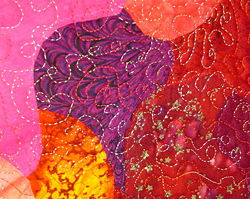
The First Stitch Every Sewer Learns
Running stitch is sewing reduced to its essence: down through the fabric, up through the fabric, repeated along a line. Several stitches are usually loaded onto the needle at once in a rocking motion before the thread is pulled through, which gives hand running stitch its rhythm and speed. Because the thread dives and surfaces alternately, the line is dashed, thread showing on top, gap, thread again, with typically more thread visible on the top of the sewing than on the underside. Controlling the length and evenness of those dashes, small and regular for a seam, long and loose for basting, is the first manual skill of the hand sewer, and every other hand stitch is a variation on this in-and-out foundation.
Its simplicity does not make it weak in its proper places. A running stitch seam, worked small in strong thread, holds light and medium fabrics adequately and was the standard seam stitch for centuries of hand-sewn clothing; tailoring still uses running stitch where a seam must be controlled precisely, eased or shaped by hand. In hand patchwork, running stitch assembles the pieces along marked lines with an accuracy machines struggle to match on small or curved pieces. In quilting, rows of running stitch through all three layers are quite literally the quilting itself, the stitch that holds top, batting and backing together.
A Family of Working Variants
Change the length, spacing or direction of running stitch and it takes new names and new jobs. Basting stitches are long running stitches, used to keep two pieces of fabric or trim aligned during final sewing or to sew pieces together temporarily, and they are meant to be removed. Darning stitches are closely spaced parallel rows of running stitches, used to fill or reinforce worn areas of a textile, the foundation of darning repairs, or worked as decoration. Double-running or Holbein stitch adds a second row of running stitches worked in the reverse direction between the stitches of the first pass, filling every gap to make a solid line of stitching that looks identical on both sides, the stitch of reversible blackwork. Double darning stitches are closely spaced rows of Holbein stitch.
Running stitch is also a world embroidery stitch in its own right. It is a component of many traditional embroidery styles, including kantha of India and Bangladesh, in which layered cloth is covered with running stitch patterning, and Japanese sashiko quilting, where white running stitches form geometric patterns on indigo fabric. Loosely spaced rows of short running stitches support padded satin stitch in surface embroidery. In each tradition the same plain action, needle in, needle out, produces a different textile character through rhythm, spacing and pattern, which is why running stitch is fairly described as the stitch on which all other forms of sewing are based.
Common Questions
What is a running stitch?
The running stitch, or straight stitch, is the basic stitch in hand sewing and embroidery. It is worked by passing the needle in and out of the fabric, with typically more thread visible on top than underneath.
What is running stitch used for?
Running stitches sew basic seams in hand sewing and tailoring, assemble pieces in hand patchwork, and hold fabric layers and batting in place in quilting. Loosely spaced rows of short running stitches also support padded satin stitch.
What are basting and darning stitches?
Basting stitches are long running stitches used to keep fabric or trim aligned during final sewing or to hold pieces temporarily. Darning stitches are closely spaced parallel rows of running stitches used to fill or reinforce worn areas, or as decoration.
More to Explore
- embroidery
- needle
- fabric
- thread
- tailoring
- patchwork
- quilting
- padded satin stitch
- trim
- Darning
- Double-running or Holbein stitches
- sewing
- GNU Free Documentation License
- https://en.wikipedia.org/wiki/running_stitch
- Seams
- Seam Ripper
- Seams Guide
- Tack
- Sewing Machinery Definition
- fabric Definition
- fiber Definition
- Hems
- Clothing Definitions