Apparel Search Consumer Guides
Dorm Room Clothing Storage
A full wardrobe in about four feet of closet: the hanging zone, the under-bed zone, and a laundry system that keeps two weeks of clothes off the floor.
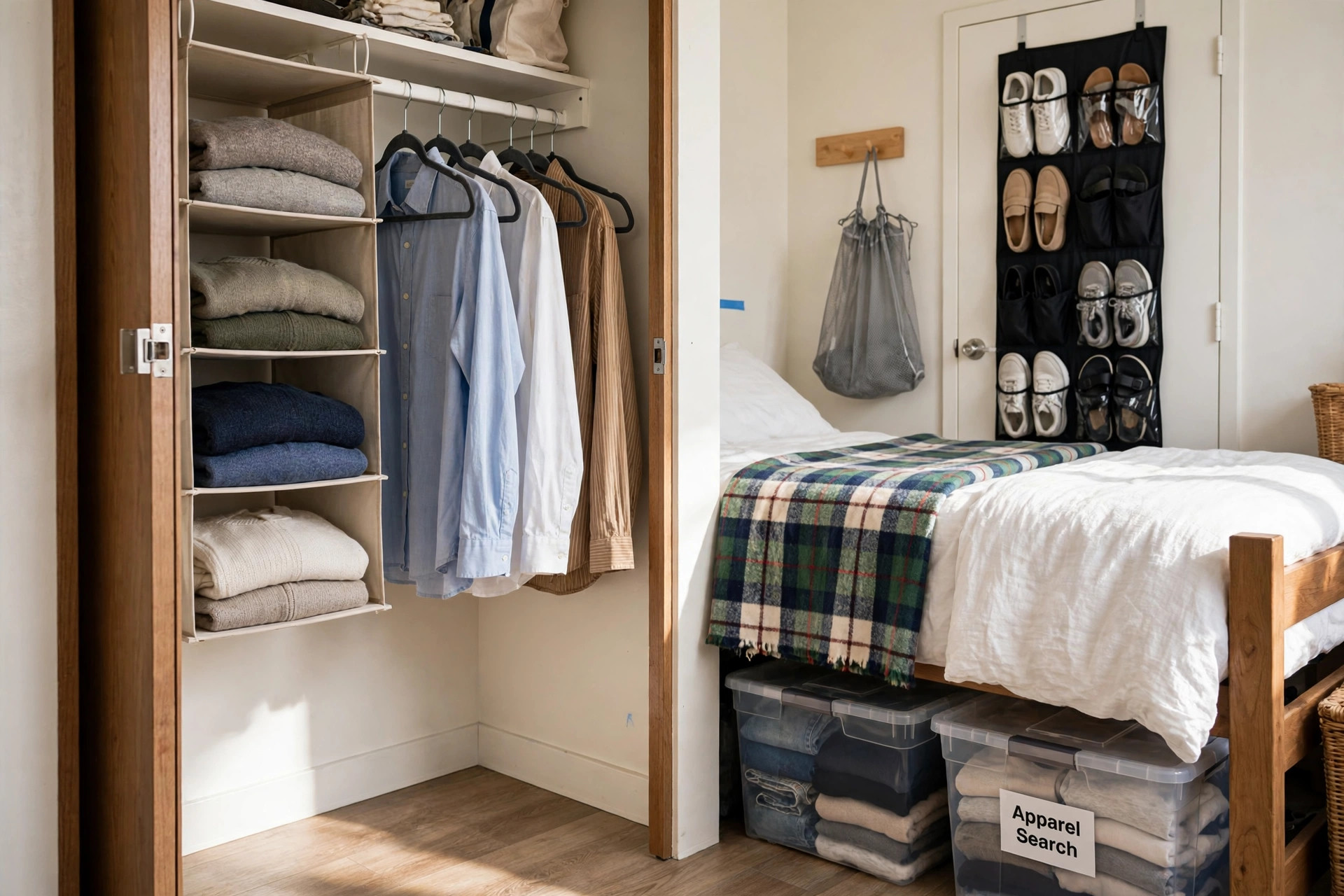
A dorm room offers a wardrobe roughly the square footage of a phone booth: a short hanging rail, two or three drawers if you are lucky, and the space under a raised bed. The students whose rooms work are not the ones with the least clothing - they are the ones who treated storage as part of the wardrobe, measured before they bought anything, and gave every category of clothing a named place. This guide is that system, zone by zone; the companion half of the problem, choosing what the wardrobe contains, is our college wardrobe essentials guide.
Measure Before You Buy
Dorm furniture is not standardized. Closets run from a three-foot wardrobe cabinet to a genuine six-foot closet; beds sit anywhere from a few inches off the floor to full loft height; and "drawers" may mean a dresser, a desk unit or none at all. Every storage product that fails in a dorm room fails the same way: it was bought for an imagined room. Measure the closet width and depth, the under-bed clearance and the drawer dimensions on move-in day - or work from the housing office's photos and floor plans beforehand - and buy to those numbers.
One caution that saves real money: most colleges restrict what can be added. Over-door hooks are banned in some residences, bed risers in others, and adhesive hooks are a deposit question nearly everywhere. The housing rules page is part of the measuring.
The Hanging Zone
The rail is the scarcest resource in the room, so it gets the clothes that genuinely need it: shirts, blouses, dresses, trousers and the blazer. Two changes roughly double it. Slim hangers - the thin, velvet-flocked kind - take about half the thickness of wooden or tubular plastic hangers, and they keep shoulders from sliding off. A hanging fabric shelf unit converts a foot of rail into five or six cubbies for the folded categories, which is usually the better trade in a closet holding more sweaters than shirts.
- Slim hangers, one style throughout - uniformity is what makes the space saving real.
- A hanging shelf unit - folded knits, tees and jeans live here, off the rail.
- A short second rod or cascade hooks, where the closet is tall - skirts and trousers double up underneath shirts.
- Over-door hooks or a rack, where the rules allow - the robe, the coat, and tomorrow's outfit.
Keep one rule for the rail: if it hangs, it is worn weekly. Anything worn less often is a candidate for the under-bed zone.
Under the Bed
The space under a dorm bed is a second closet lying down - typically room for two or three long, flat bins. It holds the wardrobe's reserves: the out-of-season clothes (the summer things in January, the heavy knits in May), the formal reserve, and the spare hoodie or two. Long flat bins with lids are the standard tool; vacuum storage bags compress bulky knits and coats to a third of their size and are the right answer for the seasonal half of the space.
Shoes live here too, in most working systems: a low rack or a clear bin beats the floor pile in every universe, and beats the over-door organizer whenever the door is already carrying hooks. Keep the daily pair by the door and the rest under the bed.
Drawers, Folding and the Chair
Drawers hold more when clothes are file-folded - folded into rectangles and stood on edge, so every piece is visible from above - than when they are stacked in piles that have collapsed by Wednesday. Drawer dividers or small open boxes keep socks, underwear and tees in their own lanes, and the whole drawer can be surveyed in one glance on a dark morning.
And the chair. Every dorm room grows one: the chair that becomes a wardrobe annex of worn-once clothes. The honest fix is not discipline but a hook - one designated row of hooks as the official worn-but-clean station, holding the jeans and hoodie in current rotation. Two hooks, emptied on laundry day, replace the chair entirely.
The Laundry System
In a dorm, laundry is a storage problem with a deadline. The system that works: a hamper you can carry with one hand - a backpack-style laundry bag or a handled tote, not a rigid basket - staged where clothes actually come off; a small kit that lives inside the bag (detergent, stain treatment, and the payment card or quarters); and a standing appointment with the laundry room instead of a crisis. Two weeks of dirty clothes makes a large bag, which is the real reason the wardrobe counts are set where they are.
Wash-day skill matters as much as storage: sorting, water temperatures and what never goes in a dryer are covered start to finish in our laundry guide and the how to sort and wash clothes page.
The Seasonal Swap
Twice a year the wardrobe rotates. The heavy clothes go home at Thanksgiving or into vacuum bags under the bed; the warm-weather pieces come back after spring break. Trips home are the swap runs - which is why packing method matters even for students: our travel packing guide and its trip-length frameworks cover getting a season of clothing home and back in one bag.
The swap is also the wardrobe's audit. Anything not worn since the last swap does not need closet space: send it home, or donate it at the end-of-year drives, and the system stays the size it was designed to be.
Dorm Storage Kit on Amazon
Slim hangers, hanging shelves, under-bed bins and a carry-able laundry bag - the near-universal dorm storage kit, gathered in the Apparel Search Amazon shopping guide.
Shop Dorm Room Storage on AmazonThis link opens the Apparel Search shopping guide for Amazon, where the product links are kept in one place.
Common Questions
How do you fit a whole wardrobe in a dorm closet?
By assigning zones: the rail for weekly-worn hanging clothes on slim hangers, a hanging shelf unit for folded knits and tees, drawers file-folded for small items, and under-bed bins for out-of-season and reserve pieces. The wardrobe itself also has to be sized for the space - about 35 to 45 regular pieces - which is the planning half of the problem.
What clothing storage should you buy before moving into a dorm?
Measure first, because dorm closets and under-bed clearances vary widely, and some residences ban bed risers or over-door hooks. The near-universal kit that fits almost every room is slim hangers, a hanging fabric shelf, one or two long under-bed bins, and a laundry bag you can carry with one hand. Everything else should wait until you have seen the room.
Where do you keep out-of-season clothes in a dorm room?
Under the bed, compressed. Vacuum storage bags shrink coats and heavy knits to about a third of their size and slide into the same flat bins that hold the reserve wardrobe. The alternative is the seasonal swap: out-of-season clothes travel home at Thanksgiving and spring break, and the trips double as a wardrobe audit.
How do you organize laundry in a dorm room?
Give dirty clothes one named place - a carry-able laundry bag hung on a hook or kept in the closet - sized for two weeks, with a small kit inside it: detergent, stain treatment and the payment method. Add one hook row for worn-but-clean clothes in current rotation, and the floor and the desk chair stay out of the system entirely.