Big & Tall Buyer Job Description
Buying extended-size menswear where fit, grading and size depth decide the sale
A big and tall buyer selects menswear in extended sizes — the ranges variously labelled big, tall, or big and tall — for men whose height, build, or both place them outside standard size runs. This is a specialist buying discipline, not ordinary menswear buying with a few larger sizes added. Garments must be graded and constructed differently, size depth must be planned around a customer who often cannot shop elsewhere, and fit failures are the single biggest cause of lost sales and returns. A loyal big and tall customer who finds a retailer that fits him well tends to stay for years, which makes this department commercially valuable far beyond its rail space. This page covers the buyer's duties, the sizing knowledge the role demands, and how people build careers in it.
More Buying Job Descriptions by Letter:
What a Big & Tall Buyer Does
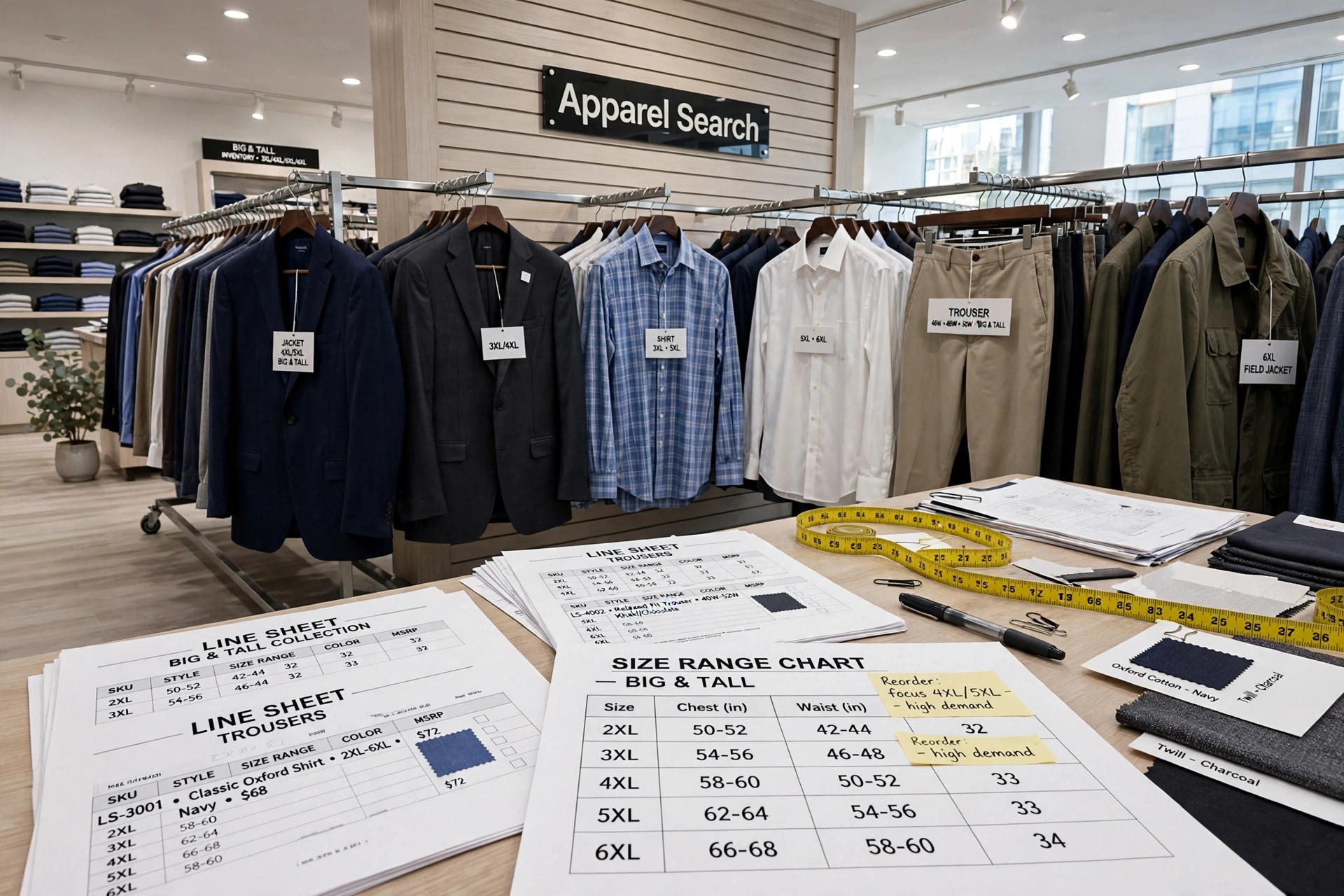
The big and tall buyer plans and buys a complete menswear offer in extended sizes: shirts, trousers, jeans, knitwear, suits, outerwear and underwear in sizes that typically run well beyond the standard range, with tall fittings adding length in body, sleeve and leg rather than simply scaling width. The buyer studies sales by size as carefully as by style, because the commercial heart of the job is the size curve — knowing which extended sizes sell in which categories, and buying enough depth in them that the customer who needs a specific size actually finds it in stock.
Vendor selection is specialised work. Not every menswear supplier grades properly into extended sizes, and the buyer seeks out manufacturers who pattern and construct for larger bodies rather than merely enlarging a standard block. Samples are fitted on big and tall fit models, orders are placed with size ratios reflecting this department's own demand rather than the parent range's, and in season the buyer watches size-level availability relentlessly: a department can show healthy overall stock while being sold out of exactly the sizes its customers came for.
Fit, Grading and the Sizing Decisions That Define the Role
Grading is the technical centre of big and tall buying. A shirt scaled up naively becomes long in the wrong places, tight across the shoulder relative to the chest, or unbalanced in collar and cuff proportions. The buyer must understand how chest, waist, shoulder, sleeve and body length should progress through the size range, how tall sizes differ from big sizes, and which construction details — longer shirt tails that stay tucked, reinforced seams, rise and seat shaping in trousers, adequate armhole depth — decide whether a garment is comfortable at larger sizes.
Size architecture is the buyer's own decision: where the extended range starts, how far it runs in each category, and how depth is split between core sizes and the extremes. Extremes sell in small numbers but their availability is a promise to the customer base; core extended sizes carry the volume. Getting that balance wrong in either direction is expensive — too shallow and the department disappoints the customers it exists for, too deep at the extremes and margin drains away in markdowns. This is why size-level sales analysis, not style-level alone, drives every rebuy and range review in this category.
Skills and Abilities the Role Requires
The big and tall buyer needs everything a menswear buyer needs — commercial judgement, numeracy, negotiation, trend awareness — plus two specialisms. The first is fit literacy: the ability to assess a sample on a larger body, diagnose why it pulls, rides or sags, and specify the correction in terms a pattern room can act on. The second is empathy grounded in evidence. Big and tall customers have often been badly served by standard ranges, and the buyer who talks to them, reads their feedback and fits accordingly builds both a better range and a more loyal business.
Analytical skill carries unusual weight here because size data is the department's map. The buyer must be comfortable working at size-by-size granularity, spotting where demand is being lost to stock-outs rather than weak product, and defending depth in unfashionable-looking sizes with numbers when range space is contested. Vendor relationships matter too: extended-size specialists are a smaller supplier pool, so long-term partnerships and clear specifications are worth more than constant switching.
Qualifications, Training and Career Path
Big and tall buyers usually arrive from menswear buying, where they have learned range planning, costing and vendor management, and then specialise — or from the big and tall retail floor itself, where fitting extended-size customers daily teaches the category's realities faster than any course. Formal qualifications in fashion buying or business help at entry to buying generally, but employers hiring for this desk weigh demonstrated fit knowledge and size-analysis experience most heavily, because those are the skills the department cannot function without.
Career progression runs through senior buyer roles in menswear or dedicated big and tall businesses — including specialist retailers and catalogue and online operations where extended sizes are the entire offer — and on to divisional merchandise management. The specialism also transfers into product development and technical roles focused on fit, and into plus-size womenswear buying, where the grading, depth and fit questions are closely related even though the customer and product differ.
Common Questions
How is big and tall sizing different from standard menswear sizing?
Big sizes add width and girth; tall sizes add length in body, sleeve and leg. Proper extended ranges are graded and patterned for larger bodies, not simply scaled up, so proportions such as shoulders, armholes and trouser rise stay comfortable and balanced.
Why does size depth matter so much in big and tall buying?
Customers in extended sizes often cannot buy the garment elsewhere, and they shop by size availability first. If the department is stocked overall but sold out of the sizes its customers wear, it loses both the sale and a notably loyal customer.
Do big and tall buyers need technical fit knowledge?
Yes. Assessing samples on big and tall fit models, understanding grading, and specifying fit corrections are core parts of the job, alongside the usual buying skills of range planning, costing and negotiation.