Children's Swimwear Buyer Job Description
Buying children's swim garments — safety first, sun protection, sizing by age and height
The children's swimwear buyer selects swim garments for babies, toddlers and older children: one-piece suits, trunks, two-piece sets, rash guards and swim nappies for the youngest wearers. This description is strictly about the products and their trade. Parents buy these garments on trust — trusting that a suit is safe, that its sun protection is genuine, that its size label matches their child's height, and that it will survive a holiday of daily swimming. The buyer's whole job is to make that trust well placed, season after season, at prices families can manage for children who will outgrow the garment within a year or two.
More Buying Job Descriptions by Letter:
What a Children's Swimwear Buyer Does
Range planning starts with the age ladder. The buyer builds the offer in age bands — baby, toddler, younger child, older child — deciding which garment types each band needs, from swim nappies and floating-friendly designs for the very young to sportier styles for older children who swim, surf and play in the water all day. Quantities are planned by band as much as by style, because a family whose child's size is missing simply buys elsewhere for the whole trip.
Supplier work centres on specification and evidence. The buyer sets out required fabric properties, seam and drawcord constructions, and labelling, then checks test reports and certifications before orders are confirmed. Samples are assessed as products: pulled, stretched, washed and examined for loose parts, rough internal finishes or fastenings a child could undo or catch. Only garments that pass that product scrutiny, at a price that respects how briefly each size is worn, earn a place in the range.
Safety: The Non-Negotiable Specification
Safety rules shape every product choice on this desk. Drawstrings and cords on children's garments are governed by strict standards in many markets because of entanglement hazards, so the buyer specifies cord-free or compliant designs and verifies them on production samples, not just on paperwork. Small parts — toggles, beads, decorative attachments — must be securely fixed or omitted entirely for younger age bands, and the buyer confirms attachment strength through supplier testing.
Visibility and labelling belong to the same discipline. Bright, easily seen colours are favoured for younger children's garments, helping supervising adults spot a child quickly in a busy pool or at the shoreline — a product attribute the buyer plans deliberately rather than leaving to fashion. Care and safety labelling must be accurate and durable: fibre content, washing guidance and any warnings are checked so the information survives the garment's life of frequent washing, sun and chlorinated water.
Sun Protection, Sizing by Age and Height
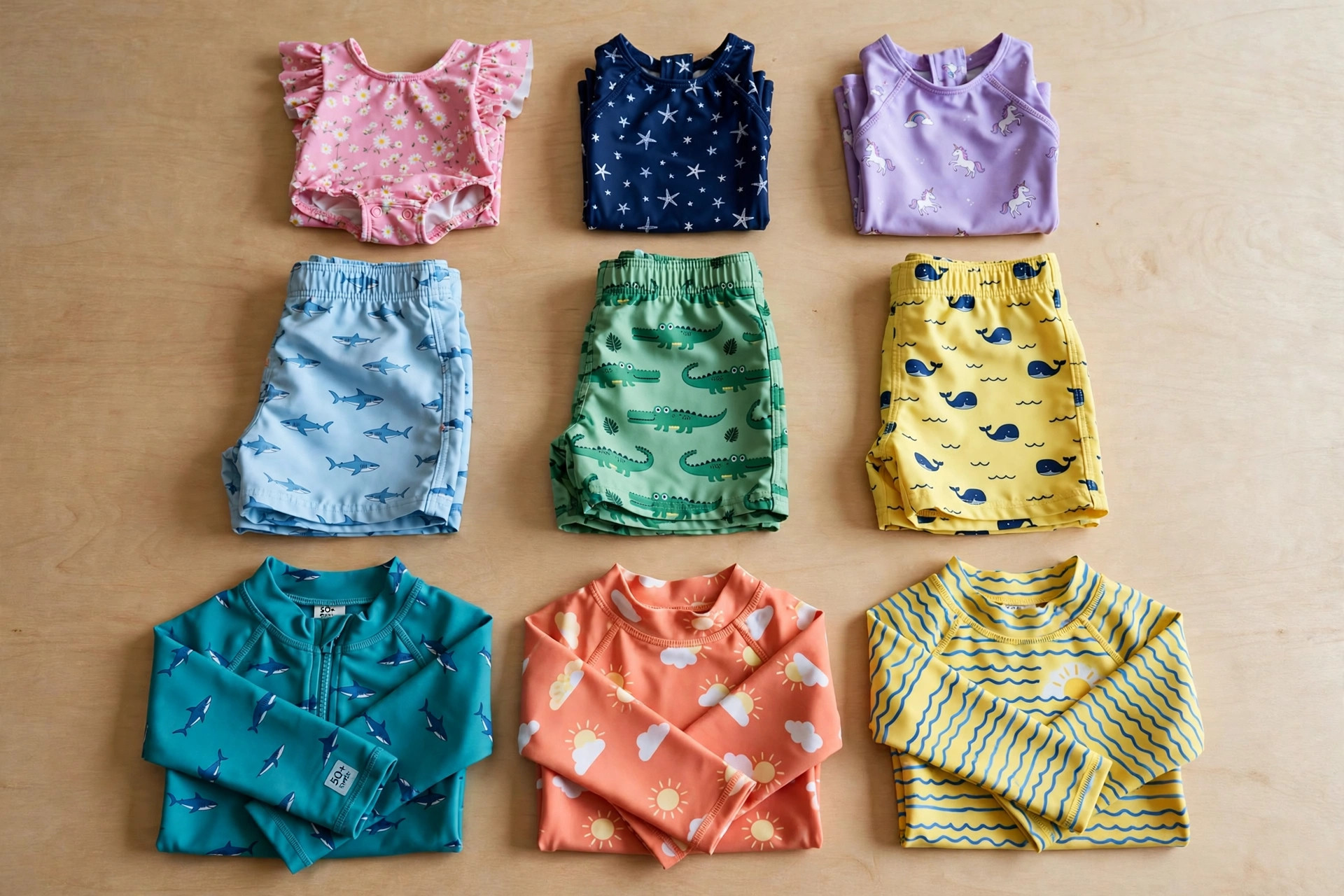
Sun-protective garments are a major and growing part of the children's range. Long-sleeve rash guards and legionnaire-style hats with neck coverage, made from fabrics rated for ultraviolet protection, let families cover shoulders and necks without relying on reapplied sunscreen alone. The buyer verifies that protection ratings come from recognised testing, plans sleeve and body coverage by age band, and makes sure the rating is communicated clearly on the product label so parents can choose with confidence.
Sizing is the desk's other technical pillar. Children's swim garments are sized by age and height together, and brands differ, so the buyer enforces a consistent size chart across suppliers, checks sample measurements against it garment by garment, and plans stock depth around growth: the middle age bands carry the volume, while baby sizes turn quickly and older children's sizes behave more like small adult ranges. Clear height guidance on labelling reduces returns and helps parents buy the right size first time.
Durability, Value and the Buying Skills Required
Children's swimwear lives hard: daily immersion, sand abrasion, sunscreen chemicals and constant washing, often for a single holiday fortnight. The buyer therefore specifies chlorine-resistant fabrics for pool-heavy lines, checks colourfastness to chlorinated and salt water, and favours constructions that tolerate rough treatment. At the same time, value discipline is absolute — garments are outgrown, not worn out, in most families — so cost engineering focuses on durable essentials rather than decoration.
The role calls for meticulous specification writing, confident reading of test reports and safety standards, and size-curve planning across many small bands. Buyers usually come from children's clothing desks, where age-and-height sizing and compliance habits are learned, and progress to senior children's buyer roles or children's department management. It is detailed, product-centred work where careful buying is directly visible in garments parents can rely on.
Common Questions
Why do children's swim garments avoid loose drawstrings?
Cords on children's clothing present an entanglement hazard and are restricted by safety standards in many markets. Buyers specify compliant or cord-free constructions and verify them on production samples before stock is accepted.
What does a sun-protection rating on a child's rash guard mean?
It records how much ultraviolet radiation the fabric blocks, established by laboratory testing. Buyers confirm the rating is test-backed, plan coverage such as long sleeves and neck flaps by age band, and check that the label explains it clearly.
How is children's swimwear sized?
By age band together with height, rather than by adult dress sizes. Buyers hold suppliers to one consistent size chart and plan quantities band by band, because children grow through sizes quickly and parents shop by their child's current height.