Swimwear Production Planner Job Description
Planning swimwear production — capacity, materials and delivery dates for a seasonal, fabric-sensitive product
A swimwear production planner builds the plan that gets swimwear made on time: which styles, in which factories, in what quantities and size ratios, cut and sewn in which weeks, so that finished ranges reach warehouses and stores before the selling season opens. Swimwear is one of the most planning-sensitive products in clothing — it is intensely seasonal, it is made from stretch fabrics and moulded components that behave differently from ordinary cloth, and a style is worth little if it lands after the holiday peak. The planner's work is the arithmetic and judgement that keep those constraints in balance.
More Production Job Descriptions by Letter:
Building the Swimwear Production Plan
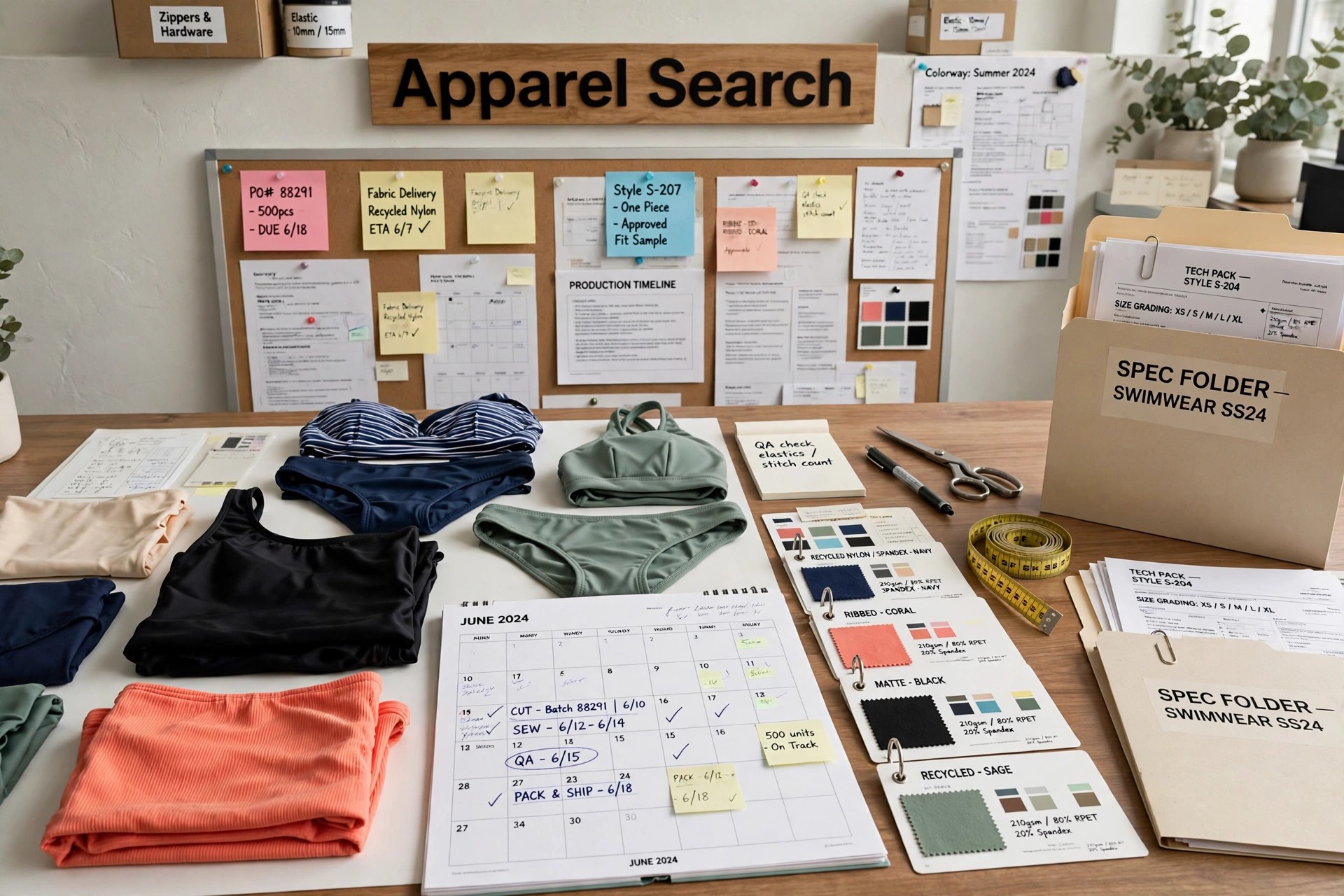
The planner starts from the confirmed range and order quantities and turns them into a production schedule. Styles are grouped by factory according to capability — swimwear needs machines and skills for elastic application, stretch stitching and, on some styles, moulded cup and boning work — and each order is placed on a timeline that counts backwards from the required delivery date through sewing, cutting, fabric and trim delivery, and sample approval. Because the selling window is short, swimwear plans are built with the season's end in view from day one: capacity booked late cannot be recovered once the season turns.
Size curves are a planning specialism of their own here. Swimwear sells in bra-sized and body-length variants as well as standard sizes, and the planner works with merchandising to set the ratio of sizes per style, then checks that cutting and sewing capacity, fabric consumption and component supply all match the curve chosen. A plan that is right in total units but wrong in sizes produces full rails of the sizes nobody buys and empty hooks in the sizes everybody needs.
Materials, Components and Capacity
Swimwear materials drive the plan's critical dates. Stretch fabrics — nylon and polyester elastane cloth, linings and powernet — are often dyed or printed to order, chlorine-resistant finishes add processing time, and components such as moulded cups, underwires, boning, rings, sliders and elastic each carry their own lead times and minimums. The planner sequences orders so materials arrive in cutting order, confirms greige and dyeing capacity with mills, and flags the styles whose components put them on the critical path long before the sewing lines feel the delay.
Capacity planning is the other half of the role. The planner loads factories and in-house lines week by week, balancing the peak — when every swimwear order wants the same weeks — against quieter periods that can absorb early production of continuity styles. Overtime, a second factory for a bestseller, or moving a delivery by agreement are planned decisions made from the planner's capacity picture, not improvisations made when a deadline is already missed.
Monitoring Production and Protecting the Season
Once production starts, the planner tracks it against the plan: fabric in, cutting complete, sewing output by day, finishing and packing rates, and the ex-factory dates that feed shipping. Variances are priced in season terms — a week lost in March may still be recoverable; a week lost in May may mean air freight or a missed launch — and the planner escalates with options and costs attached. Quality holds, re-cuts for faulty stretch fabric and late component deliveries are re-planned into the schedule so one style's problem does not silently consume another style's capacity.
The planner also guards the end of the season. As deliveries complete, open capacity and leftover materials are reviewed style by style: repeat orders for proven sellers are placed only where the remaining selling weeks justify them, and end-of-season production is wound down cleanly so fabric and trims bought for swimwear do not strand in stores. That discipline — knowing when the season makes further production worthless — is as much a part of swimwear planning as the launch schedule itself.
Skills, Qualifications and Career Path
Swimwear production planners need strong numerical and scheduling skills, fluency with planning spreadsheets and production systems, and a working knowledge of garment construction sufficient to judge whether a schedule a factory proposes is physically possible. Swimwear-specific knowledge — stretch fabric behaviour, elastic and cup components, size-curve planning and the swim calendar's selling windows — is what separates this role from general production planning, and it is usually learned inside swimwear or lingerie businesses, where the product's fitting and materials logic is shared.
Planners commonly arrive from production coordination, merchandising or general production planning roles, with business, textiles or supply-chain study behind them; employers test schedule-building on real examples and look for a record of seasons delivered whole. Progression leads to senior planning and planning management across a brand's product groups, or into production and supply-chain leadership, where the same capacity judgement runs at the scale of whole ranges rather than one seasonal category.
Common Questions
What does a swimwear production planner do?
Builds and monitors the production schedule for swimwear: placing styles with capable factories, sequencing stretch fabric and component supply, setting size curves with merchandising, loading capacity week by week and protecting the short selling season's delivery dates.
Why is swimwear planning different from general clothing planning?
Seasonality and materials. Swimwear sells in a short window, so late delivery loses most of a style's value, and its stretch fabrics, moulded cups, wires and elastic components carry long, specialised lead times that must be planned in cutting order.
How do swimwear production planners usually qualify?
Most come from production coordination, merchandising or general planning roles and learn swimwear's materials and size-curve logic inside swim or lingerie businesses. Employers test practical schedule-building and a record of seasons delivered on time.
More to Explore
Swimwear Production Resources
References & Further Reading
More Job Description Categories
- Buying Job Descriptions
- Design Job Descriptions
- Marketing & PR Job Descriptions
- Miscellaneous Job Descriptions
- Planning & Allocation Job Descriptions
- Production & Sourcing Job Descriptions (current)
- Sales & Selling Job Descriptions
- Transportation & Warehouse Job Descriptions