Production Planner Job Description
Turning confirmed garment orders into dated, workable factory plans — quantities, capacity, materials and delivery dates
A production planner is the individual specialist who converts confirmed clothing orders into a dated plan a factory can actually execute. Buyers and merchandisers decide what will be sold and in what quantities; the production planner decides when each style will be cut, sewn and finished, in which factory or line, with fabric and trims arriving in time to feed it. The planner personally builds and maintains the plan — order by order, week by week — and is the first person who can say, with evidence, whether a delivery date will be met. It is a desk-based, numbers-led role, distinct from the supervisor who leads the planning team and from the production supervisor who runs the factory floor.
More Production Job Descriptions by Letter:
Building the Production Plan
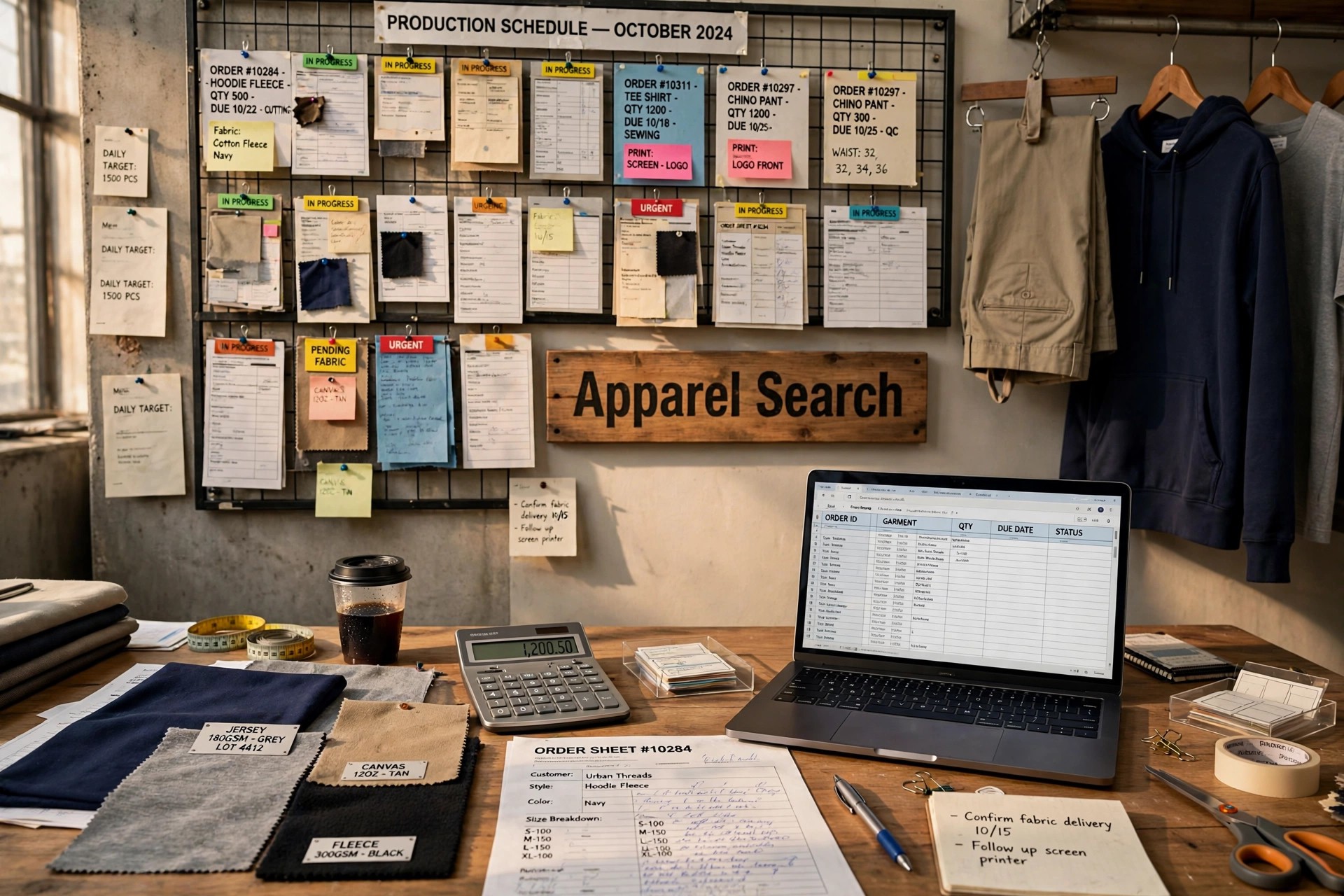
The planner starts from the confirmed order book: styles, quantities split by size and colour, delivery dates and the factories or internal lines available. Each order is broken into its production stages — fabric and trim arrival, cutting, sewing, finishing, inspection and packing — and each stage is given dates that respect real lead times, not hoped-for ones. Capacity is the planner's currency: a sewing line produces a finite number of garments a day depending on the style's complexity, so the planner loads orders onto lines and factories the way an accountant balances a ledger, checking that no week is promised twice and that difficult styles are not all scheduled into the same fortnight.
Materials planning runs alongside capacity planning. The planner calculates when fabric, linings, buttons, zips and labels must be in the factory for cutting to start on schedule, raises or confirms the requirement dates with purchasing and the mills, and builds the order's critical path from those dates. Most planners work inside a planning or ERP system, supported by spreadsheets of their own, and publish the plan as work-in-progress (WIP) reports that the whole business reads: what is cutting this week, what is sewing, what is at risk, and what has moved.
Keeping the Plan Honest When Reality Moves
No production plan survives contact with a season unchanged, and the planner's second job is re-planning. Fabric arrives late or fails inspection; a sample approval slips; a factory loses a line to a breakdown or a labour shortage. The planner absorbs each event into the plan — re-sequencing orders, splitting a quantity between two factories, moving a tolerant delivery forward to free capacity for an urgent one — and quantifies the consequence of each option before recommending it. The skill is not avoiding change but pricing it: this delay costs three days, that air-freight decision recovers two, this style can move because its delivery window allows it.
Communication is where re-planning succeeds or fails. The planner warns buying, merchandising and sales teams early, in numbers, while choices still exist — a delivery flagged at risk six weeks out is a problem; the same delivery flagged six days out is a crisis someone else caused by silence. Planners attend the weekly production meeting with their WIP evidence, answer for their orders, and leave with the agreed recovery actions recorded against dates. Over a season, a good planner's plans develop a reputation: dates from this desk can be trusted, which is the highest compliment the role receives.
Skills and Abilities the Role Requires
Numerical fluency is the foundation: quantities, ratios, percentages and lead-time arithmetic handled quickly and checked carefully, because a planning error multiplies across thousands of garments. Systems skill follows — planning and ERP software, confident spreadsheet work, and the discipline to keep data current, since the plan is only ever as good as the WIP information inside it. Production literacy matters as much as arithmetic: a planner who understands how garments are actually cut and sewn, and how long operations genuinely take, writes plans factories respect instead of plans they quietly ignore.
The personal qualities are organisation under volume — one planner may carry hundreds of live orders at different stages — and calm, factual communication when the news is bad. Planners sit between commercial teams who want everything earlier and factories who want everything easier, and the role requires holding the dated middle ground with evidence rather than volume. Attention to size-and-colour detail is unforgiving work: a transposed ratio in a plan becomes a warehouse of the wrong sizes, so the best planners check their own figures the way accountants reconcile accounts.
Qualifications, Training and Career Path
Production planners commonly arrive from production coordination, merchandising assistance, buying support or factory planning offices, where they learn order flow and lead times at first hand; others enter with textiles, garment technology, business or supply-chain education and learn the order book on the job. Employers screen for planning or coordination experience, spreadsheet and systems evidence, and examples of delivery problems diagnosed and recovered. Formal production-planning and supply-chain qualifications strengthen applications, but a record of reliable plans is the credential that carries weight at interview.
The career path is well marked. A planner with a strong record becomes a senior planner carrying the largest or most complex order books, then a production planning supervisor leading the planning team and owning the master schedule, and from there planning manager or production manager roles. Planning experience also transfers outward — into merchandising planning, sourcing and supply-chain management — because few roles teach the whole journey from order to delivery as completely as this one does.
Common Questions
What does a production planner do each day?
They build and maintain dated production plans for confirmed orders: loading styles onto factory lines by capacity, setting fabric and trim need dates, updating work-in-progress reports, re-planning around delays, and warning commercial teams early when a delivery date is at risk.
How is a production planner different from a production planning supervisor?
The planner personally plans a portfolio of orders. The planning supervisor leads the team of planners, owns the consolidated master schedule across factories, and makes the allocation calls when capacity is scarce. The supervisor reviews plans; the planner writes them.
What is a WIP report in production planning?
A work-in-progress report: the live record of every order's stage — fabric in, cutting, sewing, finishing, inspection, packing — against its planned dates. Planners maintain it, production meetings run from it, and delivery warnings are issued from it.
More to Explore
Production Resources
Production Directory Pages by Letter
References & Further Reading
More Job Description Categories
- Buying Job Descriptions
- Design Job Descriptions
- Marketing & PR Job Descriptions
- Miscellaneous Job Descriptions
- Planning & Allocation Job Descriptions
- Production & Sourcing Job Descriptions (current)
- Sales & Selling Job Descriptions
- Transportation & Warehouse Job Descriptions