Production Supervisor Job Description
Running a section of the factory floor — people, machines, output targets and garment quality, shift by shift
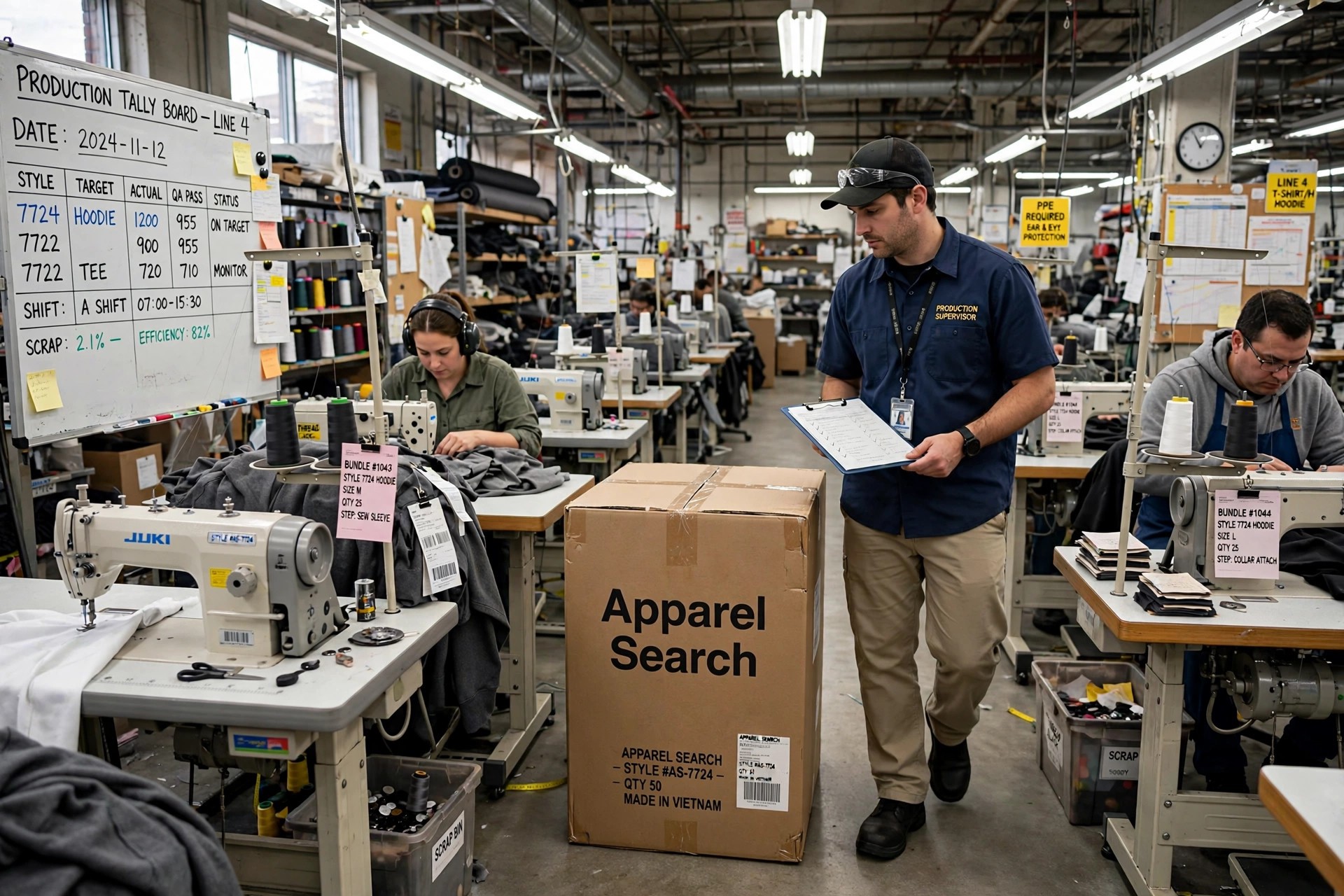
A production supervisor runs a section of the factory floor: a group of sewing lines, or a cutting, finishing or pressing department, and the people who staff it. Where the production planner works on paper and systems, and the planning supervisor owns the schedule, the production supervisor owns the shift — allocating work to operators, balancing the line so no station starves or drowns, holding output against the hourly target, and catching quality faults at the station where they are made rather than the inspection table where they are found. It is the most people-intensive role in garment production, and the one closest to the garments themselves.
More Production Job Descriptions by Letter:
Running the Line Day to Day
The supervisor's day begins before the machines do: checking which styles each line is running, confirming the bundles of cut work are ready in the right sequence, and posting operators to operations according to skill — the fastest machinist on the bottleneck operation, a trainee where the work forgives learning. Through the shift the supervisor walks the lines constantly, reading the floor the way a planner reads a WIP report: a station piling up work signals a balance problem, an operator waiting signals a feeding problem, and both cost output every minute they persist. Hourly production counts are checked against target, and the supervisor acts on the gap while it is still recoverable — rebalancing operations, moving a floater, or calling the mechanic before a struggling machine stops a line.
Style changeovers are the supervisor's set-piece. When a line finishes one garment and starts another, operations change, machine settings and attachments change, and the first garments off the line set the standard for the run. The supervisor organises the changeover to lose the least production, checks the first pieces against the specification and sample with the quality team, and only then lets the line run at pace. Output records, efficiency figures and downtime causes are the supervisor's paperwork: accurate shift reporting is what planning and management use to judge whether the schedule is real.
People, Machines and Problems
A supervisor may be responsible for thirty to a hundred operators, and most of the job's difficulty is human. Training new machinists to standard without wrecking their confidence or the line's output, covering absence so a balanced line survives its gaps, handling the first stage of grievances and discipline fairly and on the record, and enforcing safety around needles, knives and presses — all of it lands on this role daily. Experienced supervisors know their operators individually: who can be trusted with the difficult operation, who needs checking twice, who is ready to learn the next skill that raises their grade and pay.
Machines are the other constituency. The supervisor does not repair them — mechanics do — but decides when a machine's behaviour stops being an operator issue and becomes an engineering call, protects production by swapping stations where possible, and keeps the small disciplines (cleaning, oiling, needle changes) that prevent breakdowns in the first place. Quality threads through everything: the supervisor is accountable for faults made on their lines, works with inspectors on recurring defects, and traces a fault back to the operation, the operator or the machine setting that produced it, fixing the cause rather than sorting the symptom at the end of the line.
Skills and Abilities the Role Requires
Garment knowledge is non-negotiable: a production supervisor must understand construction and machine operations well enough to demonstrate an operation, judge whether output is right, and spot the station where a fault is being born. Most supervisors have sewn, cut or finished garments themselves, and the floor can tell within a day whether its supervisor has. Numeracy is practical rather than academic — targets, efficiencies, piece counts and ratios calculated on the move — and record-keeping must survive audit, because production figures drive pay, planning and customer promises alike.
The decisive skills are leadership on foot: clear instruction to a line of people with different languages and experience, fairness visible enough that difficult decisions are accepted, and the stamina to be present and attentive for a whole shift rather than administering from a desk. Conflict is routine material — between operators, between lines competing for mechanics, between output pressure and quality standards — and the supervisor resolves it at floor level before it becomes absence, attrition or a stopped line. Factories promote their best problem-solvers into this chair, and lose production when they promote anyone else.
Qualifications, Training and Career Path
Production supervisors typically rise from the floor: senior machinist, line leader or chargehand first, with a record of output, quality and reliability that other operators already respect. Employers test garment and machine knowledge practically and interview for people judgement; formal supervisory or garment-technology qualifications help and are often provided in post, alongside training in safety, employment basics and production recording. A supervisor hired from outside the factory must still prove the craft — the role's authority is earned at the machines before it is exercised over them.
The path upward runs to production manager, responsible for the whole factory's output across departments, and from there to factory or operations management. Supervisors also move into work-study and industrial engineering, quality management, and training roles, carrying floor knowledge that office roles cannot replicate. In an industry where many senior managers began as supervisors, the post remains what it has always been: the proving ground where garment production stops being a job someone does and becomes a floor someone runs.
Common Questions
What does a production supervisor do in a clothing factory?
They run a section of the floor for a shift: allocating operators to operations, balancing sewing lines, checking hourly output against target, organising style changeovers, holding quality at the station, and handling training, absence, breakdowns and first-line people issues.
How is a production supervisor different from a production planner?
The planner schedules orders on paper and systems, weeks ahead. The supervisor executes on the floor, hour by hour: people, machines and output. Planning decides what the line will run; supervision makes the line run it, to target and to standard.
Do production supervisors need sewing experience?
In practice, yes. Supervisors are usually promoted from senior machinist or line-leader roles, and the job requires demonstrating operations and judging garment quality at the station — authority on a sewing floor rests on having done the work.
More to Explore
Production Resources
References & Further Reading
More Job Description Categories
- Buying Job Descriptions
- Design Job Descriptions
- Marketing & PR Job Descriptions
- Miscellaneous Job Descriptions
- Planning & Allocation Job Descriptions
- Production & Sourcing Job Descriptions (current)
- Sales & Selling Job Descriptions
- Transportation & Warehouse Job Descriptions