Swimwear Pattern Maker Job Description
Pattern drafting for swim garments — negative ease, stretch fabrics, linings and elastic, engineered for movement in and out of the water
A swimwear pattern maker is a pattern maker who specialises in swim garments: drafting, correcting and grading the patterns from which swimsuits are cut. It is a distinct specialism because swim garments are built from high-stretch knitted fabrics and are worn close to the body, so the pattern must be engineered around stretch, recovery and negative ease in a way that woven-garment pattern work never requires. This page covers the Production-category pattern role; the general Pattern Maker description in this category covers pattern work across all garment types.
More Production Job Descriptions by Letter:
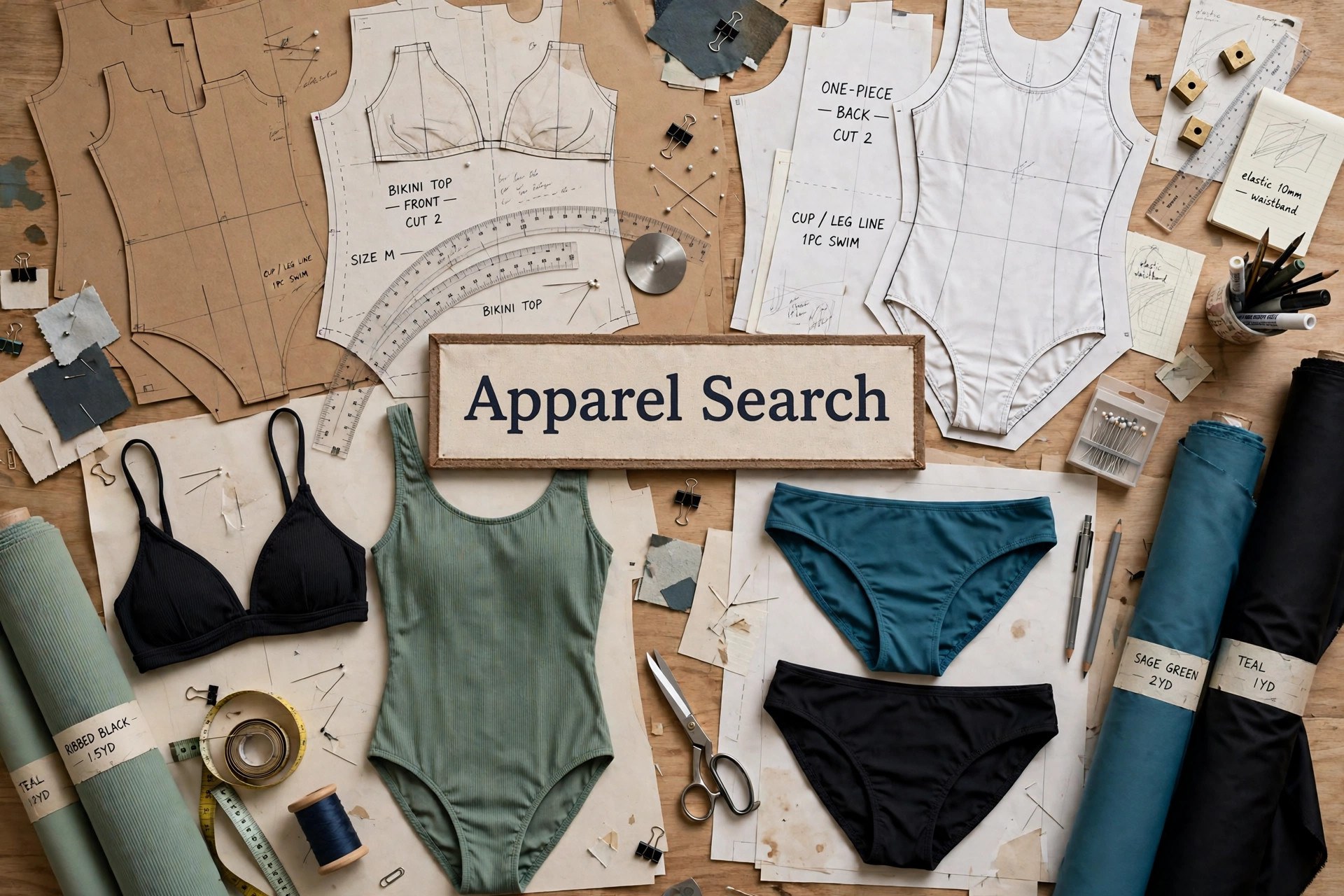
Drafting Patterns for Stretch Fabrics
The defining technique is negative ease: a swim garment is patterned smaller than the body measurements it is designed for, and the fabric’s stretch supplies the difference, holding the garment in place. How much smaller depends on the specific fabric’s stretch percentage and recovery in each direction, which the pattern maker establishes by testing the actual cloth — a pattern drafted for one swim fabric will not perform in another with different stretch, so fabric testing is part of drafting, not an afterthought.
Construction knowledge is built into the pattern. Swim garments are typically lined in whole or part, use elastic at leg, neck and arm openings to maintain fit in the water, and may include soft cups, boning channels or support bands in structured styles. The pattern maker patterns each layer — outer, lining and any support components — so they work together without bulk or drag, places elastic lengths and attachment points, and specifies seam types, such as overlocked or zigzag stretch seams, that extend with the fabric instead of cracking.
Fitting, Correction and Grading
Drafting is proven in fitting. Proto patterns are cut and sewn as test garments, assessed for fit, coverage, strap and opening placement and how the garment behaves when the fabric is wet and under movement, then corrected on the pattern — raising or lowering a leg line, rebalancing stretch between panels, adjusting where elastic tension sits. Several iterations are normal, because stretch behaviour under real conditions is only partly predictable from the flat pattern.
Grading a swim pattern follows stretch logic rather than woven logic: increments are smaller and distributed differently, because the fabric itself accommodates part of the size difference, and the balance of negative ease must stay consistent so every size holds and covers as the base size does. The pattern maker also prepares the marker and consumption information, works with sample makers on construction order, and issues the final pattern with its fabric stretch requirements stated, so production in a substitute fabric is never approved blindly.
Where Swimwear Pattern Makers Work
Swimwear pattern makers work in the technical and sample rooms of swim and beachwear brands, in factories that manufacture swim garments for several labels, and as freelance specialists serving smaller brands that cannot keep the specialism in-house. The work is seasonal in rhythm — development concentrates ahead of the swim selling season, with resort and cruise ranges adding a second cycle for some brands — and closely collaborative with designers, sample makers and the factories that will run bulk production.
Accuracy in this specialism is judged on the finished garment’s performance: whether it stays in place, keeps its shape wet and dry, fits consistently across its size range and sews without production problems at the factory. A pattern maker whose swim patterns repeatedly achieve that becomes the person swim brands call first, because swim fit failures are unusually visible to the customer and unusually hard for a factory to fix after cutting.
Skills, Training and Career Path
The foundation is full pattern-making competence — drafting, correction and grading — usually from pattern or garment technology study and general pattern-room experience, followed by specialisation in stretch and swim fabrics. Employers test practically, with a pattern task in an actual swim fabric, and they look for fabric-testing discipline, stretch mathematics, and knowledge of swim construction: linings, elastics, cups and stretch seaming.
Career paths lead to senior pattern and technical roles within swim and active brands — the stretch expertise transfers directly to activewear, dancewear and other close-fit stretch categories — to technical management, and to freelance pattern consultancies specialising in stretch garments. Some swimwear pattern makers move into product development and garment technology leadership for swim ranges, carrying the fit knowledge that defines those products.
Common Questions
What makes swimwear pattern making different from general pattern making?
Negative ease and stretch engineering. Swim garments are patterned smaller than the body and rely on the fabric’s tested stretch and recovery to fit, with linings, elastic and stretch seams patterned as part of the garment. Woven-garment patterns are drafted at or above body size with wearing ease added.
Why must the fabric be tested before drafting?
Because the pattern’s negative ease is calculated from that fabric’s stretch percentage and recovery. A different fabric with more or less stretch would make the same pattern too loose or too tight, so the pattern states its fabric requirements and substitutes must be re-tested.
How do you become a swimwear pattern maker?
By first qualifying as a pattern maker — pattern drafting, correction and grading, usually with garment technology study and pattern-room experience — then specialising in stretch fabrics through swim or activewear employers, with hiring based on practical pattern tests in swim cloth.
More to Explore
Swimwear Pattern Resources
References & Further Reading
More Job Description Categories
- Buying Job Descriptions
- Design Job Descriptions
- Marketing & PR Job Descriptions
- Miscellaneous Job Descriptions
- Planning & Allocation Job Descriptions
- Production & Sourcing Job Descriptions (current)
- Sales & Selling Job Descriptions
- Transportation & Warehouse Job Descriptions