Pattern Maker Job Description
Drafting, draping and fitting the first pattern — the craft that turns a design into a garment that can be made
The pattern maker is the craftsperson who turns a design into geometry that cloth can follow. From a designer’s sketch, a reference garment or a set of measurements, the pattern maker drafts or drapes the first pattern — the shaped pieces that, cut and sewn, become the sample garment — then fits it, corrects it and refines it until the style sits on the body exactly as intended. Every garment in production begins as this person’s judgement about shape, ease and balance, expressed in paper, card or CAD.
More Production Job Descriptions by Letter:
Drafting and Draping the First Pattern
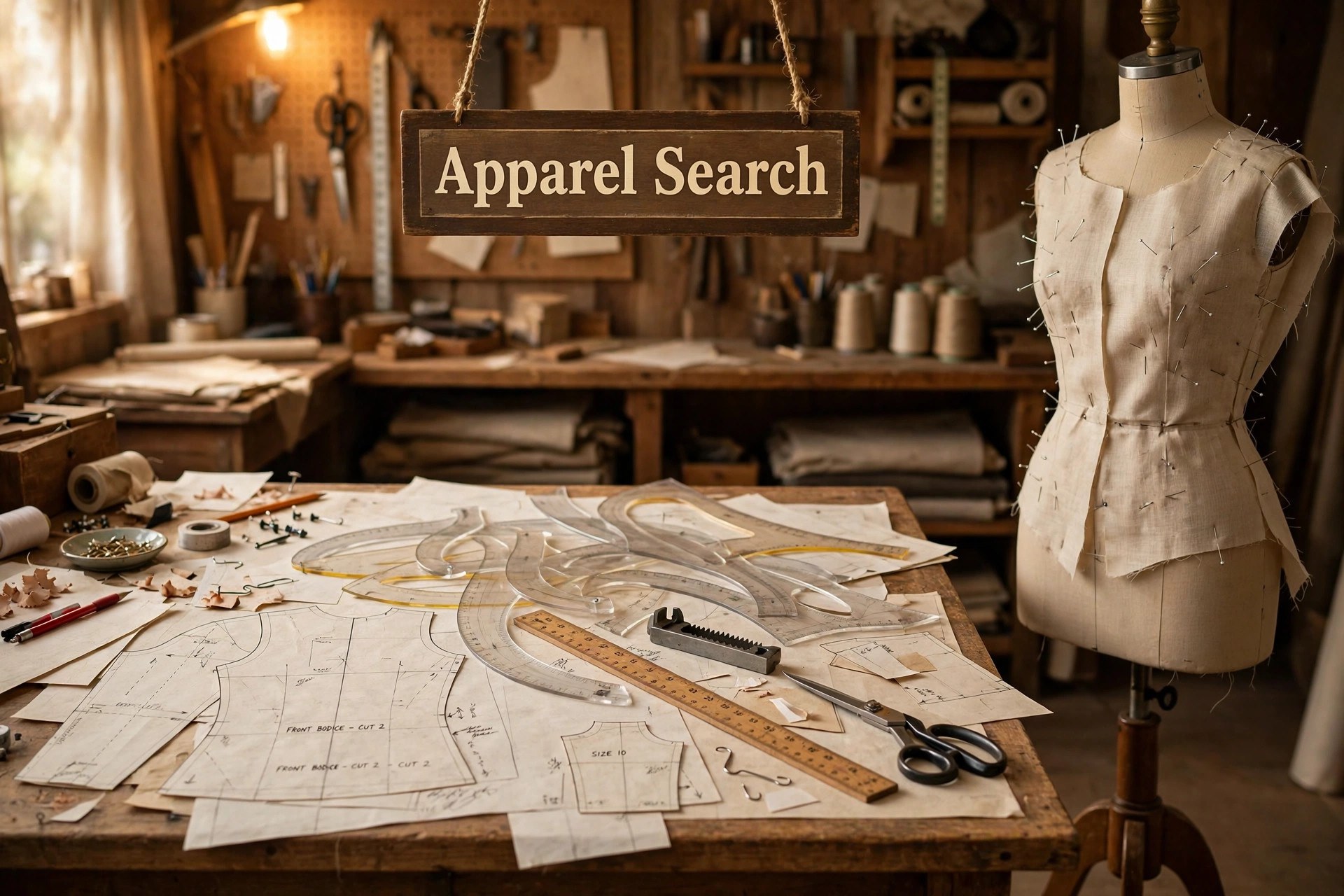
Two classical routes lead to a first pattern, and good pattern makers command both. Drafting works flat: plotting measurements onto paper with rulers, curves and set squares, building from a block — the proven base shape for a bodice, sleeve, trouser or skirt — and adding the style’s design lines, fullness, closures and details. Draping works in three dimensions: pinning and shaping muslin or toile fabric directly on the dress form, marking the style lines on the cloth, then taking it down to flatten, true and transfer the shapes to paper. Soft, fluid and asymmetric designs often drape best; structured tailoring usually drafts better.
Either way, the pattern that emerges is a working tool, not a drawing. Pieces carry grain lines, notches that tell machinists what joins what, drill marks for pockets and buttons, seam allowances suited to each seam’s construction, and the facing, lining and interfacing pieces a garment needs to be complete. The pattern maker thinks as a maker throughout: a beautiful line that cannot be sewn cleanly, pressed properly or graded later is redrawn until it can, because the pattern is a promise the whole factory must be able to keep.
Fitting, Correction and the Sample Room
The first sample is the pattern’s examination. The pattern maker attends fittings on the stand and on fit models, reading the garment’s evidence: drag lines pointing to shortage, pooling where there is excess, a collar rolling, a sleeve twisting, a waist sitting off its true line. Each fault is diagnosed to its pattern cause and corrected on the pieces — a millimetre at the pattern becoming a centimetre of comfort on the body — and a new sample is cut and fitted until design, fit and makeability agree. Experienced makers correct decisively and in sequence, changing one cause at a time so the effect of each change can be seen.
The sample room is the pattern maker’s home ground, in constant exchange with sample machinists whose sewing reveals what the paper concealed. Makers learn which corrections survive real fabric after being proven in toile, how different cloth weights change a fit, and when a designer’s sketch needs a construction conversation rather than another fitting. Pre-production samples, size sets and sealing stages repeat the loop at higher stakes: the final approved pattern, graded across sizes, becomes the standard every bulk garment is cut from.
From Craft Pattern to Production Pattern
A pattern that fits one sample must also survive production. The pattern maker prepares patterns for that journey: finalising seam allowances for the factory’s machines and methods, adding the notches and markings cutting and sewing rooms rely on, checking that paired pieces match and seam lengths walk, and supplying the measurement chart the garment will be inspected against. In CAD-equipped rooms the maker digitises hand patterns or builds them digitally from the start; the tools change, while the fit judgement remains the craft. The related Pattern Engineer page describes the technical systems — grading rules, CAD libraries and factory pattern control — that take patterns from this point into multi-factory production.
Accuracy here is economic as much as aesthetic. A pattern fault found at fitting costs an hour; found at bulk cutting it costs a production run. Pattern makers therefore document their patterns properly — style numbers, sizes, revision dates, fabric notes — and keep blocks and proven patterns filed as the company’s reusable capital. Many also contribute the practical voice in design meetings, advising early when a silhouette needs a seam moved, a dart reshaped or a fabric changed while change is still cheap.
Skills, Training and Career Path
The craft rests on trained eyes and hands: a feel for the body and how cloth behaves on it, precision with measurement and line, spatial imagination that sees a flat shape as a worn garment, and patience for iterative fitting. Training routes include fashion and pattern-cutting qualifications, dedicated pattern drafting courses, and the traditional apprenticeship of the sample room — junior pattern cutter and pattern assistant roles under senior makers, building blocks and simple styles before complex ones. Hand drafting and draping remain the foundation even where CAD is the daily tool.
Pattern makers work in design studios, sample rooms and factory technical offices, to development calendars with intense peaks before range sign-offs. The career ladder runs to senior and first pattern maker — the maker trusted with the most complex styles and the final fittings — then to sample room or pattern room management, technical design, or the pattern engineering specialism. Some makers build freelance practices serving several brands, and couture and bespoke ateliers value the same craft at its highest level of finish.
Common Questions
What does a pattern maker do?
Creates the first pattern for a garment — drafting it flat from measurements or draping it in cloth on a dress form — then fits and corrects sample garments until the style is right, and prepares the approved pattern, with allowances, notches and measurements, for grading and production.
What is the difference between drafting and draping?
Drafting builds the pattern flat on paper from measurements and blocks, using rulers and curves. Draping shapes cloth directly on a dress form and flattens the result into pattern pieces. Structured styles usually draft; soft and fluid styles often drape; most pattern makers use both.
How do pattern makers train?
Through pattern-cutting and fashion qualifications, specialist drafting and draping courses, and sample-room apprenticeships as pattern assistants under senior makers. Hand skills come first; CAD pattern tools are learned on top of them.
More to Explore
Pattern Making Resources
Terms for Pattern Makers
References & Further Reading
More Job Description Categories
- Buying Job Descriptions
- Design Job Descriptions
- Marketing & PR Job Descriptions
- Miscellaneous Job Descriptions
- Planning & Allocation Job Descriptions
- Production & Sourcing Job Descriptions (current)
- Sales & Selling Job Descriptions
- Transportation & Warehouse Job Descriptions