Pattern Makers Job Description
Turning designs into the paper and digital patterns every garment is cut from — the occupation as a whole
Pattern makers turn a designer's sketch or a buyer's brief into the flat shapes from which a garment is cut and sewn. Working by hand with paper, rulers and curves, by draping fabric on a dress form, or in computer-aided design software, they draft the pattern pieces, direct the making of the first sample, correct the pattern through fitting after fitting, and grade the approved pattern into the full size range. This page describes the occupation as a whole, wherever it is practised — design studios, sample rooms, factories and alteration workrooms.
More Job Descriptions by Letter:
Start Here: Pattern Making Work
Drafting, Draping and the First Sample
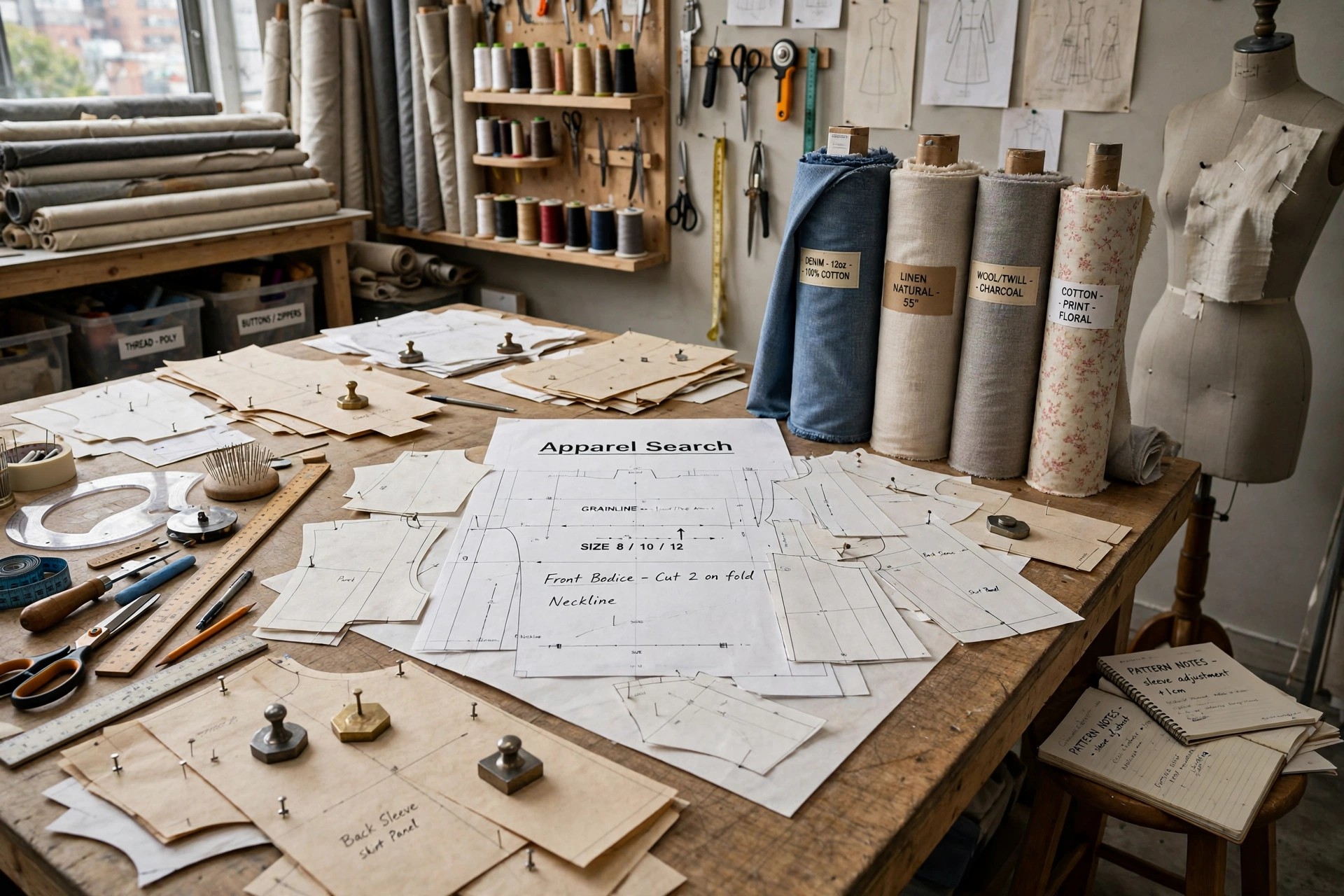
A pattern maker's work starts from one of three sources: a sketch and specification from a designer, a garment to be copied or adapted, or a standard block — the proven basic pattern for a shirt, trouser or dress from which new styles are developed. Drafting works flat: measurements and ease allowances are plotted, seam lines drawn with curves and rulers, darts and fullness positioned, and each piece marked with grain line, notches, drill holes and seam allowances. Draping works in three dimensions, pinning and shaping fabric on a stand until the design's lines sit correctly, then transferring the result to paper.
The draft becomes a sample. A machinist sews the first prototype — often in calico or a substitute fabric — and the pattern maker assesses it on the stand or a fit model: balance, ease, seam placement, how the garment moves and sits. Corrections go back onto the pattern, sometimes through several sample rounds, because every fault corrected on paper is a fault prevented across the whole production run. The approved pattern is the garment's constitution; everything downstream assumes it is right.
Grading, Markers and Computer-Aided Pattern Work
An approved pattern exists in one size; production needs every size. Grading is the pattern maker's systematic enlargement and reduction of each piece between sizes, applying the company's grade rules so proportions hold across the range — a skill where small errors multiply visibly, because a badly graded armhole or neck fails on the largest and smallest sizes first. Pattern makers also supply the information cutting depends on: piece lists, fabric widths, and in many workplaces the marker — the efficient layout of pieces that decides how much fabric a garment consumes.
Computer-aided design has moved much of this work onto screens without changing its substance. CAD pattern systems draft, grade and store patterns digitally, plot them at full size, and pass markers straight to automatic cutters; many pattern makers now work hybrid — a hand draft for a difficult drape, digitised for grading and production. The judgement remains the occupation's core: software applies rules, but the pattern maker decides what the rules should be for this garment, this fabric and this body of customers.
Fit, Fabric and Working With Designers and Factories
Pattern making is the meeting point of design intent and physical possibility. The pattern maker reads a sketch and knows what it omits: how a sleeve will actually hang, whether a woven fabric can achieve the drape drawn, where a seam must move for a body to sit down. Fittings are negotiations as much as measurements — the designer defending the look, the pattern maker defending wearability and producibility, the sample in front of both as evidence. Fabric knowledge is constant: stretch, bias behaviour, shrinkage and thickness all change what a correct pattern is.
The occupation's settings shape its day. In a design studio or sample room, the pattern maker works close to designers across a season's styles. In a factory, the work runs closer to production — patterns adapted, checked and graded for orders at volume. Freelance and service pattern makers supply smaller brands that cannot employ the skill full-time. One neighbouring page should be distinguished: the Production category of this section carries its own pattern maker description, written from the production and sourcing workplace; this page is the occupation-wide treatment, and the two are cross-linked rather than merged.
Skills, Training and Career Paths
Pattern makers usually train through fashion or clothing-technology courses with pattern cutting at their core, through apprenticeships in sample rooms, or by progressing from skilled sewing and sample machining, where garment construction is learned seam by seam. Employers test the craft directly — a draft, a fitting assessment, a grading exercise — because pattern ability is demonstrable. The skills employers name are precision, spatial imagination, garment construction knowledge, measurement discipline and, increasingly, fluency in a CAD pattern system alongside the hand skills that remain the craft's foundation.
Careers deepen before they widen: from assistant pattern maker to pattern maker to senior or head pattern maker responsible for a range's fit identity. Movement sideways is common and valued — into technical design, garment technology and quality roles, into sample-room management, or into freelance practice serving several brands. Because fit is the most common reason garments are returned, the experienced pattern maker's judgement — what will fit this customer, in this fabric, at this price — is among the most commercially valuable crafts in the clothing trade.
Common Questions
What does a pattern maker do?
Converts designs into the patterns garments are cut from: drafting or draping pattern pieces, directing and correcting sample garments through fittings, grading the approved pattern across the size range, and supplying the piece and layout information cutting depends on.
How do pattern makers train?
Mostly through fashion or clothing-technology courses centred on pattern cutting, sample-room apprenticeships, or progression from sample machining. Employers test drafting and fitting judgement directly, and CAD pattern software skills are now expected alongside hand drafting.
How does this page differ from the Production category's pattern maker page?
That page treats the role from inside production and sourcing workplaces. This page is the occupation-wide overview — studios, sample rooms, factories and freelance practice — and the two pages cross-link rather than duplicate each other.