Polyester Chips
Polyester chips are the small solid pellets of polymer from which polyester fiber, yarn and film are made, and their price quietly drives the whole polyester chain. This page explains what chips are, how their pricing is reported and how to use chip information when you buy downstream products.
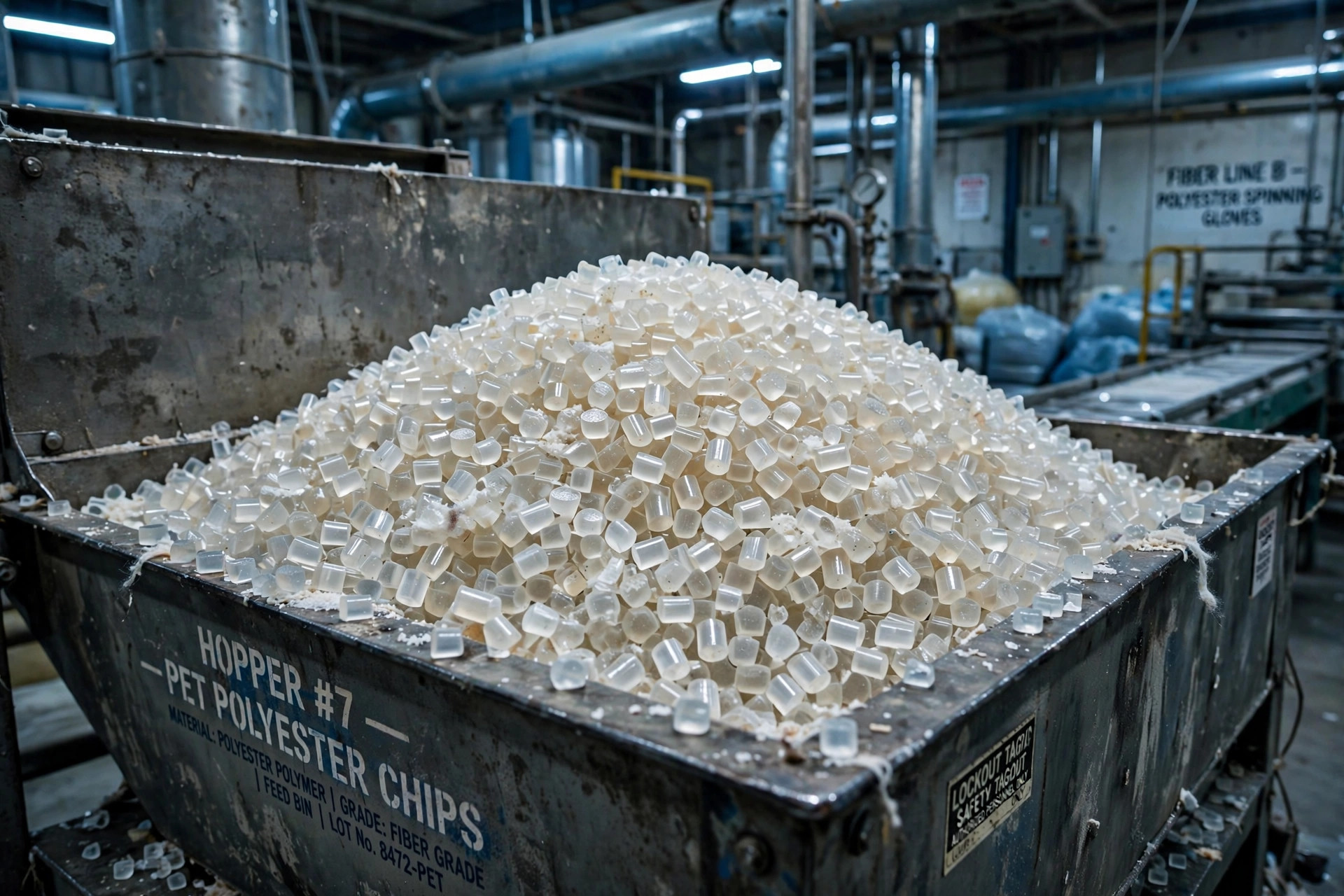
The Pellet at the Start of the Chain
Every polyester textile begins as polymer, and the polymer usually travels in chip form: small, uniform pellets that are easy to store, ship, dry and melt. A fiber producer melts polyester chip and extrudes it into filament or cuts it toward staple fiber; a bottle and film producer uses closely related grades for entirely different products. The chip market sits underneath fiber, yarn and fabric prices: it is the first price in the chain.
Chips are not all identical, and the differences matter to both processing and price. Textile chip is produced for spinning, with viscosity and purity suited to drawing fine filaments, while bottle-grade chip is engineered for a different forming process and food-contact requirements. Within textile chip, producers distinguish grades by characteristics such as luster, with bright and semi-dull variants created by additives that later show up in the yarn's appearance. A chip quotation without a grade is like a yarn quotation without a denier: a number attached to an incomplete description.
How Chip Prices Are Reported and Used
Yarns and Fibers provides polyester chip price coverage, a service that gathers price information for the fiber trade. Chip prices are typically reported as market levels for defined grades in defined producing regions, updated frequently because the market moves with its raw materials. Polyester is made from petrochemical building blocks, so chip prices respond to crude-oil-linked feedstock costs, to plant operating rates and to how strongly fiber, film and bottle buyers are competing for output in the same weeks.
A downstream buyer uses chip reporting diagnostically rather than transactionally. You will probably never buy a truckload of chip, but watching its trend tells you whether the yarn increase a supplier just announced reflects the market or merely the supplier. A chip rise that persists for several weeks normally reaches fiber prices, then yarn prices, then fabric quotations, with lags at each stage while inventories turn over. Chip data therefore functions as an early-warning gauge: by the time a fabric price moves, the chip market has usually been explaining it for a month.
From Chips to Fiber, Yarn and Fabric
The conversion path explains the lags. Chip is melted and spun into polyester fiber, in filament form for continuous yarns or cut into staple for spinning with other fibers. Yarn producers add texturing, dyeing preparation and quality control, and fabric mills add weaving or knitting and finishing. At each step the previous stage's price becomes the largest single cost inside the next stage's price, which is why chip, fiber, yarn and fabric prices are tracked separately, stage by stage.
Readers who want the full path can follow it through this section: start with polyester fiber as a material, keep up with polyester news articles for the industry events behind price moves, and use the About Polyester Fibers material for production background. The resin, fiber, yarn and fabric price pages then let you track a movement spotted in chip prices as it moves toward the fabric quotation on your desk.
What to Ask When Chip Prices Move
When chip prices shift sharply, useful questions follow for every supplier downstream. Ask your yarn or fabric supplier how much of their increase is raw material pass-through and how much is conversion, because only the first part should track the chip market exactly. Ask how long their current inventory position insulates your price, since a supplier holding older chip or yarn stock may phase an increase rather than apply it at once. And ask what would reverse the movement, which reveals whether the supplier reads the same feedstock story you do.
Keep perspective on scale, too. A small chip movement inside normal weekly noise rarely justifies renegotiating a fabric program, while a sustained feedstock-driven climb eventually reaches every polyester product without exception. The habit that matters is calibration: check chip prices regularly, note the trend rather than the daily figure, and bring that trend, politely and with dates, into downstream price discussions. Suppliers expect informed buyers to do exactly this, and the conversation improves when both sides are reading the same upstream gauge.
Common Questions
What are polyester chips?
They are small solid pellets of polyester polymer, the transportable form in which PET is stored, shipped, dried and melted before being extruded into fiber and yarn, or formed into film and bottles in related grades.
Why should a fabric buyer watch chip prices?
Chip is the first price in the polyester chain. Its trend passes through fiber and yarn costs into fabric quotations with a lag, so chip reporting works as an early warning that a downstream price change is market-driven.
Are all polyester chips the same?
No. Textile chip is graded for spinning, with variants such as bright and semi-dull luster, while bottle-grade chip is engineered for a different process. A chip price only makes sense attached to its grade and region.
More to Explore
References & Further Reading
Looking for Fabric Mills and Suppliers?
Follow the polyester chain downstream in the Apparel Search fabric directory or from the Fabric Search hub, where the fiber, yarn and fabric price pages continue the story.