David Holah Profiles
The career in three acts — Bodymap, the freelance years, the printmaker.
David Holah obtained a first class BA with honours in Fashion and Textiles at Middlesex Polytechnic, then set up the pioneering label Bodymap with partner Stevie Stewart — and together they put British fashion back on the map, enticing international press and buyers with their controversial catwalk shows. This profiles page tells the whole career: the label's five-year run of honors, the freelance and teaching years that followed its closure, and the second creative life, as a printmaker, that began in 2006. It is the fullest biographical account in this series, and the one the other seven pages quietly depend on.
The biography searches in the references gather the wider career coverage. Pair this page with the collections page for the work itself, and with the main David Holah page for the news, photo and video routes.
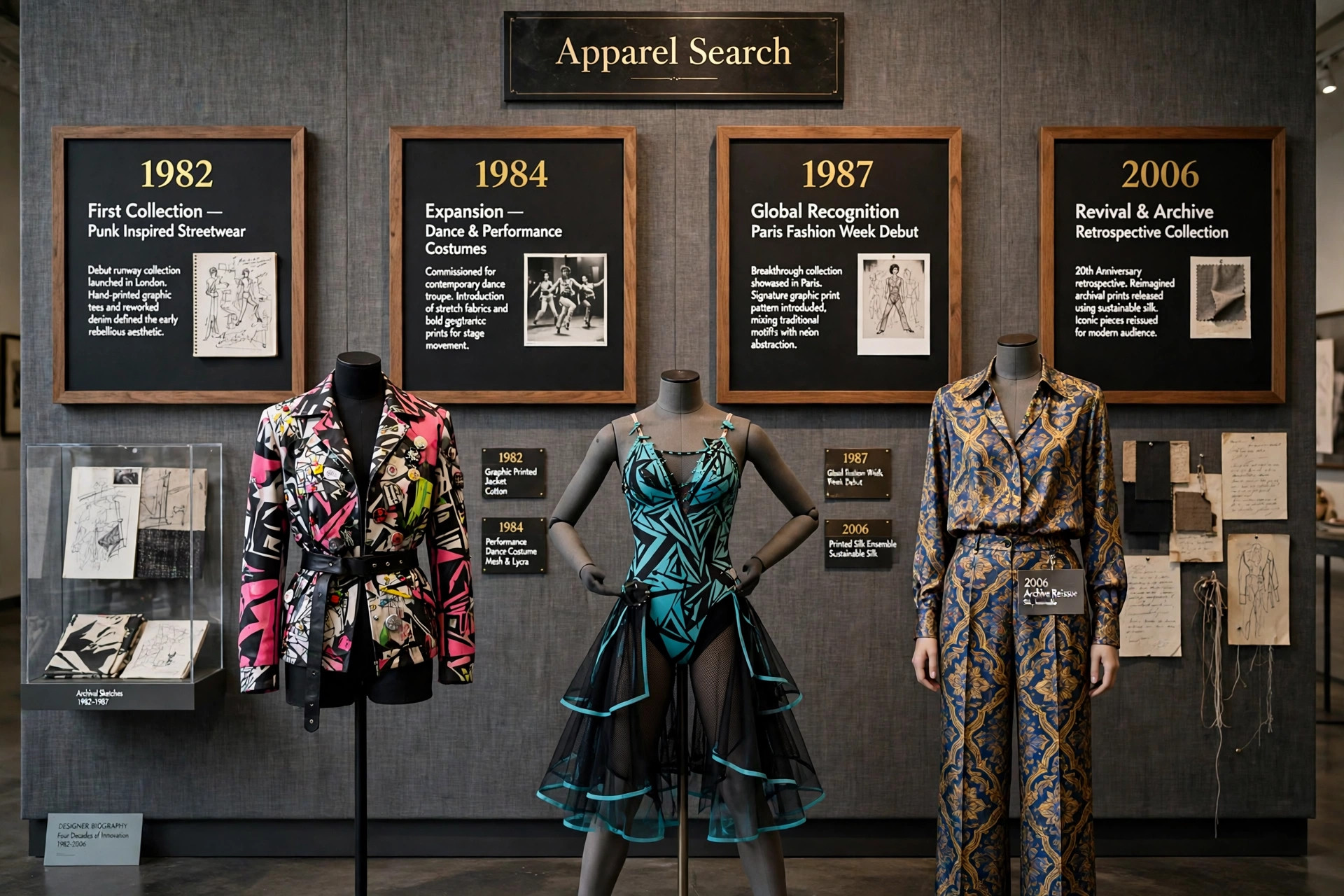
Illustrative image created for this guide — an artistic impression, not this designer's own garments.
News, Photos & VideoCollectionsFall FashionsFashion WeekNewsProfilesRunwaySpring Fashions
Bodymap: 1982 to the Bessie Award
The duo worked in Japan and New York and in Italy, designing womenswear, menswear, childrenswear and swimwear. In 1983 they won the Martini Award for most innovative designer of the year at the Individual Clothes Show; in 1984 Bodymap put on its first fashion show. In 1985 Bodymap represented Britain at the Wool Awards in New York and took part in Fashion Aid at the Royal Albert Hall. In 1986 the label was nominated for BBC Designer of the Year and invited to take part in the Best of British at the British Embassy in Paris. Throughout the 1980s Bodymap designed costumes for Michael Clark's company and costumed commissioned pieces for the Ballet Rambert and the Royal Festival Ballet; in 1987 the Michael Clark costumes won the Bessie Award. In 1989 Bodymap opened its own retail outlet — and at the beginning of the 1990s, the label closed. Its outfits remain displayed in museums worldwide, including the Victoria and Albert Museum.
Alongside the label, Holah designed freelance for companies worldwide — Goldie and Goldie Junior, Aqua Girl, Dimensione Danza, Benetton and Fiorucci in Italy, Arabella Pollen and Rifat Ozbek in England, Itochu Fashion System in Japan — across womenswear, childrenswear, swimwear and textile prints.
After Bodymap: Stylist, Lecturer, Printmaker
After the closure, Holah continued to design freelance and became a visiting lecturer in art colleges in the south of England, including St Martins College of Art, Middlesex University and the colleges at Epsom, Brighton and Barnet. Throughout the 1990s he also worked as a freelance stylist for commercials, pop promos and artistes — the Bodymap eye for a theatrical image, hired by the moving image.
In 2006, with the revival of 1980s fashion, Holah emerged from Camberwell College with an MA in Fine Art, making his mark as an extraordinary printmaker. His practice explores notions of sexual identity and gender in a transmorphic state, and the social perception of gender roles; the work contains suggestive symbolism concerning gender disguise, complex and subliminal elements relating to his own history, and — in the record's summary — printmaking techniques employed to explore the glamour and decoration of fashion in an amusing and camp framework. The designer who mapped the body in cloth ended by mapping identity in print: the profiles record holds both, as one continuous investigation of how appearance is made.
Common Questions
Who is David Holah?
David Holah is a British fashion designer. After obtaining a first class BA with honours in Fashion and Textiles at Middlesex Polytechnic, he set up the pioneering label Bodymap with partner Stevie Stewart, and together they put British fashion back on the map.
What did Bodymap achieve?
The label won the Martini Award for most innovative designer of the year in 1983, represented Britain at the Wool Awards in New York in 1985, was nominated for BBC Designer of the Year in 1986, and won the Bessie Award in 1987 for its costumes for the Michael Clark Company. Bodymap outfits are displayed in museums worldwide, including the Victoria and Albert Museum.
What did Holah do after Bodymap closed?
Bodymap closed at the beginning of the 1990s. Holah continued to design freelance, became a visiting lecturer at art colleges in the south of England including St Martins, and worked through the 1990s as a freelance stylist for commercials and pop promos. In 2006 he emerged with an MA in Fine Art from Camberwell as a printmaker.