David Holah Collections
The Holah collections filed by strand — Bodymap, costumes and the freelance years.
A David Holah collection was never just a season's clothes. As Bodymap — the label he formed with Stevie Stewart in 1982 — his collections were graphic, layered experiments presented in controversial catwalk shows; alongside them ran a second output entirely, costumes for Michael Clark's company, the Ballet Rambert and the Royal Festival Ballet; and a third, the freelance womenswear, childrenswear, swimwear and textile prints he designed for companies from Benetton and Fiorucci to Itochu in Japan. This page holds the collections view of his record in this guide: all three strands, filed together as they were worked.
Work through the strands here, then use the fall fashions and spring fashions pages to follow the seasonal rhythm of the Bodymap years. The Photos section routes to collection imagery, and the main David Holah page links the news, photo and video searches.
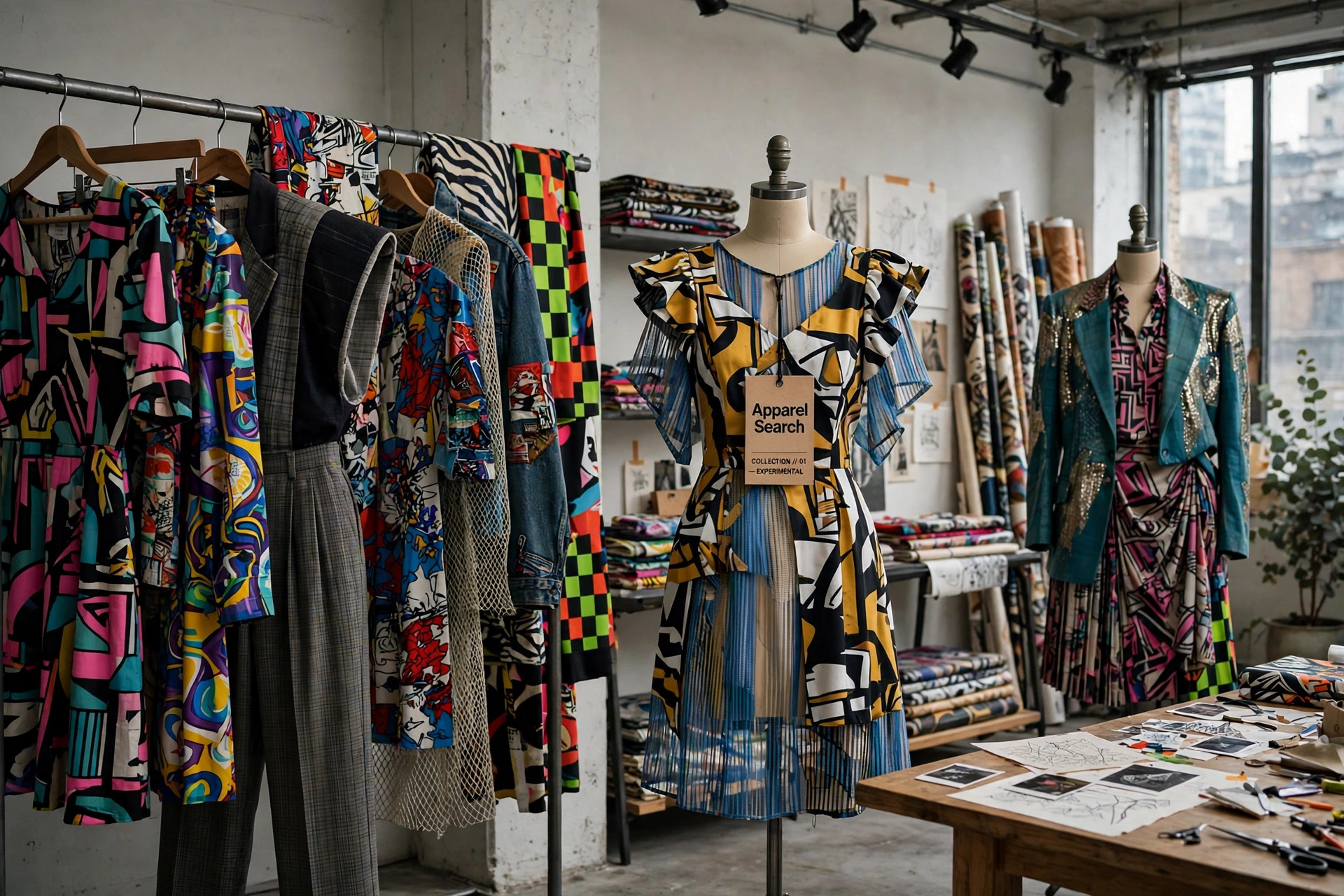
Illustrative image created for this guide — an artistic impression, not this designer's own garments.
News, Photos & VideoCollectionsFall FashionsFashion WeekNewsProfilesRunwaySpring Fashions
Bodymap: The Collection as Experiment
Bodymap's collections began from the body outward — the label's very name announces it. Graphic textile prints of Holah's own design, layered cutting and a body-conscious silhouette made each season's clothes read as a map of the figure in motion, and the presentations matched: the controversial catwalk shows that won the Martini Award for most innovative designer of the year in 1983 and carried the label to the Wool Awards in New York in 1985 and the Best of British in Paris in 1986. Filed season by season, the Bodymap collections document a moment when British fashion's center of gravity shifted toward the young, the printed and the theatrical — a shift Holah and Stewart helped engineer.
The label's retail chapter belongs to the collections record too: in 1989 Bodymap opened its own retail outlet, taking the experiment directly to the street at the decade's end, shortly before the label closed at the beginning of the 1990s.
Costumes and Freelance Ranges
The costume collections run beside the fashion ones. Throughout the 1980s Bodymap designed costumes for Michael Clark's company and commissioned pieces for the Ballet Rambert and the Royal Festival Ballet — work that won the Bessie Award in 1987 and that explains the movement in the fashion collections: a designer dressing dancers learns exactly how cloth behaves at full stretch. The freelance ranges widen the file further: womenswear, menswear, childrenswear and swimwear designed in Japan and New York and in Italy, for Goldie and Goldie Junior, Aqua Girl, Dimensione Danza, Benetton, Fiorucci, Arabella Pollen, Rifat Ozbek and Itochu Fashion System.
Read with the profiles page for the full chronology — and with the runway page for the shows — the collections give the complete measure of Holah's design output: a pioneering label, a dance wardrobe, and a freelance practice that carried one graphic sensibility across three continents. The museum displays, the V&A among them, are the collections' final filing.
Common Questions
How are David Holah collections organized here?
By strand rather than by season alone: the Bodymap collections he designed with Stevie Stewart from 1982, the dance costumes of the 1980s, and the freelance womenswear, childrenswear, swimwear and textile prints he designed for companies worldwide. The fall and spring pages pull out the seasonal strands.
What defines a Bodymap collection?
Experiment worn on the body: graphic textile prints, layered and body-conscious outfits, presented in controversial catwalk shows that enticed international press and buyers and put British fashion back on the map.
Where can Bodymap clothes be seen now?
Bodymap outfits are displayed in museums worldwide, including the Victoria and Albert Museum — the collections' afterlife as design history.