Martin Grant Profiles
From a Melbourne prodigy's first collection to the Paris house — and the navy, ruby and fuchsia uniform of Qantas.
Martin Grant is an Australian fashion designer based in Paris, celebrated for contemporary reinterpretations of wardrobe classics — impeccably tailored suiting, exquisitely draped gowns and dramatic capes and jumpsuits. Born in Melbourne, he built his career first in Australia and then in Paris, where his label has stood since the early 1990s for pure lines, rigorous pattern-cutting and clothes designed to last rather than to chase a season. To most travellers, though, his most widely seen work is not on a runway at all: it is the uniform worn by Qantas cabin crew, ground staff and pilots, a commission that carried his precise, minimalist tailoring onto aircraft and into airports around the world.
This profile traces that double career: the Melbourne prodigy who launched a ready-to-wear collection at sixteen, the sculptor's training that still shapes how he drapes cloth on a mannequin, the Paris house championed by Vogue's André Leon Talley, and the airline uniform that made his name familiar far beyond fashion.
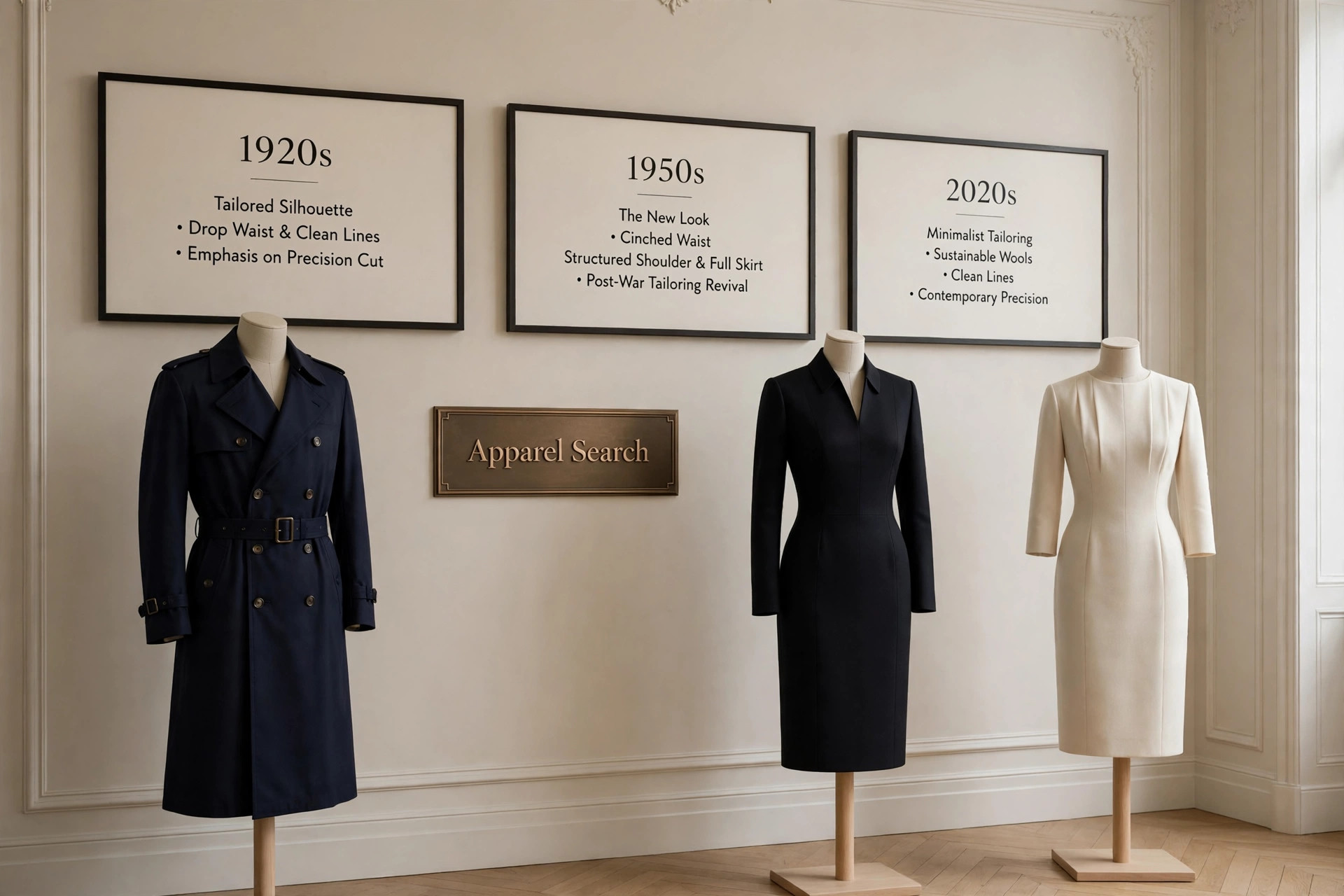
Illustrative image created for this guide — an artistic impression, not this designer's own garments.
Early Life & Training
Grant was born in Melbourne, Australia, and fashion claimed him early. He launched his first ready-to-wear collection at the age of sixteen and was quickly recognised by the Australian fashion industry; four years later he was named Cointreau Young Designer of the Year. Through the 1980s he ran his own label in Melbourne as part of a thriving independent fashion scene, showing in the Fashion Design Council parades, which were known for their innovative approach to the presentation of contemporary Australian fashion.
Then he stepped sideways. After years running his Melbourne label, Grant enrolled to study sculpture at the Victorian College of the Arts. The detour became the foundation of his method: he approaches fashion with a sculptor's eye, and his garments are still developed by draping and manipulating fabric directly on a dressmaker's mannequin rather than from a detailed sketch. In 1990 he travelled to the United Kingdom and worked for two London-based fashion houses — the apprenticeship that preceded the move that would define his career.
The Career
In 1992 Grant re-established his fashion label in Paris, the city that has been his base ever since. Four years later he opened his own boutique in an old barber's shop on the rue des Rosiers in the Marais district, presenting collections in and around the tiny shop. His Crinoline coat — nicknamed the Mary Poppins coat — came from his autumn–winter 1994–95 collection, the first he presented in Paris, shown on the cobbled street outside a Marais café.
The breakthrough arrived in March 1999, when Naomi Campbell modelled in the presentation of his autumn–winter 1999–2000 collection, wearing his red wool Joan of Arc sheath dress and Napoleon coat on a runway laid inside the boutique. Campbell's appearance brought international attention, and the late André Leon Talley, editor-at-large of US Vogue, championed Grant's work, describing his garments as “precise, sharp and full of grace” and praising their “couture vocabulary”.
Institutional recognition followed. In 2004 the Fédération Française de la Couture invited the Martin Grant house to show on its official calendar. Alongside his own label, Grant spent ten years from 2003 as artistic director of the Barneys Private Label for Barneys New York, was artistic director for Agnona of the Ermenegildo Zegna group, and created capsule collections for Moncler. His private clients and muses have included Cate Blanchett and Lee Radziwill, along with Juliette Binoche, Tilda Swinton, Emma Stone and Lady Gaga. In 2005 the National Gallery of Victoria held an exhibition celebrating his work — the beginning of a long museum relationship with his home city.
Design Signature
Grant's silhouettes stand out for pure lines that are at once simple and spectacular. His work reflects a refined understanding of structure and volume: each garment is constructed to maintain a direct relationship to the body as a sculptural form. The process begins with the fabric itself, which he drapes and sculpts over the mannequin; designs rarely begin as a two-dimensional sketch, but emerge from an image held in his imagination, and key designs are revisited and refined across subsequent collections — evolution rather than revolution.
Restraint is the discipline underneath. Grant works with a restricted colour palette, classic fabrics such as felted wool and silk satin, and very limited surface embellishment, relying instead on immaculate finishing and details such as his signature topstitched seams. His repertoire reinterprets wardrobe classics — tailored suiting, draped gowns, capes and jumpsuits — and his signature outerwear, expertly tailored jackets, peacoats and trench coats, balances minimalism with a playful approach to proportion. It is a vocabulary of precision that translates naturally from a Paris salon to an airline cabin.
The Qantas Uniform
In 2013 Qantas, Australia's national airline, called on Grant to design its new uniform — the airline's first new uniform in ten years, and its tenth since 1938. Unveiled in Sydney on 16 April 2013, the collection was worn by 12,600 uniformed cabin crew and ground employees from early 2014. Grant developed it in collaboration with the Qantas Uniform Panel, a group of staff representatives who fed back on functionality and wearability, and he took his inspiration from the Qantas logo itself: “My inspiration for the uniform came from Qantas' striking logo — the powerful red triangle and the flying kangaroo.”
The collection comprised 35 garments for female and male employees. Against French navy suiting and white shirting, variations of the Qantas red — ruby red and fuchsia pink — appear in diagonal stripes recreating the idea of the Qantas triangle, across tops and dresses for women and on ties for men. Women could wear a dress, tops, a suit and a trench overcoat, finished with a scarf and a trilby hat in a knitted fabric made from recycled bottle tops; the men's suiting was neat and structured. Fifteen types of fabric were used, including Australian wool for the suits and cotton blends for the shirts, chosen for comfort across climates and for a very active frontline workforce. Grant said he strove for something simple and durable with a bold colour palette — a uniform that reflected the glamour of flying and would suit every body shape.
The Pilot Uniform
Two years after the cabin and ground launch, Qantas commissioned Grant to update the pilot uniform as well — the first new pilot uniform in thirteen years. Unveiled on 29 April 2016, the single-breasted navy suit in pure Australian merino wool, with Australian cotton shirting, was designed for Qantas' 3,000 domestic, international and regional pilots, all wearing the new design by the end of 2016. Grant described it as traditional yet modern, keeping the military and naval heritage of pilot dress: a waterproof white-top hat with a gold embroidered kangaroo badge, golden wattle embroidery on captains' hats, a new wing badge, finer gold rank stripes and red vents at the back of the jacket. For the first time the uniform was cut specifically for women pilots, with a more fitted jacket and shirt and a specific female tie, and the design was tested in flight simulators for reach, movement and long-haul comfort.
Beyond the Uniform
Grant's Qantas era is a defined chapter with an announced ending. His uniform remains the design Qantas crews wear, but the airline has appointed Rebecca Vallance, chosen after a nationwide search and competitive process, to design the next Qantas uniform, set to debut in 2027 and replace his design. His decade-plus in the role places him in the line of designers who have dressed the airline across its history, and his French navy, ruby red and fuchsia look will stand as the uniform of a full era of the Flying Kangaroo.
At home, his standing was confirmed by the National Gallery of Victoria. In 2024 Grant gifted the gallery more than 200 works from his personal archive, and in March 2025 the NGV opened Martin Grant, his first major full-career retrospective, surveying four decades from his mid-1980s Melbourne beginnings to the present day. For a designer who has always preferred the work to speak quietly, the arc is fitting: a self-taught Melbourne teenager who learned to think in three dimensions, built a Paris house on precision, and ended up dressing both the red carpet and the cabin crew of his country's airline.
Airline Uniform Designers
Common Questions
Who is Martin Grant?
Martin Grant is an Australian fashion designer based in Paris. Born in Melbourne, he re-established his label in Paris in 1992 and is known for precise, minimalist tailoring — and for designing the Qantas cabin, ground and pilot uniforms.
What is Martin Grant's design signature?
Pure lines, structure and volume. Grant develops each garment by draping fabric directly on a dressmaker's mannequin, works with a restricted colour palette and classic fabrics such as felted wool and silk satin, and reinterprets wardrobe classics — tailored suiting, draped gowns, capes, jumpsuits and his signature trench coats and peacoats.
What did Martin Grant design for Qantas?
Grant designed Qantas' cabin crew and ground staff uniform, unveiled on 16 April 2013 and worn from early 2014: 35 garments in French navy with ruby red and fuchsia diagonal stripes, including a trench overcoat and a trilby hat. In 2016 he also designed a separate new uniform for Qantas pilots.
Is the Martin Grant Qantas uniform still current?
Grant's uniform is the design Qantas crews wear today, and it has been in service since early 2014. Qantas has appointed Rebecca Vallance to design the next uniform, which is set to debut in 2027 and will replace Grant's design.