Coco Before Chanel
The portrait of the early life of Gabrielle Chanel — the orphan who would build a fashion empire and be known universally by her nickname, Coco.
Audrey Tautou shines in this portrait of the early life of Gabrielle Bonheur Chanel, the orphan who would build a fashion empire and be known universally by her nickname, Coco. She journeys from a mundane seamstress job to boisterous cabarets to the opulent French countryside, possessing little more than her unwavering determination, her unique style and her visionary talent. Also starring Benoît Poelvoorde and Alessandro Nivola, and featuring lush settings and stunning costume design, Coco Before Chanel is the dramatic story of an icon who defied convention and defined the modern woman.
Most fashion biographies begin with the famous name. This one ends where the fame begins: it is the story of Gabrielle before she became Coco — of the orphanage, the sewing skills and the stubborn taste that made the later empire possible.
Gabrielle Before Coco
Before she became Coco, the world-famous fashion designer, Gabrielle Chanel struggled to make ends meet. After her mother's death, her father deposited her and her sister Adrienne at an orphanage, where they learned to sew — and where Chanel developed her taste for monochromatic ensembles. The sisters went on to become cabaret singers, but when Adrienne ran off with a wealthy suitor, the newly christened Coco had to go it alone until she met the gentleman farmer Étienne Balsan. She lived comfortably at his château, but he refused to take her out in public — so she put her skills as a seamstress to use and designed outfits for his lady friends, such as Emilienne, an actress.
Her situation improved further when the British investor Arthur 'Boy' Capel entered the scene. Her working-class origins presented less of a problem with Capel, and he gave her the money to open her own Parisian studio. The film ends with the tweed suit-clad Chanel of the popular imagination — the icon arrived at, rather than assumed.
Cast and Direction
Audrey Tautou, known to international audiences from Amélie and The Da Vinci Code, gives a fiercely determined performance as Gabrielle. Benoît Poelvoorde plays Étienne Balsan, the gentleman farmer whose château shelters and confines her; Alessandro Nivola plays Arthur Capel, the British investor who finances her studio, with an impeccable French accent; Marie Gillain plays her sister Adrienne and Emmanuelle Devos the actress Emilienne. The writer-director is Anne Fontaine, who presents a character very different from the worldly sophisticate of legend: a woman who was not worldly or sophisticated, but who saw no reason why fashion — or style, as she called it — should be complicated or uncomfortable.
The Fashion Argument of the Film
That last point is the film's fashion thesis, and it is historically the heart of Chanel's revolution. In transforming herself, Coco Chanel transformed an entire industry — and, arguably, an entire gender's expectations of dress. The film shows the argument forming in practice: a seamstress trained in an orphanage, dressing herself simply because she could not compete in the ornate styles around her, discovers that simplicity reads as elegance, and that comfort can be a luxury. The hats, the borrowed men's tailoring and the monochrome palette that fill the frame are not period decoration; they are the working materials of the modern wardrobe being invented. For the designer behind the film, the fashion designer pages and the Chanel brand profile linked below carry the story on from the Paris studio to the house of Chanel.
Costume as Biography
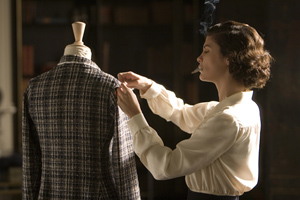
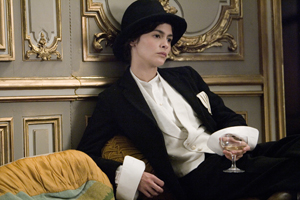
The film's stunning costume design does biographical work. In the orphanage scenes the palette is the monochrome of uniforms and habits; in the cabaret and château scenes, the women around Gabrielle wear the upholstered, corseted fashion of the period at its most elaborate, while she simplifies — a plain dress, a straw boater, a man's shirt borrowed and worn as if it were always hers. By the final scenes the audience has watched a style assemble itself out of refusals: everything she would not wear becomes, by subtraction, the most recognisable silhouette of the twentieth century.
Photos
Common Questions
Who plays Coco Chanel in Coco Before Chanel?
Audrey Tautou plays Gabrielle Chanel, in a fiercely determined performance, with Benoît Poelvoorde as Étienne Balsan and Alessandro Nivola as Arthur 'Boy' Capel. The film was written and directed by Anne Fontaine.
What part of Chanel's life does the film cover?
Her early life before fame: the orphanage where she learned to sew, cabaret singing with her sister Adrienne, life at Étienne Balsan's château where she began designing for his friends, and Arthur Capel's financing of her first Parisian studio.
Why is the film called Coco Before Chanel?
Because it ends where the legend begins — with Gabrielle, nicknamed Coco, opening her own studio. The tweed-suited Chanel of the popular imagination appears only at the end; the film is about the seamstress who made her possible.