Apparel Search · Design Guide
Fashion Croquis & Figure Drawing
The reusable figure templates behind fast fashion sketching — measured in heads, built on a balance line, and posed to make garments move.
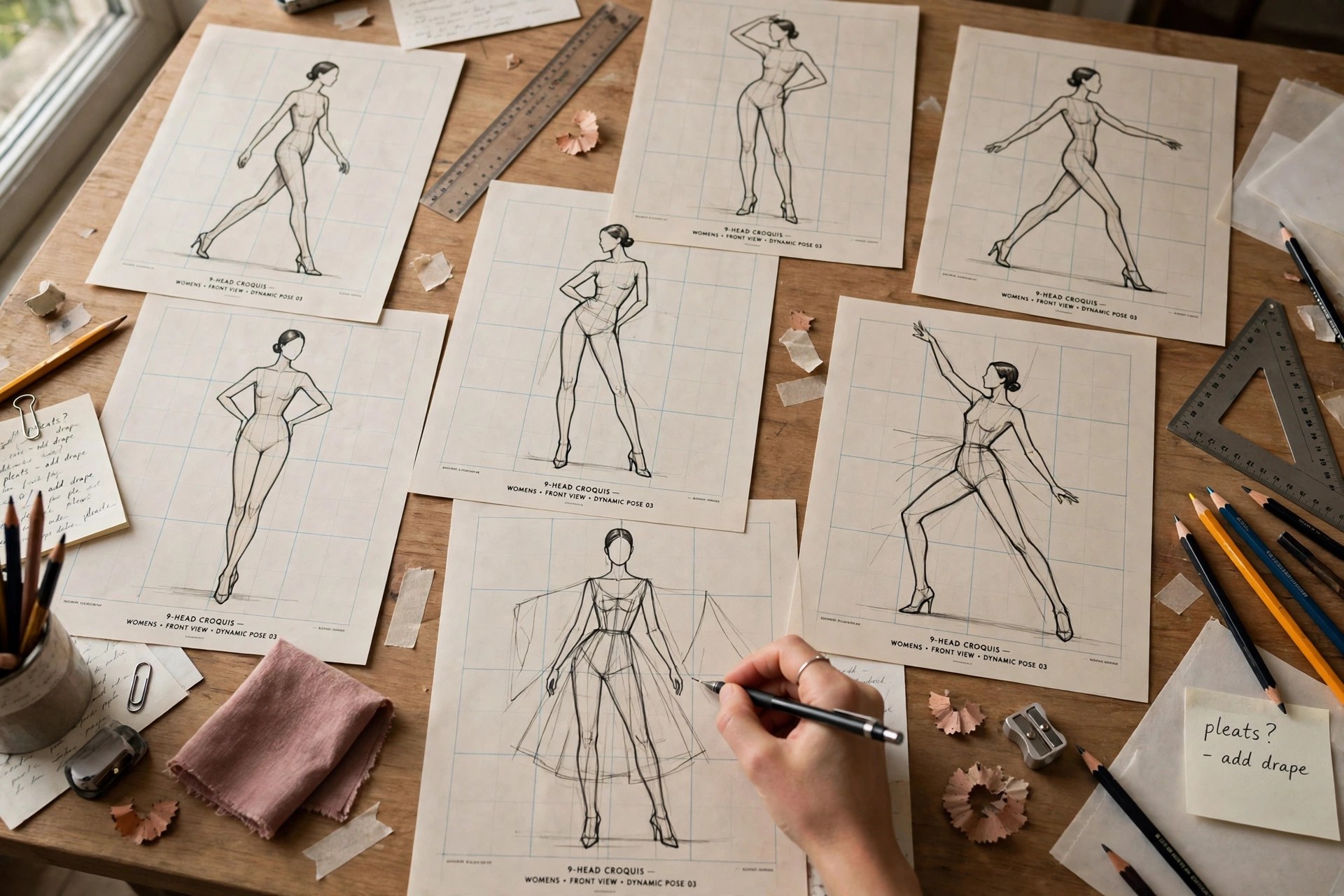
Ask a room of fashion students to sketch a dress and you get a room of anatomy lessons — every figure different, most of them fighting the drawing instead of the design. Professionals sidestep the problem with the croquis, the foundation tool of the Fashion Design & Illustration cluster. This guide explains what a croquis is, how the nine-head figure is measured, and how designers build and use templates in daily work.
Croquis, Defined
Croquis (pronounced kroh-KEE) is French for a quick sketch, and in fashion it means a lightly drawn figure in fashion proportions, used as a template. The designer places sketch paper over the croquis — or traces it — and draws the garment on top, so proportion, balance and pose are already solved before the first design line is drawn. A designer’s croquis set is personal equipment, like a tailor’s shears.
The Nine-Head Figure
Fashion proportion is measured in head-lengths: the height of the head becomes the ruler for the whole body. A realistic adult stands about seven and a half to eight heads tall. The fashion figure adds roughly another head — nine heads in total — with nearly all the extra length placed in the legs. The elongation is deliberate and functional: longer lines display drape and silhouette more clearly, give a garment visual elegance, and let design details read at a glance. The standard landmarks, counted down from the top of the head, are:
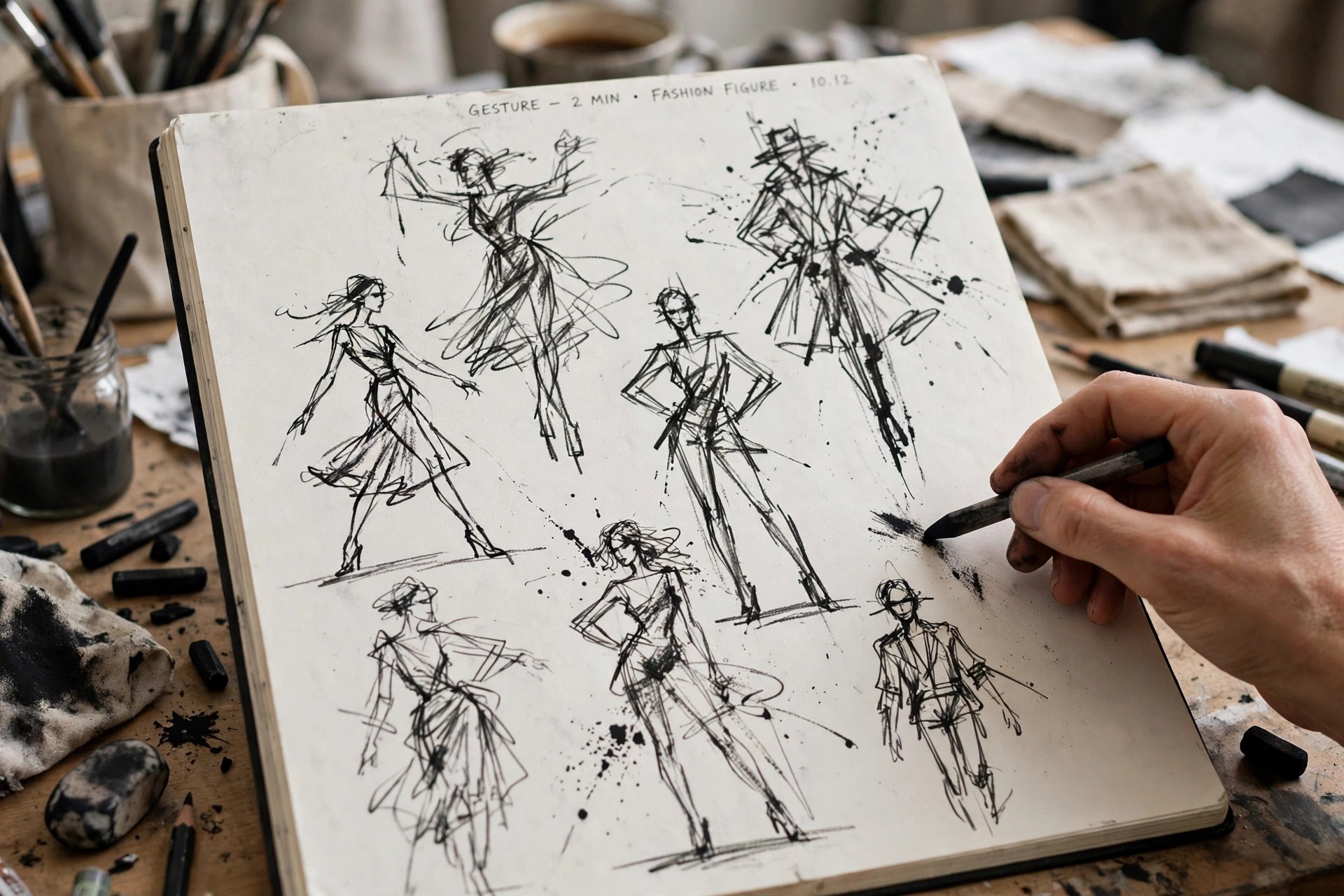
The second structural tool is the balance line: a vertical dropped from the pit of the neck. In a standing pose it falls through the supporting foot — the simple test of whether a drawn figure would stand or topple. Around that line, shoulders and hips tilt in opposition (contrapposto), which is what makes a pose look alive instead of mannequin-stiff. Master these two tools — the head units and the balance line — and any pose can be constructed rather than copied.
Building Your Croquis Family
One template is not enough, because garments behave differently in different poses. Working designers build a small family: a straight front view, a back view (essential — half of every garment is the back), a walking pose for showing movement and hem swing, a contrapposto standing pose for presentation sketches, and often a seated pose for tailoring and trousers. Each is drawn once, carefully — from a measured construction, a traced photograph re-proportioned to nine heads, or an adapted published template — then reused hundreds of times, on paper under a light sheet or scanned as a digital underlay.
From Croquis to Finished Drawing
In the design process, croquis do the high-speed work: dozens of silhouette ideas tested in an afternoon, all in identical proportion so the edit compares designs, not drawings. The selected ideas then graduate — the garment is refined on the figure, rendered with fabric and light as an illustration, and finally taken off the body altogether and drawn exactly as a technical flat. Students sometimes apologize for tracing templates; they should not. The croquis is the drawing equivalent of the dress form — a professional tool that keeps the creative argument about the clothes, where it belongs.
Common Questions
Why is the fashion figure nine heads tall?
A realistic adult figure measures about seven and a half to eight head-lengths. Fashion drawing deliberately stretches that to about nine heads — the extra length goes mostly into the legs — because elongation shows drape, line and silhouette at their most elegant and gives garments room to read clearly. It is a presentational convention, not a claim about real bodies, and every designer learns to switch back to true proportion for technical work.
What is a croquis used for?
Speed and consistency. A designer with a set of croquis templates — front, back, walking, seated poses — can test dozens of garment ideas in an hour without redrawing a figure each time, certain that every sketch shares correct proportion. Croquis are used for early ideation sketches, design development and line presentations, and students use them to build proportion sense before drawing figures freehand.
How do you make your own croquis?
Draw or trace one good figure in a pose you use often, measured out in head-length units with the balance line marked, then refine it into a clean template. Designers commonly build a small family — standing front and back, a walking pose, a seated pose — and trace them lightly under sketch paper or scan them as digital underlays. Many also adapt figures from fashion photography, re-proportioned to nine heads.
Is using croquis templates cheating?
No — it is standard professional practice, the drawing equivalent of a dress form. The creative work is the garment design, and templates simply guarantee that the design is judged on correct proportions rather than on anatomy-drawing skill. Designers are expected to be able to construct a figure freehand when needed, but nobody in a working studio redraws one from scratch for every sketch.
Back to the Fashion Design & Illustration Guide
The Fashion Design & Illustration hub maps the whole creative front end — the design process, illustration, flats, mood boards and portfolios alongside this guide.