What French Terry Is
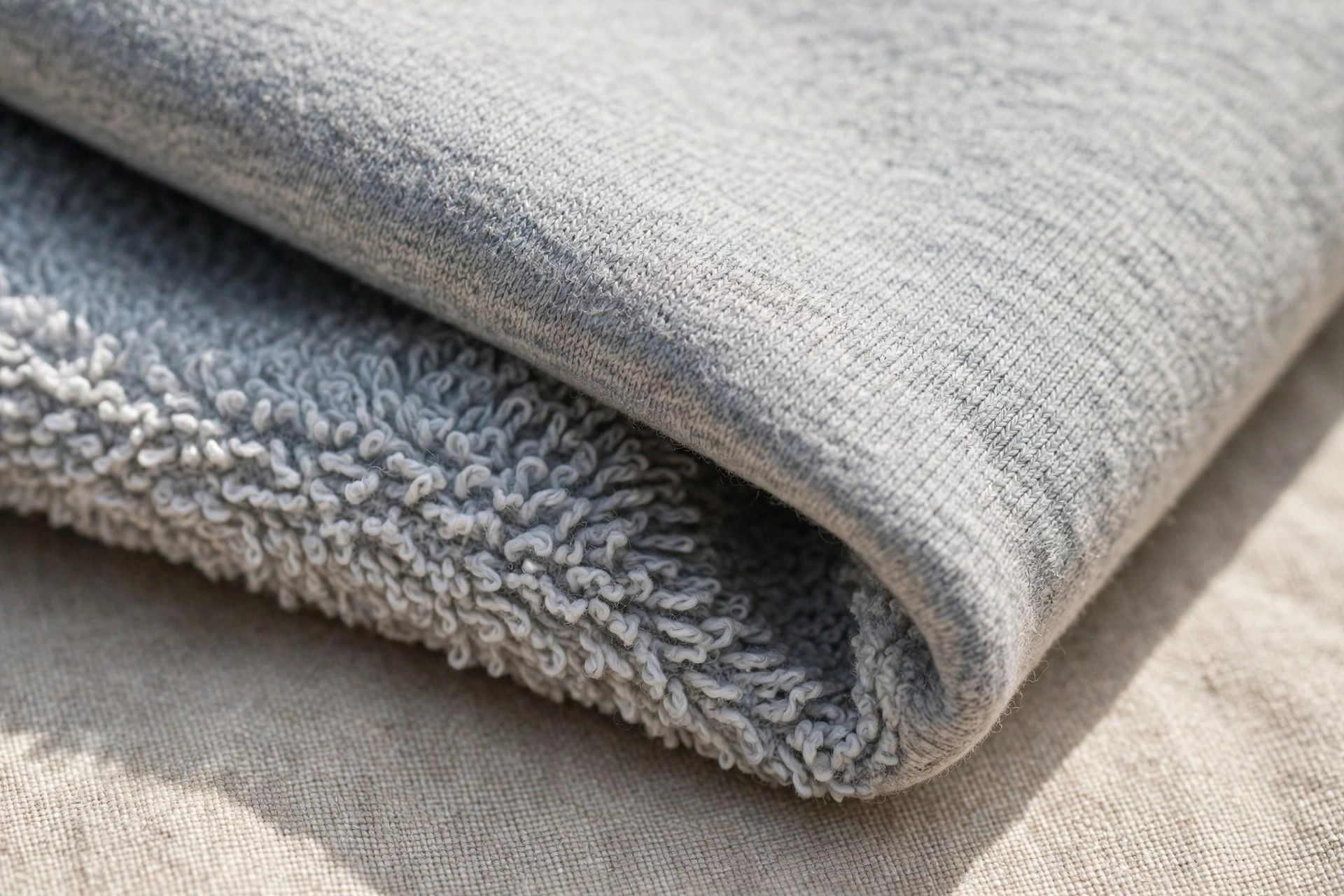
Turn a good sweatshirt inside out and you have probably already met French terry. The outside is smooth and flat, like an ordinary jersey T-shirt, but the inside is covered in neat, soft loops that stand up from the surface. That looped back is the whole point of the fabric: it traps a layer of still air against the skin, absorbs moisture, and gives a midweight knit a comfort that plain jersey cannot match. Hoodies, sweatshirts, joggers, casual shorts and relaxed dresses are its home ground, and it is the fabric most people are wearing when they describe something as “sweatshirt material” that is not fluffy inside.
One confusion is worth clearing up at the start. French terry is a knit, made on a knitting machine in the weft-knit family described in Weft vs Warp Knitting. It is not the same cloth as woven terry towelling, the fabric of bath towels. Towelling is woven on a loom with an extra warp yarn that forms loops on both sides of the cloth, and it has no stretch. French terry is knitted, its loops stand on one side only — the back — and the fabric stretches and recovers like the jersey it is built from. The shared name comes from the shared idea, a loop pile, not from a shared construction.
French terry (knit) is a weft-knitted fabric with a smooth jersey face and a back covered in uncut loops. A loop yarn is knitted in with the ground yarn and drawn into longer sinker loops on the technical back of the cloth; left unbrushed, those loops give the fabric its absorbency, softness and light insulation.
Leave its back loops exactly as they come off the machine and it stays French terry; brush a related inlay structure open and it becomes knit fleece; shear a taller pile level and it becomes velour. This page explains the first route — the loop left alone.
How French Terry Is Knitted
French terry is knitted on a circular weft-knitting machine fitted for terry work. Two yarns are fed together at each feeder. The ground yarn is the structural yarn: it forms the ordinary single-jersey loops that you see as the smooth face of the fabric. The loop yarn (sometimes called the pile yarn) is fed with it, plated so that it lies toward the back of the cloth. Plating means the two yarns pass through the same needles but are positioned so that one shows on the face and the other is carried to the back — the same trick that puts a different colour or fibre on each side of a plated jersey.
The loops themselves are made by the sinkers, the thin metal plates that sit between the needles and hold the fabric down as new loops are drawn through old ones. On a terry machine the sinkers have an extended nose or a raised profile. As each course is knitted, the loop yarn is drawn over that profile, so on the back of the fabric it is pulled into a much longer loop than the tight ground loop beside it. Course after course, those long sinker loops accumulate on the technical back, standing up from the ground like the pile of a carpet that has never been cut. Loop height is set by the sinker profile and the yarn feed: a longer draw gives a loftier, more absorbent back; a shorter draw gives the flatter loopback used in lighter summer sweatshirting.
Because both yarns are knitted in the same course, the loops are locked into the fabric rather than laid on top of it — nothing is glued or laminated, which is why the back survives washing. The finishing step that defines French terry is the step that is not taken: the loops are not brushed. Brushing would tear them open into a fuzzy pile and the fabric would become fleece instead — the direct comparison is set out on the Knit Fleece page.
Yarn choice follows the job. Cotton and cotton-rich blends dominate because the loop back is valued for absorbing perspiration against the skin; polyester is blended in for shape retention, faster drying and resistance to the bagging that all-cotton loopback can develop at knees and elbows. A small elastane content appears in fitted styles. Whatever the fibre, the construction stays the same, and it is filed with its parent structures in Knit Stitches & Structures.
Properties of French Terry
The loop back drives almost everything about how French terry behaves. Each loop holds air, so the fabric insulates more than a flat jersey of the same weight, yet the loops are open rather than matted, so air and moisture still move through it. That balance — warmer than a T-shirt, cooler and drier than fleece — is exactly why it became the default fabric for between-season sweatshirts and for sportswear that is worn during activity rather than only after it.
- Absorbent back. The loops present a large yarn surface to the skin and wick perspiration into the fabric, which is why loopback sweatshirts feel dry longer than brushed ones during exercise.
- Moderate warmth. Still air in the loops insulates, but with less loft than brushed fleece, so French terry suits mild cold and layering rather than deep winter on its own.
- Jersey stretch and recovery. As a weft knit it stretches across its width, does not fray at cut edges, and resists creasing in wear and in the wash.
- Smooth, printable face. The flat jersey face takes prints, embroidery and appliqué cleanly, which is why so much branded sweatshirting is French terry.
- Weight range. Light loopback serves summer shorts and tees-with-substance; heavier qualities serve hoodies and joggers. Weight alone does not tell you the loop height, so the back is worth inspecting when buying.
Its weaknesses are the other side of the same structure. The loops can snag on anything sharp, leaving a drawn thread across the back, and the open structure gives less wind resistance than its bulk suggests. Those limits simply mark where fleece or a double knit serves better.
Where French Terry Is Used
The classic garment is the loopback sweatshirt: crew necks, hoodies and zip-throughs whose inside has never been brushed. Joggers and sweat shorts follow the same logic — soft loops against the legs, a clean face to the world. Because the face is smooth and the fabric presses well, French terry also serves casual dresses, relaxed blazers and children’s clothing, where its absorbency and easy washing are practical virtues and its gentle warmth suits small bodies that overheat in fleece.
In activewear, French terry is the warm-up and cool-down fabric: pullovers worn to the gym, layers for runners in cool weather, and team kit that has to absorb sweat without clinging. A lighter loopback appears in premium T-shirts and polo-style tops that want more body than jersey gives. In the home it turns up in casual throws and cushion covers, though woven towelling keeps its grip on towels and bathrobes, where loops on both sides and maximum absorbency matter more than stretch.
When buying it, three checks separate good French terry from indifferent cloth: the back loops should be even, upright and closely set; the fabric should recover promptly from a widthways stretch; and the face should show no shadow of the loop yarn through it, a sign of poor plating that no finish will hide.
Recognising French Terry — and Its Neighbours
The recognition test takes two seconds: smooth on one side, looped on the other, with stretch. If the inside is fuzzy rather than looped, the fabric has been brushed and you are looking at knit fleece, French terry’s closest relative — the two often start from near-identical knitted cloth and part company only at the finishing frame. If the surface is a dense, even, velvety pile that changes shade as you stroke it, that is velour, where the loops have been cut and sheared rather than left standing. And if the loops are on both sides and the cloth does not stretch, it is woven terry towelling, a different fabric family altogether.
Within this guide series, French terry belongs to the weft-knit structures gathered under Knit Stitches & Structures, alongside the double knits, ribs and pattern structures that share its machines. Readers comparing the two great knitting families will find the context in Weft vs Warp Knitting: everything on this page is weft knitting, built course by course from yarns running across the fabric, which is why it stretches the way it does and why a cut edge curls toward the face rather than fraying.
Common Questions
- Is French terry the same as terry towelling?
- No. French terry is a knit with loops on the back only and a smooth jersey face, and it stretches. Terry towelling is a woven fabric, used for towels, with loops on both sides and no stretch. They share the idea of a loop pile but are made on completely different machines.
- What is the difference between French terry and fleece?
- The back. French terry leaves its back loops intact and unbrushed, so it is absorbent, breathable and moderately warm. Knit fleece brushes a similar back structure open into a fuzzy pile, which traps more air and feels warmer but absorbs less and can pill.
- Why is it called French terry?
- The name follows the older terry tradition of loop-pile cloth associated with French manufacture, adapted to knitting. In the trade the same fabric is also sold as loopback jersey or unbrushed fleece, which describe its construction more literally.
- Is French terry warm enough for winter?
- On its own it is a mild-weather and layering fabric. The loops insulate, but the open structure lets air through, so in deep cold it works best under a shell or over a base layer. For warmth alone, brushed fleece of the same weight will feel warmer.
- How should French terry be washed?
- Wash it inside out to protect the loops from snagging, on a normal cool or warm cycle, and dry it flat, on a line, or in a gentle tumble. Avoid catching the back loops on hooks, zips and rough trims, which can pull a loop into a snag.
More Knit Structures
- Knit Stitches & Structures — the parent guide to every structure in this series.
- Knit Fleece — inlay yarn floated on the back, then brushed into pile.
- Velour & Plush Knits — pile loops sheared level for a plush face.
- Pointelle Knit — transferred stitches open lace-like eyelets.
- Purl Knit Structure — links-links fabric that reverses course by course.
- Ponte di Roma — the stable double-jersey for structured garments.
Back to Knit Stitches & Structures
This page is one part of Knit Stitches & Structures, Apparel Search’s deep guide to the structures inside the Knitwear Construction Guide series on how knitted fabric is made.
Search Apparel Search