What Pointelle Knit Is
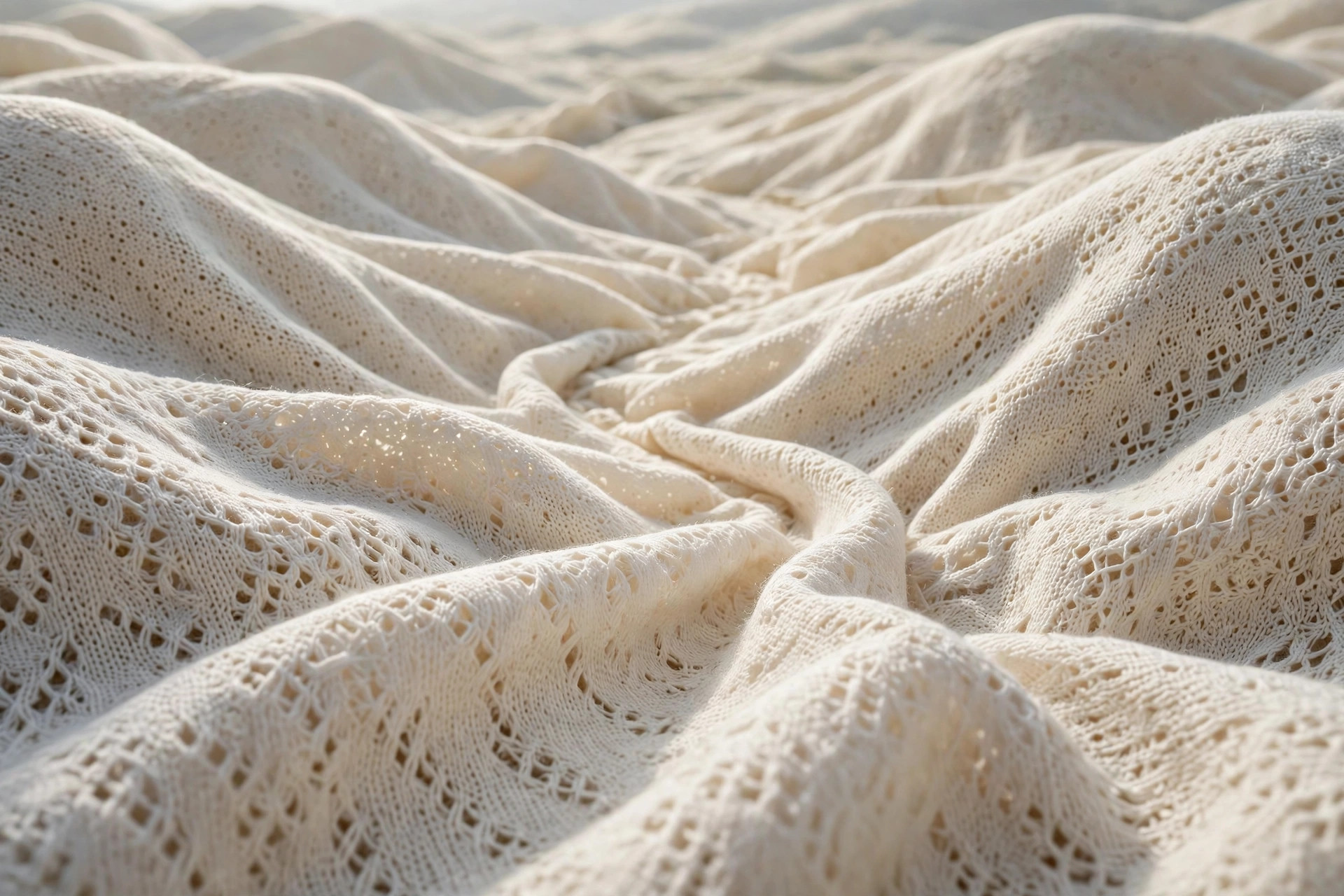
Pointelle is the knit that looks like lace but behaves like a T-shirt. Across a fine, soft jersey ground run tiny, regular holes — eyelets — arranged into diamonds, chevrons, hearts and floral sprigs. Nothing has been embroidered, punched or burned into the cloth: every hole was made on the knitting machine itself, by moving a stitch sideways from its own needle to a neighbouring one and leaving a gap behind. The result is decoration that is part of the structure, in the fabric from the first course, on baby vests, women’s tops, camisoles and the prettiest thermal underwear ever made.
This page is the construction companion to the fabric and directory guide: for mills, buying and the directory listings, see the Pointelle Fabric Guide. Here the focus is the mechanism — loop transfer — because pointelle is best understood as a technique applied to jersey rather than a separate fabric. It belongs to the weft-knit family described in Weft vs Warp Knitting, and its patterning sits naturally beside the colour patterning of jacquard knits: jacquard patterns with yarns, pointelle patterns with holes.
Pointelle is a fine weft-knitted fabric, usually single jersey, patterned with small open eyelets formed by transferring selected stitches to adjacent needles during knitting. The transferred stitches leave empty needles that become holes in the cloth, building lace-like motifs into the ground.
How Pointelle Is Knitted: Loop Transfer
Ordinary jersey knits every stitch on its own needle, course after course. Pointelle interrupts that regularity with loop transfer. At a chosen point in the pattern, the machine lifts a formed loop off its needle and places it onto the needle next door, so that one needle now holds two loops and its neighbour holds none. Knitting then continues. The doubled needle knits its two loops together as one stitch, slightly firmer than its neighbours, and the empty needle, having no loop to knit through, leaves a small open hole — an eyelet — in the fabric. One transfer makes one hole; a programmed arrangement of transfers makes the motif.
On a flatbed machine, transfer is a native talent: the needle beds can be racked sideways relative to each other, and transfer springs or jacks pass loops from one bed’s needles to the other’s, which is how hand-flat and V-bed machines build the lace patterns of fashion knitwear stitch by stitch. On circular machines, the workhorse for pointelle yardage, transfer is arranged between the cylinder and dial needles or with dedicated transfer elements, and the pattern is stored as a program or set by pattern wheels and cams. Either way, the logic in the diagram is the same: read each X as a stitch that moved, and the diamond of holes appears where the moved stitches left gaps.
Transfer costs the fabric something, and good pointelle design respects the bill. Every hole is a place where the ground is interrupted, so heavily patterned pointelle is less stable than plain jersey: it stretches more unevenly, ladders more readily if a yarn is cut, and loses its pattern if it is pulled hard across the width. Designers therefore keep motifs small and well distributed, anchor them with plain courses, and choose fine, even yarns — usually cotton or cotton blends for next-to-skin garments — that let the holes stay open and crisp after washing rather than relaxing shut. The parent survey of stitch structures, Knit Stitches & Structures, places transfer alongside the knit, tuck and miss actions from which all of these patterns are built.
Properties of Pointelle Knit
Pointelle behaves like the fine jersey it mostly is, with the eyelets adding their own character. It is soft, stretchy and breathable, with the holes giving real ventilation at exactly the scale of a motif — which is why it has been a staple of baby clothing and warm-weather layering for generations: the decoration and the air-conditioning are the same feature.
- Built-in pattern. The motif is structural, not applied, so it cannot peel, crack or wash off, and it costs no extra yarn — pointelle patterns with absence.
- Breathability. The eyelets pass air and moisture, making pointelle cooler than plain jersey of the same weight.
- Softness and stretch. A fine jersey ground gives next-to-skin comfort and weft-knit stretch, with edges that curl like jersey rather than fraying.
- Reduced stability. Transferred areas distort more easily, snag more readily and need gentler washing than closed jersey; patterns blur if the fabric is overstretched.
- Delicate appearance, honest limits. At a glance it reads as lace, but the motifs are small and geometric compared with true lace — see the comparison below.
Care follows from the structure. Wash pointelle inside out, gently or in a mesh bag, dry it flat or on a line, and fold rather than hang it, because a fine openwork knit grows under its own weight on a hanger. Treated that way, well-made pointelle keeps its eyelets open and even for years; treated roughly, the motifs are the first thing to suffer.
Where Pointelle Knit Is Used
Pointelle’s home is small, close, soft garments. Baby and toddler clothing leads the list — vests, sleepsuits, cardigans and christening pieces in white and pastel cotton — followed closely by women’s tops, camisoles, cardigans and nightwear, lingerie bodies and trims, and fine thermal tops where the eyelets ventilate a layer that is otherwise purely practical. It also works as a trim in its own right: collars, cuffs, yokes and inserts of pointelle on a plain ground are a long-running device in children’s and women’s wear, giving a garment a lace gesture at knit prices and knit comfort.
When specifying pointelle, name the fibre, the gauge and the pattern, and judge it from a washed sample, because the motif after laundering is the motif the customer lives with. Check that the eyelets are even and open, that the cloth recovers across its width without the pattern pulling into ovals, and that seams are planned with support — openwork should not be asked to carry a stress seam alone. The companion Pointelle Fabric Guide carries the directory of mills for sourcing the fabric itself.
Pointelle vs True Lace — and Its Neighbours
Pointelle is often called knit lace, and the honest version of that claim is: it is lace-like patterning inside a jersey. True lace — raschel lace, Leavers lace and their relatives — is built as an openwork structure in its own right, with patterned threads forming both motif and ground over large, flowing repeats. Pointelle keeps a complete jersey ground and merely opens holes in it, so its motifs stay small, regular and geometric, and the fabric keeps jersey’s stretch, opacity and sewing behaviour. For most garments that is not a compromise but the point: lace’s look at a fraction of the cost, in a fabric a knit factory can cut and sew without lace-handling skills.
Among its fellow pattern structures, pointelle’s closest comparison is jacquard knitting: both program a design into the machine course by course, but jacquard spends extra yarn to draw with colour while pointelle moves stitches to draw with holes. Beside the pile structures in this group — French terry, knit fleece and velour — pointelle is the opposite gesture: they add yarn on top of a ground, pointelle rearranges the ground itself. All four are gathered under Knit Stitches & Structures.
Common Questions
- How is pointelle different from lace?
- Pointelle is a jersey knit with small holes opened in it by transferring stitches, so it keeps the stretch, softness and sewing behaviour of a knit and its motifs are small and regular. True lace is an openwork structure built thread by thread, with much larger and more flowing patterns and little stretch.
- How are the holes in pointelle made?
- By loop transfer. The machine moves a stitch from its own needle to the neighbouring needle, leaving an empty needle. When knitting continues, the empty needle leaves a small hole, the eyelet, and arranged transfers build the motif.
- Is pointelle knitted on flat or circular machines?
- Both. Flatbed machines transfer loops between their two needle beds and suit fashioned knitwear; circular machines use cylinder-and-dial or dedicated transfer elements and produce pointelle yardage for cut-and-sew garments.
- Why does pointelle need gentle washing?
- The transferred-stitch structure is less stable than plain jersey: it snags more easily, distorts if overstretched, and its eyelets can relax unevenly in a harsh wash. Washing inside out, gently or in a mesh bag, and drying flat keeps the motifs crisp.
- What is pointelle used for?
- Baby and children’s clothing, women’s tops, camisoles and cardigans, lingerie and nightwear, fine thermal layering, and trims such as collars, cuffs and yokes where a lace-like pattern with knit comfort is wanted.
More Knit Structures
- Knit Stitches & Structures — the parent guide to every structure in this series.
- French Terry (Knit) — smooth face, uncut loops standing on the back.
- Knit Fleece — inlay yarn floated on the back, then brushed into pile.
- Velour & Plush Knits — pile loops sheared level for a plush face.
- Purl Knit Structure — links-links fabric that reverses course by course.
- Ponte di Roma — the stable double-jersey for structured garments.
Back to Knit Stitches & Structures
This page is one part of Knit Stitches & Structures, Apparel Search’s deep guide to the structures inside the Knitwear Construction Guide series on how knitted fabric is made.
Search Apparel Search