What Velour and Plush Knits Are
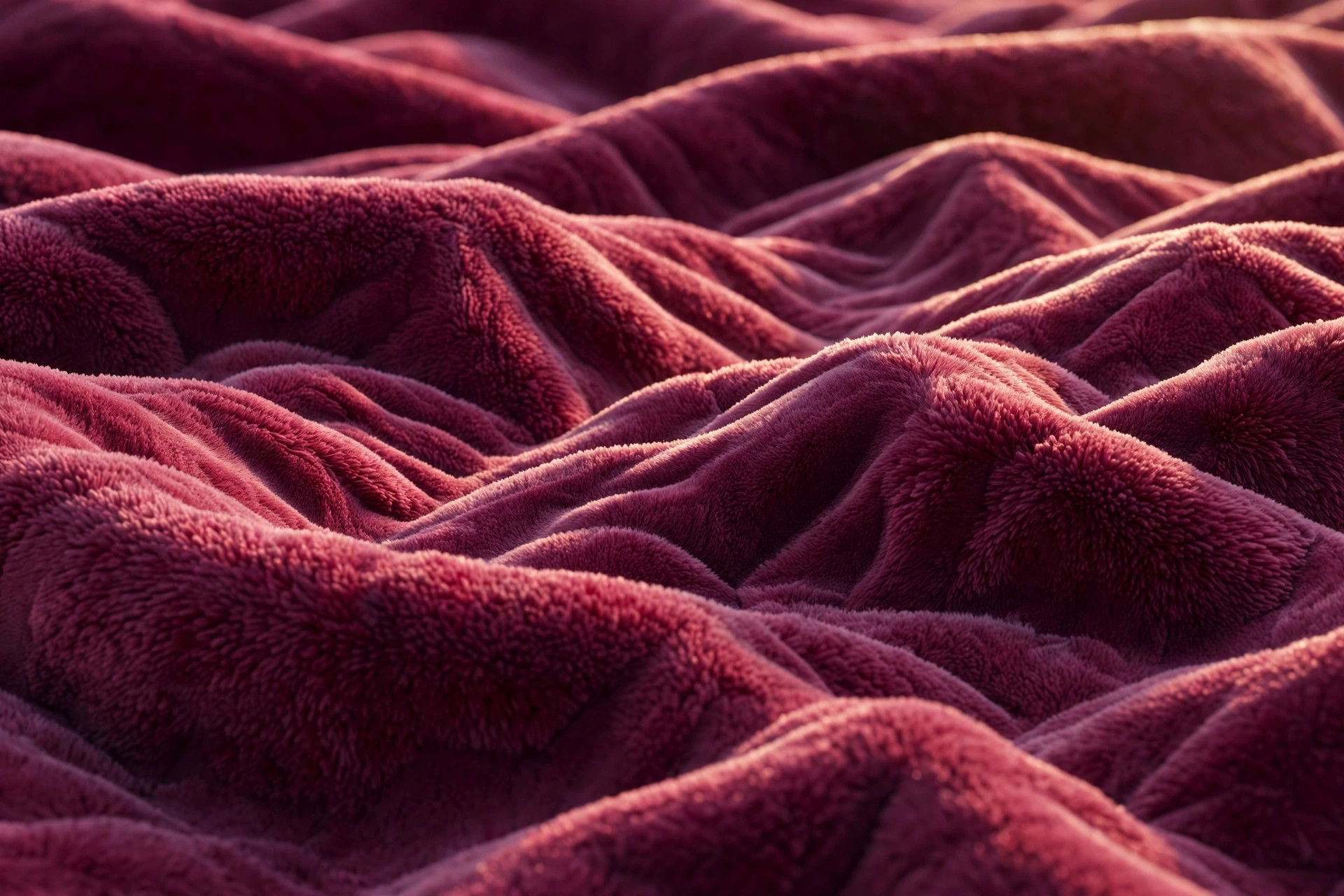
Stroke a velour tracksuit top and the surface answers: the colour deepens one way and pales the other, and your hand meets a dense, even, velvety pile. Velour is the knitted member of the pile-fabric family — a knit whose face is covered in short, upright, cut fibres that catch light exactly the way velvet does, but on a ground that stretches, drapes and washes like the jersey it is built on. Plush knits are its close family: the same idea with a longer, softer, less formal pile, the fabric of dressing gowns, baby blankets and the softest loungewear.
The distinction that organises this whole corner of textiles is velour versus velvet. Velvet is woven: its pile is an extra warp yarn woven in and cut on a loom, the ground does not stretch, and the fabric behaves like the formal woven it is. Velour is knitted, most often on a circular weft-knitting machine of the kind surveyed in Weft vs Warp Knitting, so it gives, recovers and curls at the edges like a knit. Velveteen, the third name in the tangle, is a woven cotton with a short weft pile — again, no stretch. If it stretches, it is velour. For mills and the fabric directory view of the same cloth, see the velour fabric search page.
Velour is a knitted pile fabric: an extra pile yarn is knitted into a jersey ground as extended loops, and the loops are then cut or sheared and brushed into a dense, even, upright pile. Plush is the longer-pile, softer-hand member of the same knitted family.
How Velour Is Knitted
Velour starts on a circular knitting machine fitted with pile sinkers, in a construction closely related to the terry machine behind French terry. A ground yarn knits the jersey base. A second, pile yarn is fed with it, plated to the face side, and drawn over tall sinker profiles so that it forms long loops standing up from the face of the cloth — the same sinker-loop principle as French terry, but worked on the face instead of the back, and with a longer loop, because this pile is meant to be seen and touched rather than hidden inside a garment.
Off the machine the fabric is a loop pile, closer to a fine towelling than to velvet. The velour character is created in finishing, and the decisive step is shearing. The cloth passes under a shearing cylinder — a rotating spiral blade working against a ledger blade, in effect a precision lawnmower for fabric — which cuts every loop at the same height. Cutting the loops is what turns loops into pile: each loop becomes two upright fibre ends, and thousands of them per square centimetre form the dense, even surface. A second pass may shear closer for a finer finish, and brushing and polishing steps stand the pile upright and align it so the light plays evenly across the surface.
Plush knits follow the same route with the settings relaxed: a longer loop, a softer and often bulkier yarn, and a lighter shear or none at all, leaving a deeper, more yielding pile that is brushed rather than polished. At the far end of the family, sliver-knit and high-pile fabrics feed a web of loose fibre into the ground instead of a pile yarn, producing imitation-fur depths of pile — a different feed, but the same knitted-ground-plus-pile architecture.
Fibre choice is broad because the structure does the work. Polyester velour dominates tracksuits and upholstery for its resilience, colour depth and easy care; cotton velour is softer and more absorbent for babywear and towels-adjacent uses; blends with elastane serve fitted dresses and dancewear. Whatever the fibre, quality shows in pile density: a well-made velour hides its ground completely, while a sparse pile lets the jersey grin through when the fabric is bent — the first thing to check when buying. Its parent structures are collected in Knit Stitches & Structures.
Properties of Velour and Plush Knits
The cut pile defines velour’s behaviour. Upright fibre ends scatter light, giving the deep, shaded colour and the characteristic light-and-dark stroke effect; they also make the surface soft, warm to the touch and slightly grippy, so velour garments hold their position on the body and velour upholstery holds cushions and displays in place.
- Velvet look, knit behaviour. Velour gives the pile luxury of velvet with jersey stretch, recovery and easy sewing — no fraying, and cut edges that curl rather than unravel.
- Softness and warmth. The pile holds a thin layer of air and feels warm on contact; plush versions multiply the effect for robes and blankets.
- Drape. The knitted ground drapes fluidly, which is why velour serves dresses, curtains and costume as well as sportswear.
- Pile sensitivity. The pile crushes under sustained pressure and can mark where it is folded or sat on; heat and harsh washing flatten it. Pile direction also matters in cutting — panels cut in opposite directions shade differently.
- Colour depth. Piece-dyed polyester velour achieves especially deep, light-absorbing shades, one reason it dominates evening-toned tracksuits and display work.
Against its neighbours in this series, velour is the dressiest of the pile knits. Knit fleece hides its pile inside a garment for warmth; velour puts its pile outside for appearance. French terry leaves its loops whole and works by absorbency; velour cuts its loops and works by light. Same machine family, three different answers to what a yarn standing off a ground can do.
Where Velour and Plush Knits Are Used
The velour tracksuit is the fabric’s modern emblem — matching zip tops and joggers that carried velour from sportswear into everyday luxury casualwear. Around it sits a wide wardrobe: dresses and skirts that exploit its drape and stretch, fitted tops, dance and skating costumes that must shine under lights while moving freely, children’s and baby clothing in cotton velour, and sleepwear and dressing gowns in plush. Because it sews like a knit, velour reaches garments that woven velvet, with its fraying and formality, cannot serve at the same price or comfort.
Off the body, velour’s light-absorbing, non-slip surface earns its place on jewellery and watch displays, in theatre curtains and costume stock, on car seat covers, and as the covering of soft toys and cushions, where plush pile is quite literally the product. A buyer specifying velour should ask for pile weight and fibre, check the ground does not show through on a bend, confirm every garment panel will be cut in one pile direction, and wash-test a sample: pile retention and shade consistency between dye lots are the two faults that only appear after the fact.
Recognising Velour — Velour, Velvet and Their Neighbours
Three quick tests separate the pile fabrics. Stretch it: velour stretches and recovers, velvet and velveteen barely give. Look at the back: velour shows a knitted jersey ground, velvet a woven ground. Stroke it: all three shade light and dark, but only the knit drapes and curls at a cut edge. If the pile is long, loose and unpolished, you are in plush territory — same family, softer brief.
Within the knit structures, compare velour with the brushed inside of knit fleece and the standing loops of French terry: fleece pile is torn open by brushing and never cut to a level; terry loops are never cut at all; velour pile is cut and sheared to a level, which is why its surface is the most even and formal of the three. The full family tree is set out in Knit Stitches & Structures.
Common Questions
- What is the difference between velour and velvet?
- Velvet is woven and does not stretch; its pile comes from an extra warp yarn cut on the loom. Velour is knitted, usually on a circular machine, so it stretches and recovers like jersey; its pile loops are sheared level in finishing. They look similar but sew and wear very differently.
- Is velour a knit or a woven fabric?
- A knit. Velour is a weft-knitted pile fabric with a jersey ground, which is why it stretches, drapes fluidly and does not fray. The woven pile fabrics are velvet and velveteen.
- What is the difference between velour and plush?
- Degree, not kind. Velour has a short, dense, sheared and polished pile with a formal, even finish. Plush has a longer, softer, less polished pile, used for robes, blankets and toys. Both are knitted pile structures on a jersey ground.
- Why does velour change colour when stroked?
- The upright pile fibres reflect light differently depending on direction. Stroking the pile one way aligns the fibres to reflect more light, the other way less, producing the light and dark shading that is characteristic of all cut-pile fabrics.
- How should velour be washed and stored?
- Wash inside out, cool and gentle, and dry away from direct heat, which flattens the pile. Store garments folded or hung without pressure on the pile, and revive a crushed pile with a soft brush or a light steam held above the surface.
More Knit Structures
- Knit Stitches & Structures — the parent guide to every structure in this series.
- French Terry (Knit) — smooth face, uncut loops standing on the back.
- Knit Fleece — inlay yarn floated on the back, then brushed into pile.
- Pointelle Knit — transferred stitches open lace-like eyelets.
- Purl Knit Structure — links-links fabric that reverses course by course.
- Ponte di Roma — the stable double-jersey for structured garments.
Back to Knit Stitches & Structures
This page is one part of Knit Stitches & Structures, Apparel Search’s deep guide to the structures inside the Knitwear Construction Guide series on how knitted fabric is made.
Search Apparel Search