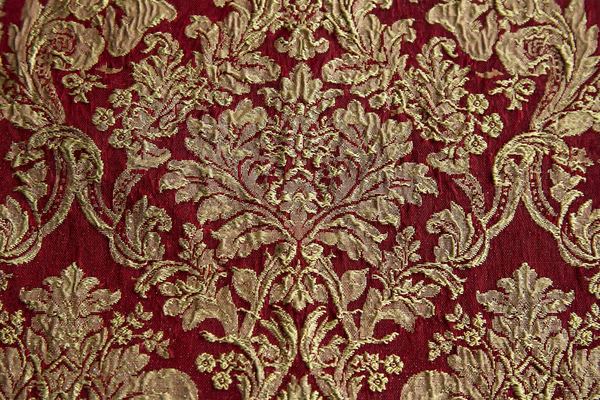
Jacquard weave uses a special loom attachment to control individual warp yarns - creating intricate woven patterns like brocade, damask, and matelasse.
The Jacquard Loom
Invented in 1804 by Joseph Marie Jacquard, the jacquard attachment uses punched cards to control each warp yarn individually - lifting or lowering it independently to create any pattern the designer can draw. It was a revolution: complex figured fabrics that once required a draw boy pulling cords by hand could now be woven automatically. Those punched cards were a direct ancestor of computer programming - the concept of stored instructions controlling a machine.
Jacquard Fabrics
- Brocade - raised patterns, often with metallic threads, on a contrasting ground
- Damask - reversible tone-on-tone patterns, classic for table linens and formal wear
- Matelasse - a double-cloth jacquard with a quilted, puckered look
Cost
Jacquard weaving is slow and setup is complex - each pattern needs its own card set (today electronic) and careful loom preparation. That makes jacquards premium fabrics, reserved for occasion wear, upholstery, ties, and anywhere the woven pattern itself is the luxury.
FAQs
- Is jacquard a fabric or a weave?
- A weave type - many different fabrics (brocade, damask, matelasse) are made with jacquard weaving.
- What's the difference between jacquard and dobby?
- Jacquard controls individual yarns (unlimited patterns); dobby controls groups of yarns (small geometrics).
- Can jacquard be printed instead?
- Imitation 'jacquard-look' prints exist, but true jacquard is woven in - the pattern has texture you can feel.
Glossary: see the full fashion glossary for more apparel industry terms.