Statistics: Asian Fibre Consumption and Production
Fifteen pages of Asian fibre statistics for 2005: consumption, production and net imports by fibre type and region
Asian fibre consumption rose by 4.2% in 2005 — the latest year for which comprehensive data are available — reaching 91,434 million lb. At the same time, production within Asia went up by a lesser 1.8%, to 57,785 million lb. As a result, the region's net imports climbed by as much as 8.6% despite increased self-sufficiency in China. This 15-page statistics report appeared in Issue 68 of Technical Textile Markets, published in the 1st quarter of 2007 by Textiles Intelligence. Its contents proceed from an overall summary of Asian consumption and production by fibre type to country and regional chapters: consumption and production in China; in Japan, South Korea and Taiwan; in South-East Asia; and in South Asia.
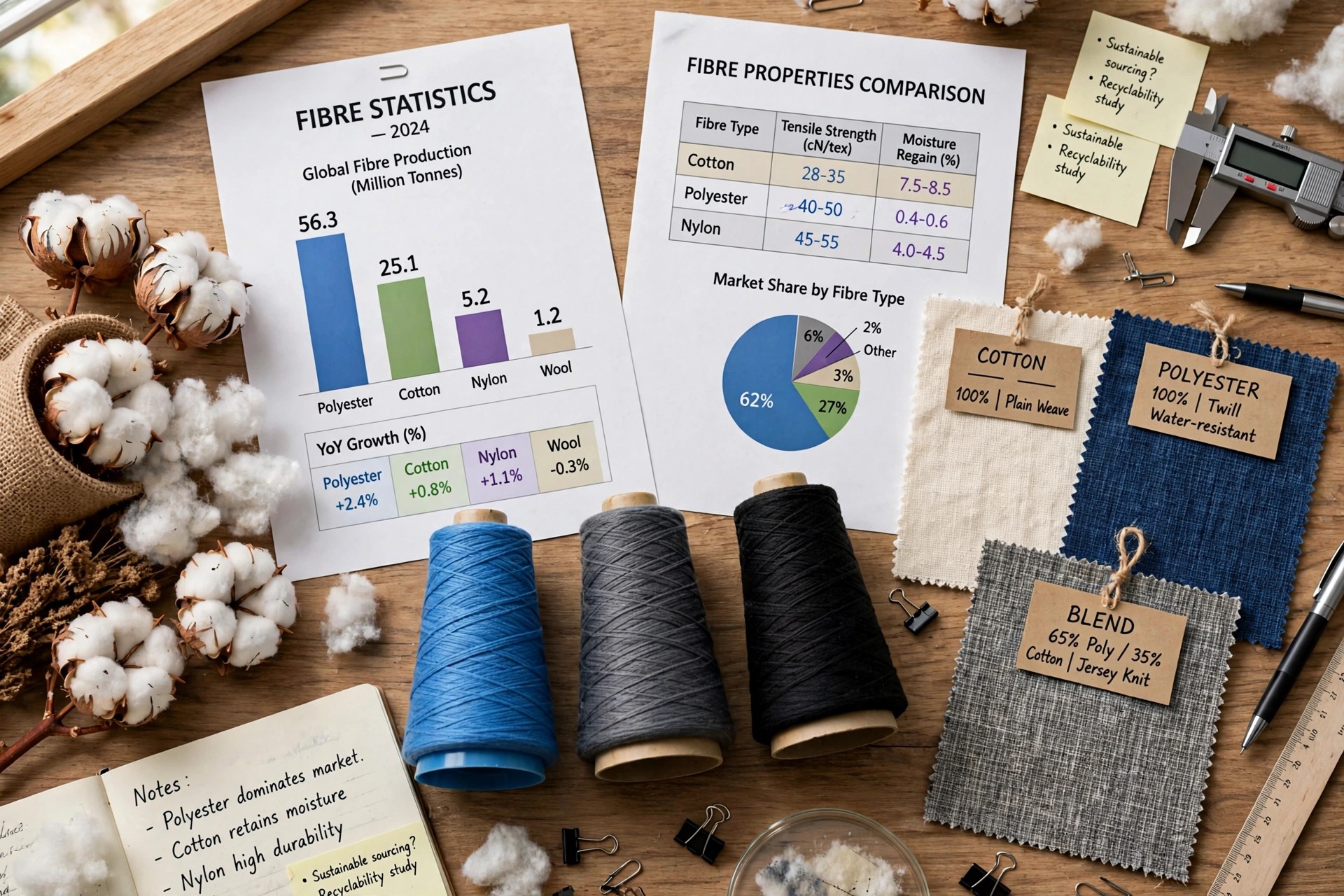
Cotton Gains, Man-Mades Hold the Majority
Cotton consumption grew faster than any other fibre type. As a result, its share of total mill fibre consumption rose by 2.1 percentage points to 40.8%. Man-made fibre, meanwhile, saw its share fall by 2.1 percentage points as growth almost stagnated, at just 0.6%. Despite this, man-mades continued to hold a dominant 58.5% of the market. In China, growth in man-made fibre consumption slowed to 6.1% following six years of double-digit increases. Cotton usage, meanwhile, rose by 14%, which led to an increase in its share of total fibre consumption — though over the seven years to 2005 cotton's share in China fell by 7 percentage points.
The Regional Split
Geographically, China and Hong Kong took the lion's share with 61% of total Asian fibre usage, up from 58.5% in 2004. South Asia was the second largest consumer with 22%, followed by Japan, South Korea and Taiwan with a collective 9% of consumption. South-East Asia made up the remaining 8%. Consumption in South Asia, unlike in other regions in Asia, is dominated by cotton: cotton held a 68% share in 2005, up from 65% a year earlier, following an 8% rise in usage, aided by a 7% drop in usage of man-made fibre, whose share fell to little over 30%. Total fibre consumption in South Asia continued to rise in 2005, albeit by 3%, to surpass the 20 billion lb mark.
Contraction in the North, a Crossover in the South-East
Consumption in Japan, South Korea and Taiwan fell for the fifth successive year, and the deterioration accelerated to 13%, from a 7% decline in 2004 — due almost entirely to a 15% decrease in man-made fibre consumption, which lost market share as a result. Total fibre usage in South-East Asia fell by a marginal 1.3%, due entirely to a drop in man-made fibre consumption. Nonetheless, it is likely that South-East Asia's share of total Asian fibre consumption overtook that of Japan, South Korea and Taiwan in 2006, as consumption increased in Indonesia and Vietnam while the industries in Japan, South Korea and Taiwan continued to contract — the regional changing of the guard, captured in a single statistics report.
Common Questions
How much fibre did Asia consume and produce in 2005?
Consumption rose 4.2% to 91,434 million lb, while production within Asia rose 1.8% to 57,785 million lb, so the region's net imports climbed by 8.6% despite increased self-sufficiency in China.
How did cotton and man-made fibres compare?
Cotton consumption grew fastest, its share of mill fibre consumption rising 2.1 percentage points to 40.8%; man-made fibre growth almost stagnated at 0.6% and its share fell 2.1 points, though man-mades still held a dominant 58.5% of the market.
Which regions consumed the most fibre?
China and Hong Kong took 61% of total Asian fibre usage, South Asia 22%, Japan, South Korea and Taiwan a collective 9%, and South-East Asia the remaining 8% — with South-East Asia likely to overtake Japan, South Korea and Taiwan in 2006.
More to Explore
- Technical Textile Market Report
- Textiles Intelligence Reports
- Apparel Research
- Apparel Industry Guides
- Fashion
- fabric
- fibers
- Fashion News
- Apparel Industry Jobs
- Trend Forecasting
- Editorial: New Technologies for Smart fabric and Intelligent Textile Products: Dye-Sensitised Solar Cells and Plastic Electronics
- Global Technical Textiles Business Update
- Profile of Lenzing: A Leader in Cellulosic Fibres and a Joint Venture Partner in Carbon Fibres
- Smart fabrics and Intelligent Textiles in the UK: Seven Companies at the Forefront of Innovation
- The World Nonwovens Industry: Part 3
- Belinda Carp