Apparel Search Consumer Guides
How to Fold a Pocket Square
Six folds, step by step — presidential, one-point, two-point, crown, puff and scallop — and how to choose between them by occasion and fabric.
The pocket square itself — its fabrics, sizes and colors — is covered by our pocket squares guide. This page is the other half of the subject: the folds, one by one, with the steps in order. Six folds cover every occasion a square will ever be asked to attend, and they divide neatly into the crisp folds, which are built from linen or cotton and hold an edge, and the soft folds, which are built from silk and are meant to billow. Learn the first of each kind and you are equipped; learn all six and you are fluent.
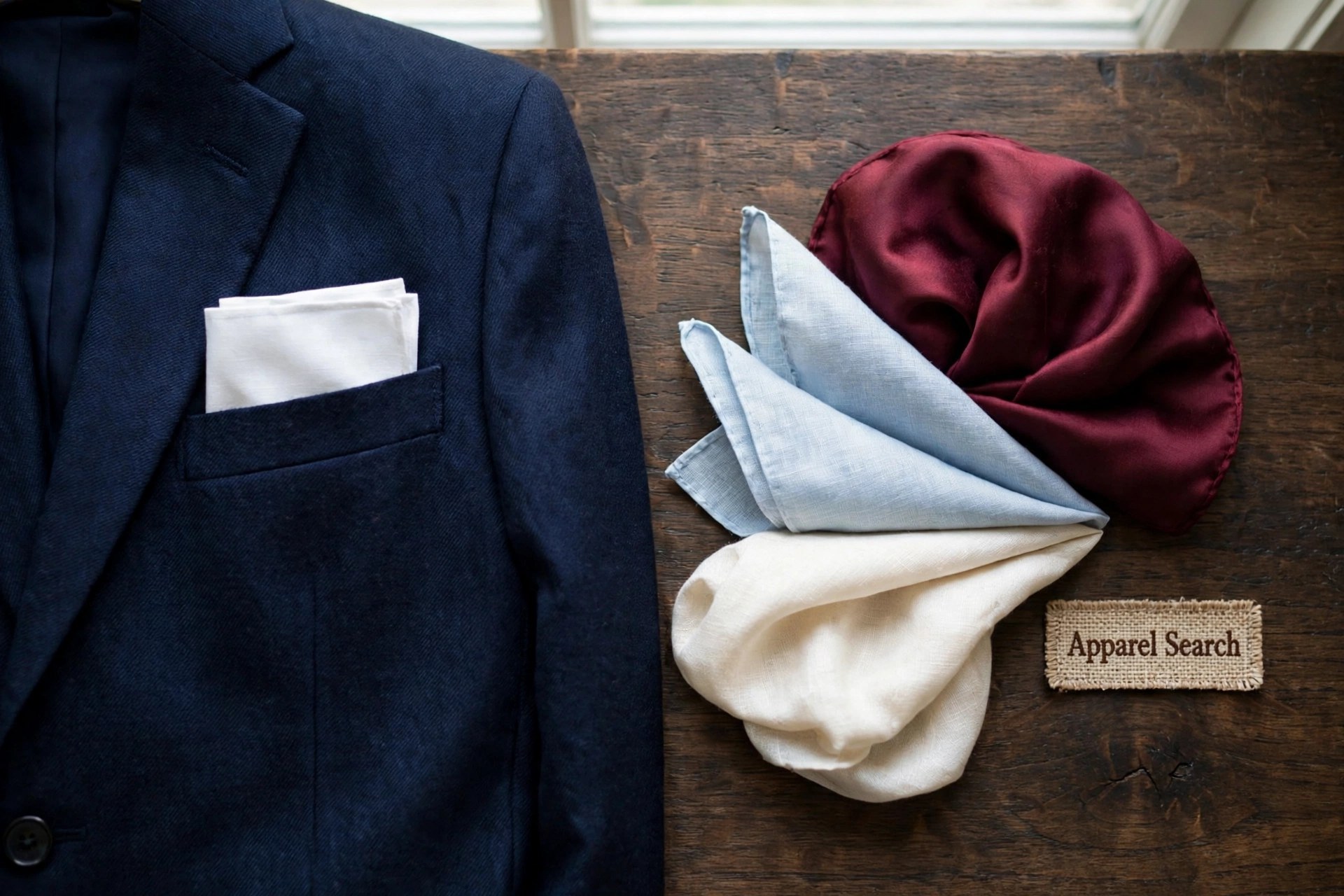
Before Any Fold
Three habits separate a folded square from a stuffed one. Start flat and pressed: every fold below begins with the square laid out smooth, and a wrinkled square folds wrinkled. Fold to the pocket, not to the diagram: pockets differ in width and depth, so the final fold of each method is a sizing fold — the square should enter the pocket snugly, neither swimming nor jammed. Insert, then adjust once: place the square, straighten it with two fingers, and leave it alone. A square fussed with all evening looks it.
The Presidential (Straight) Fold
The most formal fold and the easiest: a clean, even band of white — the fold of black tie, of boardrooms, and of every man who has decided that the square should whisper. White linen is the classic material; it holds the edge that makes the fold.
- Lay the square flat and smooth it out.
- Fold it in half vertically, bringing one side edge over to meet the other, forming a rectangle.
- Fold it again if needed, until the width is just narrower than your pocket — most squares need this second fold, a few narrow ones do not.
- Fold the bottom up to just short of the pocket's depth, so the top edge will sit at the height you want to show.
- Place it in the pocket with the folded side edges hidden and the top edge level, showing about a quarter to a half inch.
The One-Point Fold
One crisp triangle point rising from the pocket: a step more decorative than the presidential, still entirely business-appropriate, and the natural fold for cotton and linen squares in solid colors.
- Lay the square flat as a diamond, one corner pointing at you.
- Fold the bottom corner up to meet the top corner exactly, forming a triangle with the point at the top.
- Fold the left corner in toward the center, about two-thirds of the way across.
- Fold the right corner in the same way, so the package is pocket width with a single point centered at the top.
- Fold the bottom up behind if the pocket is shallow, and place the square point-up.
The Two-Point Fold
Two points, slightly rakish: the fold of a man who wants the square noticed but not discussed. It is the one-point built with a deliberate offset, and it pairs well with a patterned tie, since the points add the interest and the square itself can stay quiet.
- Lay the square flat as a diamond.
- Fold the bottom corner up past the top corner, landing it slightly to one side of the top point, so two points stand side by side.
- Fold the left corner in to pocket width.
- Fold the right corner in to match.
- Fold the bottom up to pocket depth and place it, two points showing, the taller of them no more than an inch above the pocket.
The Three-Point (Crown) Fold
The most decorative of the crisp folds — three points like a crown — and the ceiling of formality for pointed folds. It asks for a stiffer square: linen or a firm cotton. Built patiently, it is the fold that gets asked about.
- Lay the square flat as a diamond.
- Fold the bottom corner up to just beside the top corner, slightly to its left, so two points stand at the top.
- Fold the right corner up diagonally so its point lands to the right of the top points — the third point. The package is now wider at the top than the bottom.
- Fold the left corner straight across behind the fold, locking the three points in place and bringing the width down to pocket size.
- Fold the bottom up to pocket depth and place it carefully — crowns reward a single, confident insertion.
The Puff Fold
The soft fold: no edges, no points, just a billow of silk rising from the pocket. It is the fold for sport coats, patterned silks, and any setting where crisp would look stiff — and it is the most forgiving fold here, since it cannot be creased wrong.
- Lay the square flat and pinch it at its exact center, then lift — the four corners hang down and the center rises.
- Run the hanging cloth through your other hand loosely, gathering it into a soft column below the puffed center.
- Fold the hanging corners up behind the puff, roughly to its middle, so nothing dangles below pocket depth.
- Place the square puff-first into the pocket, the billow showing, and tease it once with a fingertip into a rounded shape.
The Casual (Scallop) Fold
The puff's relaxed cousin: the square is folded loosely so a scalloped edge — often the decorative border of a printed silk — shows in soft waves. It is the fold for open collars, knit jackets and summer sport coats.
- Lay the square flat and fold it in half diagonally, loosely and a little unevenly — precision is the enemy here.
- Fold it in half again along its length, just as loosely, keeping the patterned edge on top.
- Gather the middle gently in one hand so the top edge falls into soft scallops.
- Tuck the gathered square in with the scalloped edge showing, and let it settle where it falls.
Shop Pocket Squares on Amazon
Linen squares for the crisp folds and silk for the puff are collected on the Apparel Search shopping guide:
Shop Pocket Squares on AmazonThis link opens the Apparel Search shopping guide for Amazon, where the product links are kept in one place.
Which Fold for Which Occasion
- Black tie and formal evenings: presidential, white linen. Nothing else is in the conversation.
- Business and interviews: presidential or one-point, in white or a quiet solid. The square should support the suit, not star in it.
- Weddings and celebrations: two-point or three-point for a guest who dresses carefully; a silk puff in a color drawn from the tie for a festive note. (The wedding party's squares, if any, follow the couple's scheme, not this page.)
- Sport coats and smart casual: puff or scallop, in patterned silk or a linen with a colored border — the setting where the square earns its keep as the one expressive item in the outfit.
- No tie: a puff or scallop, almost obligatory — with the tie gone, the square is what tells the room the jacket was a decision.
Fabric Notes: Why Linen Holds and Silk Puffs
The crisp folds are architecture, and architecture needs a material that keeps an edge: linen first, cotton second. Both crease where they are folded and stay folded. Silk is a fluid — it slips out of sharp folds, slides down in the pocket, and is wasted on points; its genius is volume and sheen, which is exactly what the puff and scallop ask for. Size plays a part too: a generous silk square (16–18 inches) puffs with real presence, while a small one makes a timid fold of any kind. If you own one square, make it white linen. If you own two, add a silk with a pattern in colors your ties already wear. The rest of the wardrobe for these folds — knot, jacket, trousers — is covered by our suit fit guide and our necktie knots, and the square's own buying guide is the pocket squares guide.
Common Questions
How much of the pocket square should show?
For the straight presidential fold, about a quarter to a half inch of even edge above the pocket — a clean line, not a flag. Pointed folds show more by design: the points typically rise half an inch to an inch above the pocket. Puffs sit higher still and are judged by fullness rather than measurement. Whatever the fold, less is safer than more: a square that towers out of the pocket looks like it is trying to escape.
Should a pocket square match the tie exactly?
No — coordinate, never match. A square identical to the tie reads as a boxed gift set. Instead, pick up a secondary color from the tie, shirt or jacket and let the square echo it in a different pattern and a different scale. When in doubt, plain white linen in a straight fold goes with every tie ever made, which is why it has been the default for a century.
Why does my pocket square keep sliding down into the pocket?
Usually size or fabric. A small silk square in a deep pocket has nothing to grip and too little bulk to stay put. Fixes, in order: use a larger square (16–18 inches for silk), fold it so the bulk fills the pocket's depth, or choose linen or cotton, whose crisper hand holds both its fold and its place. Folding the bottom third up before inserting adds depth where pockets run deep.
Which fold should a beginner start with?
The presidential. It is three folds, works in every pocket, suits every level of formality from a boardroom to black tie, and is nearly impossible to get wrong. Add the puff next if you wear sport coats and patterned silk — it is the most forgiving fold of all, since it is supposed to look unstudied. The pointed folds are polish for later.