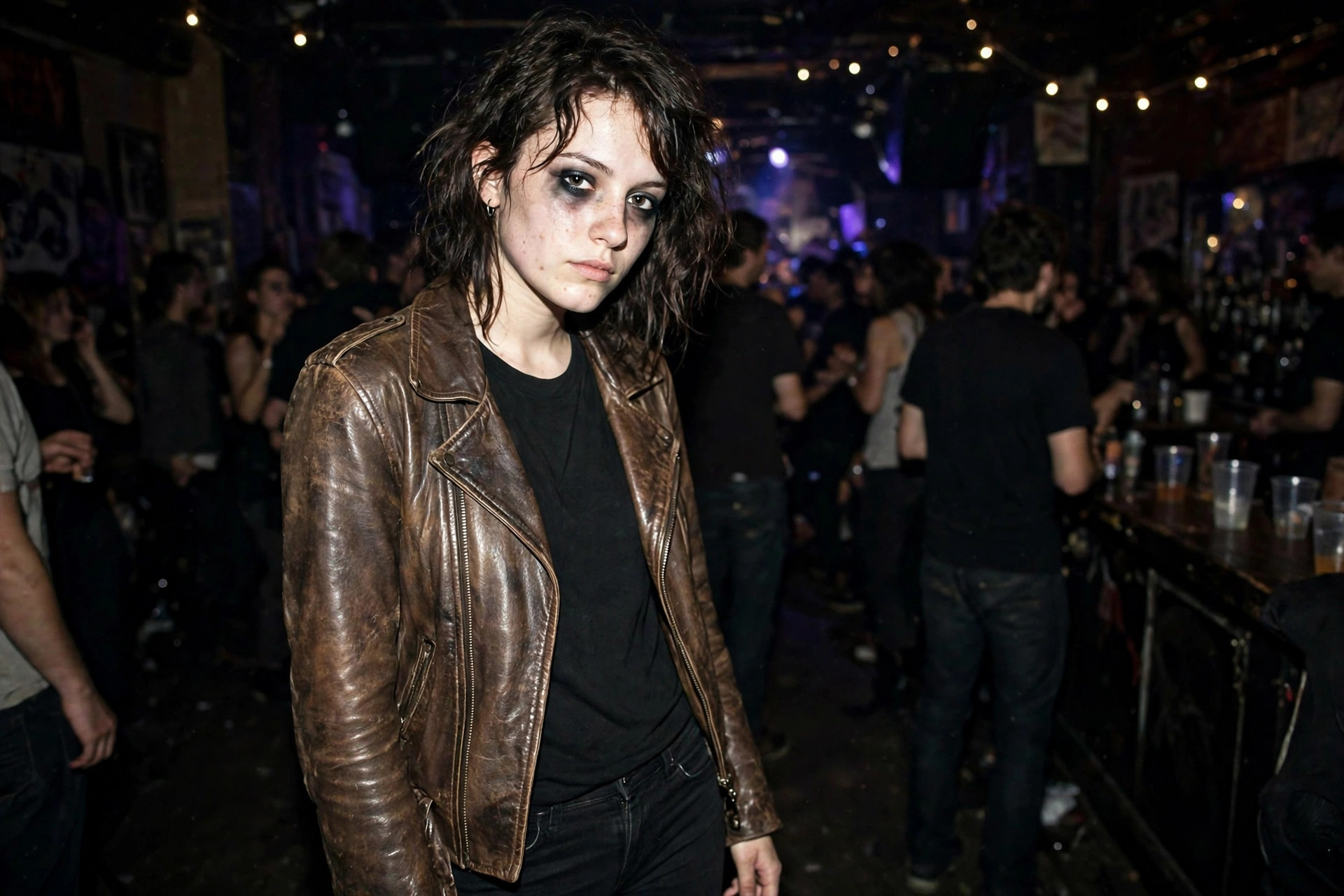
Indie Sleaze is the revival of the indie party style of roughly 2005 to 2014: skinny jeans, leather jackets, vintage tees, ballet flats, gold lamé, smudged eyeliner and photographs taken with a hard flash in dark venues. Named retrospectively in the early 2020s, when the era's look began cycling back, it is fashion history as much as trend — a decade's going-out wardrobe, re-examined by the generation that grew up watching it.
The Era: Indie Music, Flash Photography and the Party Photo
Indie Sleaze documents a specific cultural machine. Guitar bands and electroclash filled small venues; fashion's centre of gravity sat with skinny silhouettes — the decade of the skinny jean, documented in our skinny jeans guide — and a new kind of party photography, shot on compact cameras and early blogs, made nightlife itself a published fashion medium. The look was documented messily, in flash glare, and that documentation became its aesthetic signature.
Its ancestry is honestly mixed: punk's leather and ripped denim, grunge fashion's thrifted layers, glam rock's lamé and eyeliner, and the mod revival's skinny tailoring all fed the same wardrobe. Our guide to 2000s fashion sets the wider decade context. What Indie Sleaze added was the internet: the first era whose party style was styled for the camera that was always there.
The Key Indie Sleaze Pieces
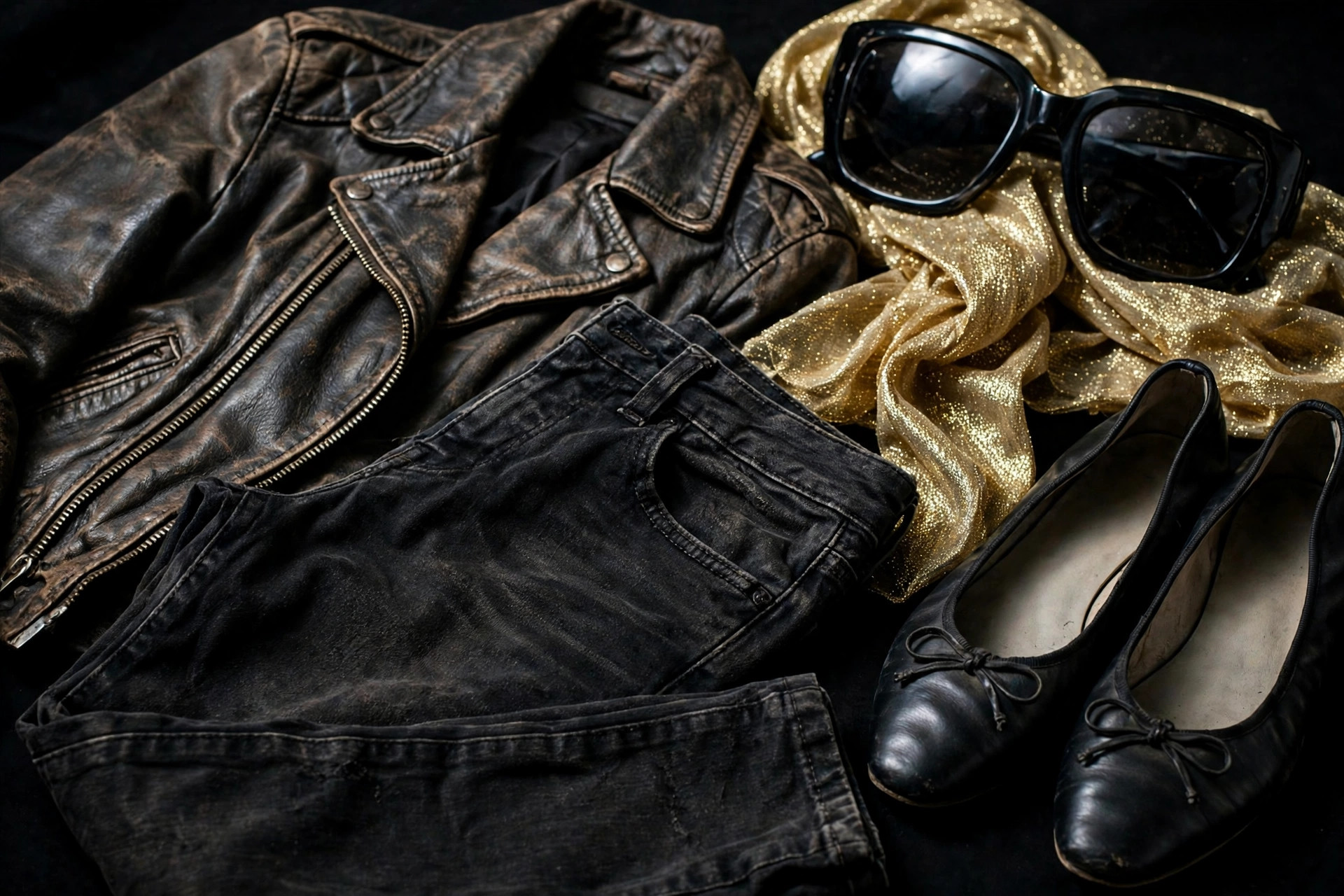
Skinny jeans are the load-bearing garment — black first, indigo second, occasionally ripped — worn with the era's defining shoes: ballet flats by day and in half the party photos ever taken, battered boots and plimsolls for the rest. Over them, the uniform layers: a vintage or plain worn-in tee, a leather jacket that looks borrowed, a thin scarf, and gold lamé as the era's improbable glamour fabric, in leggings, skirts and tops that caught the flash.
The details are era-exact: oversized sunglasses worn indoors and at night, smudged black eyeliner as the whole makeup plan, messy hair as a styling decision, chunky vintage jewellery, and a bag carried in the crook of the arm. Menswear ran parallel — skinny jeans, leather jacket, deep V or vintage tee, boots — making Indie Sleaze one of the more genuinely unisex aesthetics in this series, closer to a scene uniform than to a gendered trend.
Why It Came Back
Revival cycles run on roughly twenty-year loops, but Indie Sleaze returned early and with unusual affection, because its era is the last one that feels pre-algorithmic: photographed badly, dressed from thrift shops and high-street sales rails, and organised around physical venues rather than feeds. For its original wearers it is nostalgia; for younger adopters it reads as freedom — imperfection as a style, at a moment when most fashion imagery is filtered to glass.
It also revives usefully. Almost everything in the wardrobe is second-hand by definition, the skinny silhouette corrects years of wide-leg dominance, and the look requires no expensive pieces — a worn leather jacket and black skinnies do most of the work. Its relationship to Y2K fashion is generational: Y2K revives the pop, logo-heavy early 2000s, while Indie Sleaze revives the scruffier guitar-and-warehouse late 2000s that followed — and to emo fashion, its darker sibling scene from the same years, it is a near cousin separated mainly by venue and eyeliner placement.
Wearing Indie Sleaze Now, Without the Costume Effect
The revival works best edited: take the silhouette and two or three signifiers, not the full time capsule. Black skinny jeans, a good leather jacket, ballet flats and one lamé or vintage piece read as Indie Sleaze in 2026; adding the indoor sunglasses, the scarf, the smudge and the tee all at once reads as a themed party outfit. Modern fit helps — the jeans skinny but not sprayed, the jacket worn rather than distressed by hand.
The photographic half of the aesthetic is part of the fun and part of the point: direct flash, dark backgrounds, unposed groups. Dress for that light — lamé, leather and black denim were all, in part, flash-optimised fabrics. And keep the spirit thrifted: the era's real stylists mixed a designer's jacket with a market tee without thinking about it, and that ease, more than any single garment, is what the revival is actually trying to recover.
Common Questions
- What years does Indie Sleaze cover?
- Roughly 2005 to 2014 — the indie music and party-photography era between Y2K pop style and the minimalist mid-2010s. Its markers are skinny jeans, leather jackets, ballet flats, gold lamé, smudged eyeliner and hard-flash nightlife photography.
- Where did the name Indie Sleaze come from?
- It was coined retrospectively, around 2021, as the era's style began to be revived and analysed online. The name is affectionate rather than insulting: sleaze points to the era's messy, unpolished glamour, in deliberate contrast to today's filtered fashion imagery.
- What is the difference between Indie Sleaze and Y2K fashion?
- Y2K fashion revives the early 2000s: pop, logos, low-rise denim, bright colours and futurism. Indie Sleaze revives the later 2000s indie scene: darker, scruffier, thrift-based, built on skinny black denim and leather. They are neighbouring decades in the same revival wave, with almost opposite colour palettes.
- Is Indie Sleaze a unisex aesthetic?
- More than most. The era's scene uniform — skinny jeans, leather jacket, vintage tee, boots or flats, eyeliner optional — was worn across genders with minor variations, and the revival keeps that quality. It is a scene look, not a gendered one.
- How do I build Indie Sleaze on a budget?
- Easily, because it was a budget aesthetic originally. Thrift the leather jacket and vintage tees, buy one pair of black skinny jeans that fit perfectly, add ballet flats, and let a single lamé piece supply the glamour. Expensive versions usually look wrong — polish is the enemy of this look.
Fashion Aesthetics and Trends Series
This guide is part of the Apparel Search fashion aesthetics and trends series: the named styles, from social-media aesthetics to revived eras, that shape how people dress now — what each one is, where it came from, and how to wear it well. Browse the full series below.