Metallic Yarn Factory Directory
Factories producing metallic yarns — the glittering Lurex-type yarns for weaving, knitting and embroidery.
Metallic yarn is decorative yarn with a metallic appearance, made not by spinning metal but by coating and slitting film. In the best-known construction, a synthetic fibre or film carries an aluminium layer that has been vaporised onto it; the film is then slit into very fine flat strips that catch the light like metal thread. Lurex is the brand name for this type of yarn — a registered trademark and, for decades, a byword for quality metallic yarns — and cloth created with the yarn is also called Lurex. Around that core technology sit related products: zari and jari yarns for traditional Indian weaving and embroidery, gimped yarns, and spandex yarns covered with metallic yarn.
This directory lists metallic yarn producers in China, India, Korea and Taiwan, and the Lurex company itself: a factory offering a great range of metallic yarns for weaving, knitting, jacquard fabrics, embroidery, curtains, lace, labels and ribbons; a leading Indian manufacturer and exporter of metallic yarn, Lurex, jari, zari and gimped yarn; a Korean supplier of spandex and metallic yarn; and a Taiwanese maker of spandex and metallic covered yarns. The sections below explain how metallic yarn is made, the forms it is sold in, and what to check about colour, dyeing and durability before ordering.
Yarn, Metallic Fabric & Textile Resources
How Metallic Yarn Is Made
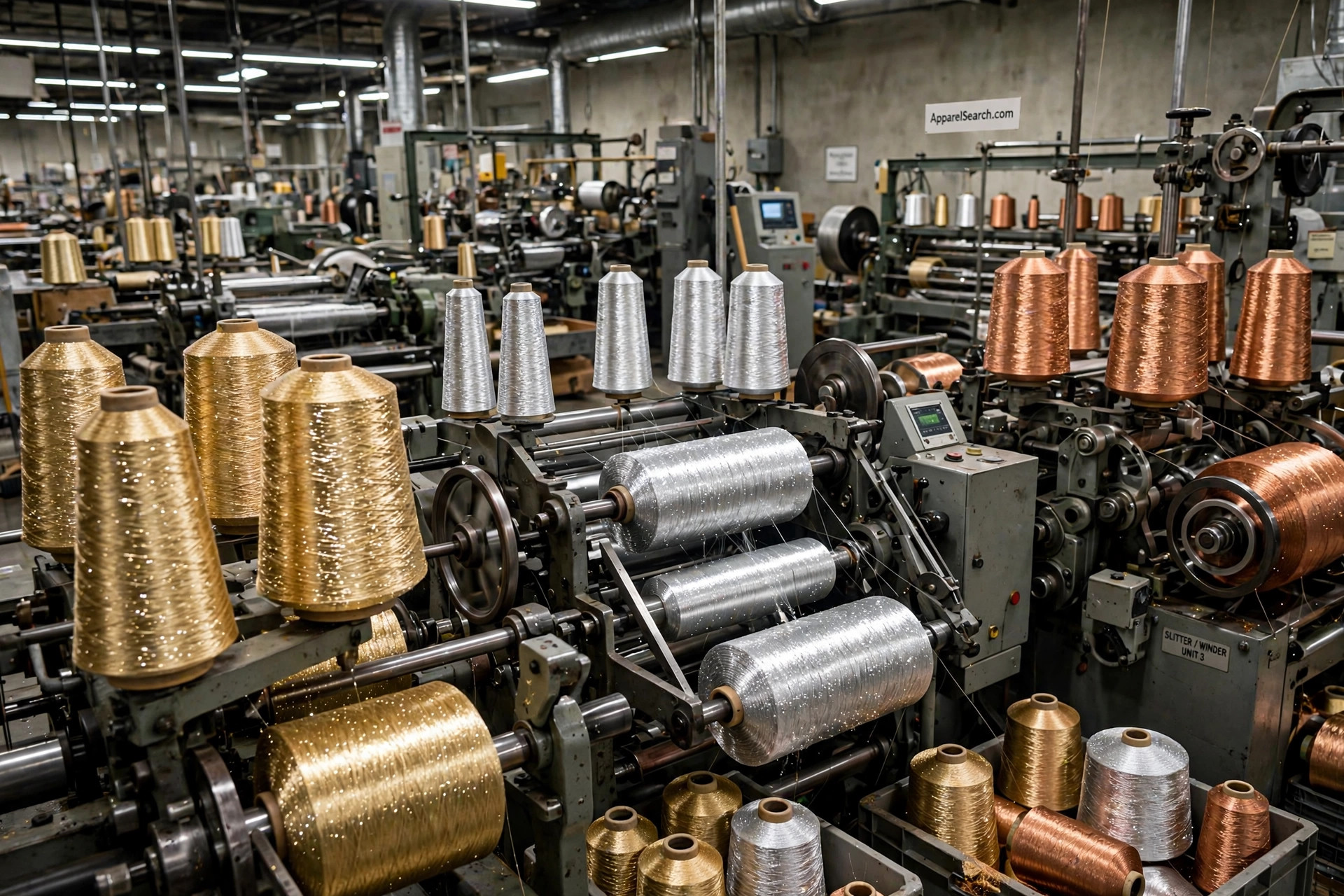
Production starts with film, not fibre. A polyester or similar film is metallised — most characteristically by vaporising aluminium onto its surface — and may be lacquered or dyed to give gold, copper, coloured and iridescent effects as well as silver. The metallised film is then slit into fine, even strips. The Lurex production described in the listings runs on high-speed, computer-controlled primary slitter and creeling machines capable of making various bobbin sizes to a very high standard; slitting quality is the product quality, because a rough or uneven strip edge shows in the fabric, catches in knitting and embroidery machines, and breaks under tension.
Flat slit-film yarn is the simplest form, and it is also the harshest to handle and the most fragile in fabric. Many metallic yarns are therefore supported or combined: the flat strip is wound around a textile core yarn (a supported or gimped construction), twisted with other yarns, or used to cover another core — including spandex, which produces the stretch metallic covered yarns that two of the factories here supply. The supporting yarn adds strength, softness and sewing performance and lets the maker tune how bright, or how subtle, the finished effect is.
Lurex, Zari, Jari and Gimped Yarns
Names in this trade carry history. Lurex is a trademark, not a generic term, and its maker points to decades of reputation for quality, service and innovative development — when a listing or a supplier uses the name, it should mean yarn from that source. Zari (also spelled jari) is the traditional metallic thread of Indian handloom weaving, embroidery and garment decoration, historically made with real silver and gold and today produced in imitation and metallised forms; the Indian manufacturer in this directory lists metallic yarn, Lurex, jari, zari and gimped yarn together, along with pure silver metallic yarn, balda and tilla, serving apparel, knitting, weaving, embroidery, garments, handloom and laces.
A gimped yarn is a core yarn wrapped with another yarn — here, a metallic wrapping around a textile core — which gives a corded, rounded thread that stands up in embroidery and decorative weaving better than a flat strip. Between flat film yarn for woven sparkle, supported yarns for knitting, zari for handloom and embroidery traditions, and metallic-covered spandex for stretch fabrics, 'metallic yarn' covers several distinct products; a good enquiry names the tradition and the end use, not just the colour.
Colour, Dye Resistance and Durability
Metallic yarn's weakness is chemical, not mechanical. The metallic layer and its coloured lacquers can tarnish, dull or change shade under heat, dye baths, bleaching, perspiration and some finishing chemicals. The listings answer that weakness directly with a dye-resistant range of metallic yarns, which leaves the colour and brilliance intact despite high temperature and chemical treatment — for a garment maker who plans to piece-dye or aggressively finish a fabric containing metallic yarn, that range, or an equivalent tested claim from another maker, is the difference between a usable product and a complaint.
Buyers should test metallic yarn the way the finished article will be treated: dye it, wash it, press it, and expose it to the finishes in the production route, then judge brilliance after treatment rather than on the cone. State the treatments in the enquiry so the maker can steer you to the right grade. Also discuss abrasion: flat film edges are delicate, and in high-rub positions a supported or covered construction outlasts a bare strip.
Uses and Ordering Metallic Yarn
Metallic yarns are widely used in weaving, knitting, jacquard fabrics, embroidery, curtains, lace, labels, ribbons and decorative sponges and scourers, and in metallic fabrics for ready-made garments. In fashion they appear as glitter knitwear, lurex-striped tops, evening fabrics, embroidered motifs, woven labels and ribbon trims, and the brocade traditions served by zari. A small percentage transforms a plain fabric; the production question is whether the yarn survives the chosen fabric route.
Order by construction (flat, supported, gimped or covered), width or count, colour with a physical standard — metallic shades cannot be approved reliably from a screen — the bobbin or cone put-up, and the treatments the yarn must withstand. If stretch is needed, say so: spandex and metallic covered yarns for hosiery and narrow fabrics are supplied by the Korean and Taiwanese listings here.
Metallic Yarn Factories & Suppliers
Producers and suppliers of metallic, Lurex-type, zari and covered metallic yarns. Contact details are given in the listings where they were provided.
Dongyang Salu Metallic Yarn Factory (China)
Dongyang Salu Metallic Yarn Factory can provide a great range of metallic yarns of high quality and moderate price, which can offer special features to your products. Their metallic yarns can be widely used in weaving, knitting, jacquard fabrics, embroidery, curtains, lace, labels, ribbons, sponges & scourer, and so on.
Address: Baitan Industrial Zone, Dongyang, Zhejiang, China 322000 Mob: 0086 135 6235 0875 Fax: 0086 153 2579 7946 Email: salugroup2@gmail.com
I.C.Gandhi (India)
Leading manufacturer / exporter of metallic yarn, Lurex, jari, zari and gimped yarn for apparel, knitting, weaving, embroidery, garments, handloom, laces and decoration, and metallic fabrics for ready made garments from India.
Manufacturer Item # 1: Metallic Yarn · Manufacturer Item # 2: Lurex Yarn · Manufacturer Item # 3: Embroidery Thread · Manufacturer Item # 4: Zari · Manufacturer Item # 5: Pure Silver Metallic · Manufacturer Item # 6: Jari, Balda, Tilla · Manufacturer Item # 7: Gimped Yarn
Address: Post Box # 522 Surat, Gujarat, Surat, India 395008 Phone: 091-261-550972 or 091-261-540312 Fax: 091-261-544017 Email: metallic99@hotmail.com Contact: Gandhi. R.G
KI SHIN Corp. (Korea)
Supplier of spandex and metallic yarn.
Manufacturer Item # 1: Spandex · Manufacturer Item # 2: Lycra · Manufacturer Item # 3: Metallic Yarn · Manufacturer Item # 4: Lurex Yarn
Address: 925-11, Wolam-dong, Dalseogu Daegu, S. Korea 704 320 Phone: +82.53.588.4441 Fax: +82.53.588.4448 Email: kishin@kishincorp.com Contact: Kwon / General Manager
Lurex Company Limited
Lurex has, for decades, been known as a byword for quality metallic yarns; it is a household name, but it is also a registered trademark with a unique international reputation for quality, service and innovative development. Production takes place on high-speed computer controlled primary slitter and creeling machines capable of making various bobbin sizes to a very high standard. A feature of the production is a dye resistant range of metallic yarns, which leaves the color and brilliance intact despite high temperature and chemical treatment.
Maw Chawg Enterprise Co. Ltd. (Taiwan)
It is a manufacturer of spandex & metallic (lurex) covered yarns as well as qualified artificial yarns. The yarns they produce are widely used in many fields of the textile industry. They are used in the production of narrows, hosiery (tights, stocking and socks), embroidery, knitwear, knitted fabrics (flat and round knitting machines) and at weaving plants. Some of them are also used for special technical purposes such as bamboo yarn, nano silver yarn, recycling PET and so on. They produce elasticity covering yarn.
Spandex & Metallic (Lurex) Covered Yarns · Artificial Yarns · Elasticity Covering Yarn · Bamboo Yarn · Nano Silver Yarn · Recycled PET Yarn — bamboo yarn manufacturer · metallic yarn manufacturer · elastic yarn manufacturer
Address: No. 374 Fan Hua RD., Shiow Shui Township, Chung Hua County, Taiwan Phone: 886-4-7683889 Fax: 886-4-7683974 E-mail: maw.chawg@msa.hinet.net or webmaster@machangx.com Contact: David Tsao
More Yarn & Industry Resources
Common Questions
What is Lurex yarn?
Lurex is the brand name — a registered trademark — for a type of yarn with a metallic appearance. The yarn is most commonly a synthetic fibre or film onto which an aluminium layer has been vaporised, slit into fine strips. Cloth created with the yarn is also called Lurex. Other metallic yarns are sold under their own makers’ names.
Will metallic yarn survive dyeing and finishing?
Standard metallic yarn can dull, tarnish or change shade under high temperature and chemical treatment, so it must be tested through the actual production route. A dye-resistant range of metallic yarns is made to leave colour and brilliance intact despite high temperature and chemical treatment — specify that grade, and the treatments involved, when the fabric will be piece-dyed or finished after the yarn goes in.
What is zari yarn?
Zari (also spelled jari) is the traditional metallic thread used in Indian handloom weaving, embroidery and garment decoration, and in laces and decorative work. It is supplied today in metallised and imitation forms as well as pure silver metallic yarn, alongside related threads such as balda, tilla and gimped yarn.