Acrylic Yarn Factory Directory
Factories producing acrylic yarn — the lightweight, warm, wool-like synthetic yarn.
Acrylic yarn is spun from acrylic fibre, a synthetic polymer fibre (polyacrylonitrile) valued because it is lightweight, soft and warm, with a wool-like feel at a far lower cost than wool. To be called acrylic in the United States, the polymer must contain at least 85% acrylonitrile monomer. Mills spin it into knitting and weaving yarns for sweaters, blankets, socks, carpets and upholstery, sell it in solid, variegated and blended forms, and supply it on cones and in hanks ready for knitting machines and looms.
This directory is a guide for the textile industry to producers of acrylic yarns in China, Thailand and the United States. The listings below include integrated spinning groups with their own dyeing and weaving, specialist wool and blended-yarn spinners, fancy-yarn makers, a garment-accessories manufacturer and a United States agent for knitting yarn factories. The sections that follow explain how acrylic yarn is made, where it performs best, and what a buyer should specify so that samples and bulk production match.
Yarn, Fibre & Textile Resources
A Synthetic Wool Substitute
Acrylic earned its place in the yarn trade as a practical substitute for wool. It is lightweight, soft and warm, it dyes very well and has excellent colourfastness, and it is resilient — it retains its shape and resists shrinkage and wrinkles. Those properties made it the default yarn for high-volume knitwear, blankets and pile fabrics, and it has also been used in clothing as a less expensive alternative to cashmere because the hand feel can be made very similar. Products such as imitation pashmina shawls use that resemblance deliberately, so honest fibre labelling matters whenever acrylic stands in for a luxury fibre.
The trade-offs should be specified around, not discovered later. Acrylic does not insulate the wearer as well as cashmere, and it tends to fuzz and pill — surface balls of fibre that form with abrasion and washing. Pill resistance depends on staple length, twist and fabric construction, so a buyer who cares about appearance after washing should ask for pilling test results on the actual yarn and construction, agree a minimum grade, and wash-test sample garments before committing to bulk.
How Acrylic Yarn Is Spun and Bulked
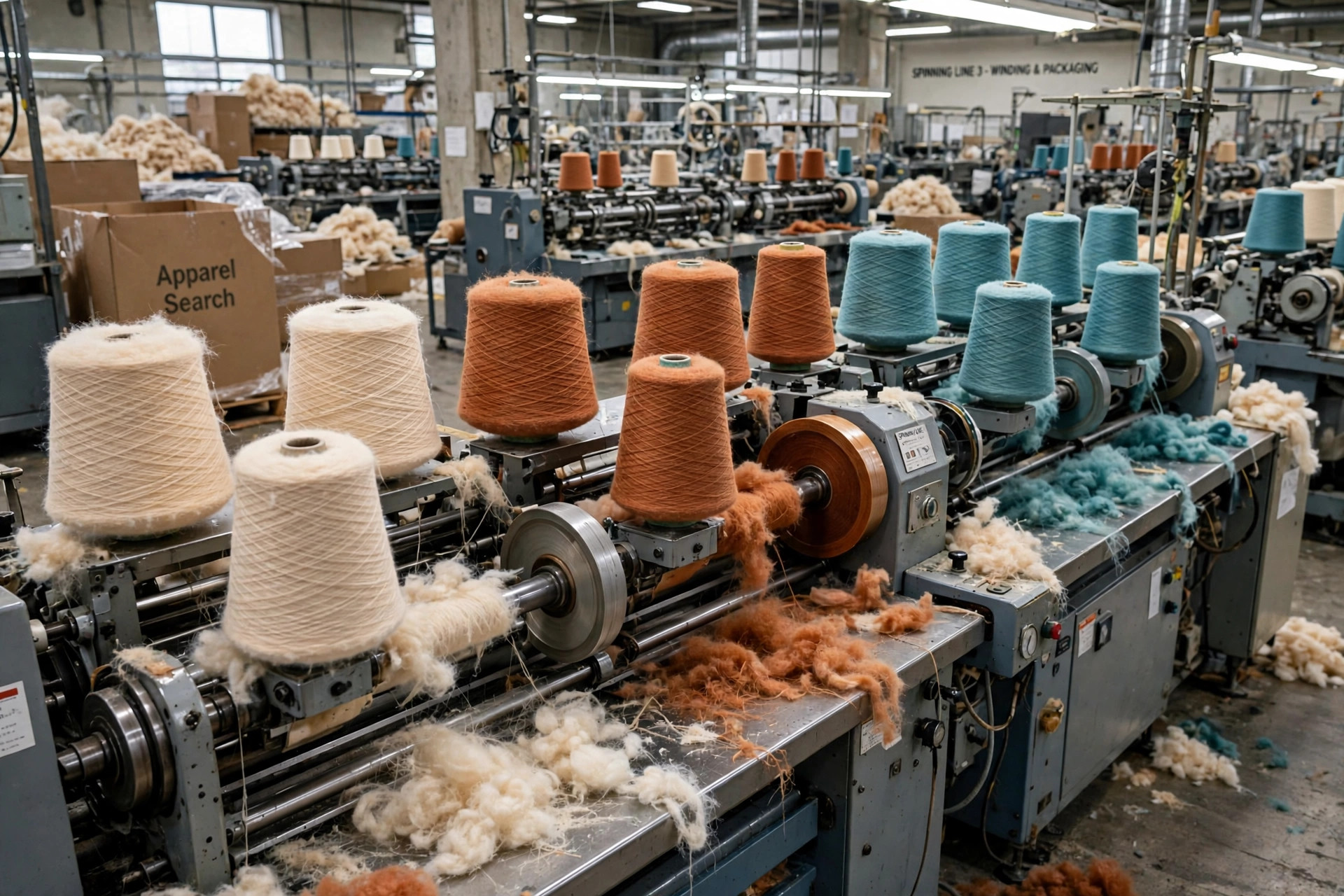
Acrylic fibre is produced as tow and cut into staple, which spinners open, card, draw and spin much as they would wool or cotton, on refined (worsted-style), semi-refined and short-staple systems. The listings below show the range: one integrated group runs spinning, blending and refined spinning lines alongside half-refined lines, and a wool-textile spinner uses Italian strand machinery to make yarn slivers before spinning. Blending is routine — acrylic is combined with wool, polyester, polypropylene and other fibres to balance cost, warmth, strength and appearance, and blended-yarn names in a listing tell a buyer which combinations a mill already runs.
High-bulk acrylic is a signature product of this fibre. It is made by combining shrinkable and non-shrinkable acrylic fibres in one yarn and then applying heat or steam, so the shrinkable portion contracts and forces the rest into a lofty, springy structure. The result knits into light, bulky sweaters that look far heavier than they are. Buyers should state whether they want regular or high-bulk yarn, the relaxed count after bulking, and the bulking conditions the mill used, because the same yarn can measure differently before and after it is relaxed.
Counts, Put-Ups and Fancy Acrylic Yarns
Acrylic yarn is sold by count and by form. Spinners supply solid yarn, colour yarn and variegated yarn, cone yarn for machine knitting and weaving, and hank yarn for dyeing and hand-knitting trades. When ordering, name the count system you are using, the ply, the twist direction and level, and the put-up — cone size and weight, or hank weight — because a count quoted in one system converts imperfectly into another and disputes usually start there. Colour yarn spun from dyed fibre holds its shade through the yarn's cross-section, while hank-dyed and package-dyed yarns offer smaller colour lots at a higher handling cost.
Acrylic is also a base for fancy yarns. The fancy-yarn maker in the listings works with tucking machines across more than thirty types of textile material — tape yarn, feather yarn, orbit yarn, centipede yarn and bi-coloured corn-spun yarns among them — using cotton, acrylic, viscose and other fibres in fixed (set) combinations. Fancy effects depend on precise feed rates and core-and-effect yarn pairings, so sample approval should cover the effect's repeat, the yarn's usable yield per kilogram, and how the effect survives knitting tension on the buyer's own machines.
Specifying an Acrylic Yarn Order
A complete enquiry states the end use (sweater, blanket, sock, carpet, furnishing), the fibre composition including any blend partners and their percentages, the count and ply, regular or high-bulk construction, the colour route (fibre-dyed, package-dyed or hank-dyed) with colourfastness requirements, and the put-up. Ask about minimum order quantities per colour, because dyed-to-order colours carry very different minimums from stock colours held on cone.
Finally, check the end use against acrylic's heat behaviour. Acrylic softens at temperatures wool tolerates, so pressing, steaming and garment dyeing instructions should come from the yarn supplier rather than habit. Mills that dye, spin and weave in one group can advise across the whole route; agents and trading companies can be the better route for smaller or mixed orders. Confirm which party is the manufacturer of record before paying a deposit.
Acrylic Yarn Factories & Suppliers
Producers, spinners and agents supplying acrylic yarn to the textile industry. Contact details are given in the listings where they were provided.
Createx USA (USA)
Agent for knitting yarn factories. One of the yarn types they supply is acrylic yarn.
Jiangsu Santong Weiye Trade and Industry Co. Ltd. (China)
A Chinese trade and industry company listed as a supplier in this acrylic yarn directory.
Jong Stit Co. Ltd. (Thailand)
Since their establishment in 1940, they pride themselves as an innovator in the textile field and conduct their business with continuous dedication to improving and developing a wide range of products including yarns, polyester fabrics, pile fabrics (toys and garments) and blankets.
Acrylic Yarn · Spun Yarn · Twisted Yarn · Textured Yarn · Chenille Yarn
Ningbo MH Industry Co., Ltd. (China)
One of the largest enterprises in China that specializes in the manufacture and sales of garment accessories and tailoring materials. MH was established in 1999 and, on the principle of credible quality and best credit standing, began to gain much more market share in international markets such as Europe, North America, Asia, the Mid East and Africa.
Shandong Hengtai Textile Co., Ltd. (China)
A provincial group enterprise combining dyeing, spinning, weaving, arranging and nap cloth. Established in 1988, with 3,500 workers and staff and fixed assets of 150 million yuan. Its products are sold to South-eastern Asia, Europe, America, Korea, Japan, Hong Kong, Macao and other markets.
Working with natural green fibre and special animal fibre, it has 10 spinning, blending and refined spinning lines with an annual capacity of 300 tons, and 30 half-refined spinning lines with an annual capacity of 800 tons. It also has an annual capacity of white polyacrylonitrile yarn of 10 thousand tons, colour yarn of 8 thousand tons, variegated yarn of 1 thousand tons, high-grade decorating flannel of 1.2 million meters and sheep-hair sweaters of 300 thousand.
Zibo Tianli Wool Textile Co. Ltd (China)
Their factory was established in 2002, when they built a large-scale spinning production base. Using professional Italian strand snap machinery, they can produce yarn slivers of 2,600 tons per year; spinning capacity is 12,000 spindles and the year's production of yarn is 2,500 tons.
Wool Yarn · Blended Yarn · Acrylic Yarn · Polyester Yarn · Blanket Yarn · Fur Yarn · Super Soft Yarn · Acrylic Knitting Yarn · Sock Yarn · Sweater Yarn · Carpet Yarn · 100% Acrylic Yarn · Polyester-Acrylic Blended Yarn · Acrylic-Polypropylene Blended Yarn · Polypropylene-Polyester Blended Yarn · Weaving Yarn · High Bulk Yarn · Solid Yarn · Cone Yarn · Hank Yarn
Zhangjiagang Jiyuanxiang Textile Co., Ltd (China)
Workshops directly under the administration of the company are well equipped. There stand fifty sets of tucking machines with the production capability of over thirty types of textile materials in a completed range of specifications, and circular weaving machines which can produce 0.8–1 tons of hollow braids and 1.8–2.5 tons of bi-coloured corn-spun yarn as required every day. Sample services are provided free where the resulting sample with common materials is no more than 1 kg.
Tape Yarn · Feather Yarn · Orbit Yarn · Centipede Yarn · Cotton · Acrylic · Viscose · Cotton and Acrylic Fixed Yarn · Dacron · Nylon · Artificial Silk and Purl
More Yarn & Industry Resources
Common Questions
What is acrylic yarn made from?
Acrylic yarn is spun from acrylic fibre, a synthetic fibre made from the polymer polyacrylonitrile. To be called acrylic in the United States the polymer must contain at least 85% acrylonitrile monomer. The fibre is lightweight, soft and warm with a wool-like feel.
Why does acrylic yarn pill, and how can a buyer reduce it?
Acrylic tends to fuzz and pill because short surface fibres work loose and tangle into balls under abrasion. Longer staple, adequate twist, tighter fabric construction and anti-pill fibre grades all reduce it. Ask for pilling test results on the actual yarn and construction, and wash-test sample garments before bulk production.
What is high-bulk acrylic yarn?
High-bulk yarn combines shrinkable and non-shrinkable acrylic fibres in one yarn. When heat or steam is applied, the shrinkable fibres contract and push the others into a lofty, springy structure, giving bulky-looking knitwear at a light weight. State whether you want regular or high-bulk yarn, and the relaxed count after bulking, when you order.